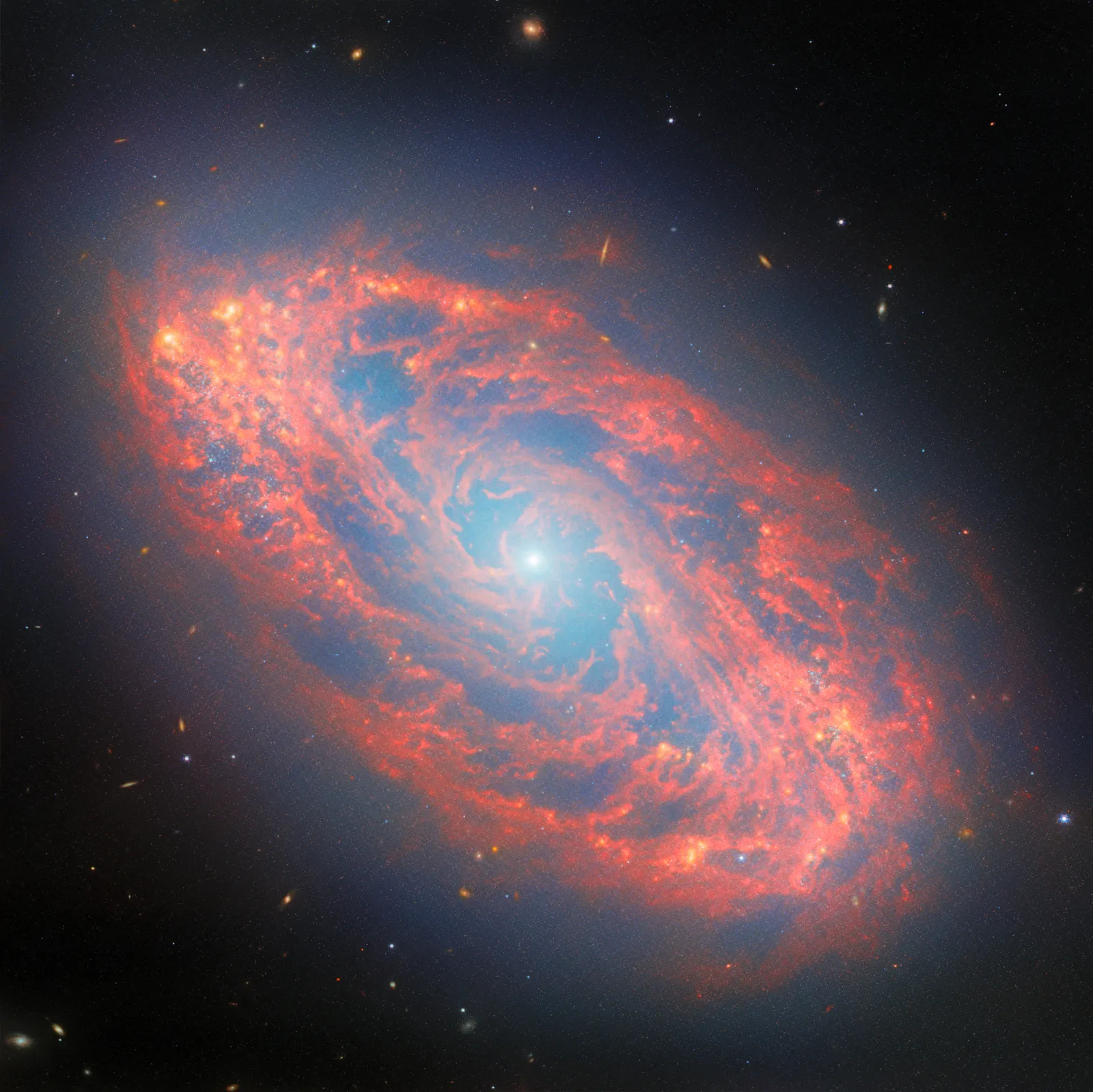
The James Webb Space Telescope has turned its instruments toward NGC 5134, a spiral galaxy in the constellation Virgo located 65 million light-years from Earth. The image, released as the mission's latest "Picture of the Month," is more than a striking portrait: two of Webb's instruments captured different layers of the galaxy, together revealing how stars are born, live, and return material to interstellar space.
The light collected for this image began its journey around the time Tyrannosaurus rex went extinct on Earth. Over those millions of years the galaxy has likely changed in ways we cannot see, but what Webb captured is a snapshot of its past, rendered in remarkable detail thanks to the galaxy's relative proximity.
Two instruments, two layers of the galaxy
Webb's NIRCam captures near-infrared light and reveals the stars and star clusters scattered across NGC 5134's spiral arms. This starlight produces the galaxy's overall blue-white glow and its bright central core.
The MIRI instrument detects mid-infrared emission — heat radiating from dust within the galaxy's interstellar clouds. In the image, this dust appears as red and orange waves and strands swirling around the core, at times forming dense clumps and elsewhere torn apart into gaps and holes.
Some of that dust consists of polycyclic aromatic hydrocarbons — molecules built from interconnected rings of carbon atoms. These compounds give astronomers a way to probe the chemistry unfolding in cold interstellar gas, processes invisible in ordinary visible light.
A constant exchange of gas
Combining NIRCam and MIRI data reveals a galaxy in continuous flux. The gas clouds threading NGC 5134's spiral arms are sites of star formation, and every new star chips away at the galaxy's reservoir of star-forming material.
When stars die, they return some of that gas to the galaxy. Massive stars — more than eight times the mass of the Sun — do so violently, in supernova explosions that scatter stellar material across hundreds of light-years.
Sun-like stars give back material far more gently. Near the end of their lives they swell into red giants, then gradually shed their outer atmospheres into surrounding space.
Whether released explosively or gently, this recycled gas eventually becomes the raw material for the next generation of stars — sustaining a cycle that has run for billions of years.
Why a nearby galaxy matters
NGC 5134 is close enough for Webb to resolve individual stars, clusters, and the fine structure of gas and dust within its arms. That is a rare opportunity: most spiral galaxies in the universe lie so far away that such details blur into a single glow.
By studying a relatively nearby object like NGC 5134 in fine detail, astronomers build a reference for understanding the cycle of star formation and stellar death from the inside. That knowledge can then be applied to thousands of more distant galaxies, which appear in Webb's images as little more than faint points of light.
Those very distant, barely visible galaxies scattered across the background of this image are a reminder of the payoff: detailed study of one nearby object provides a key to understanding structures that remain far too distant to observe directly.