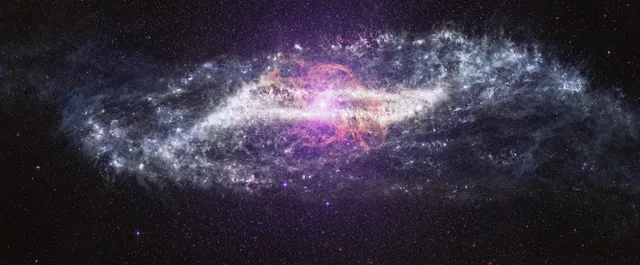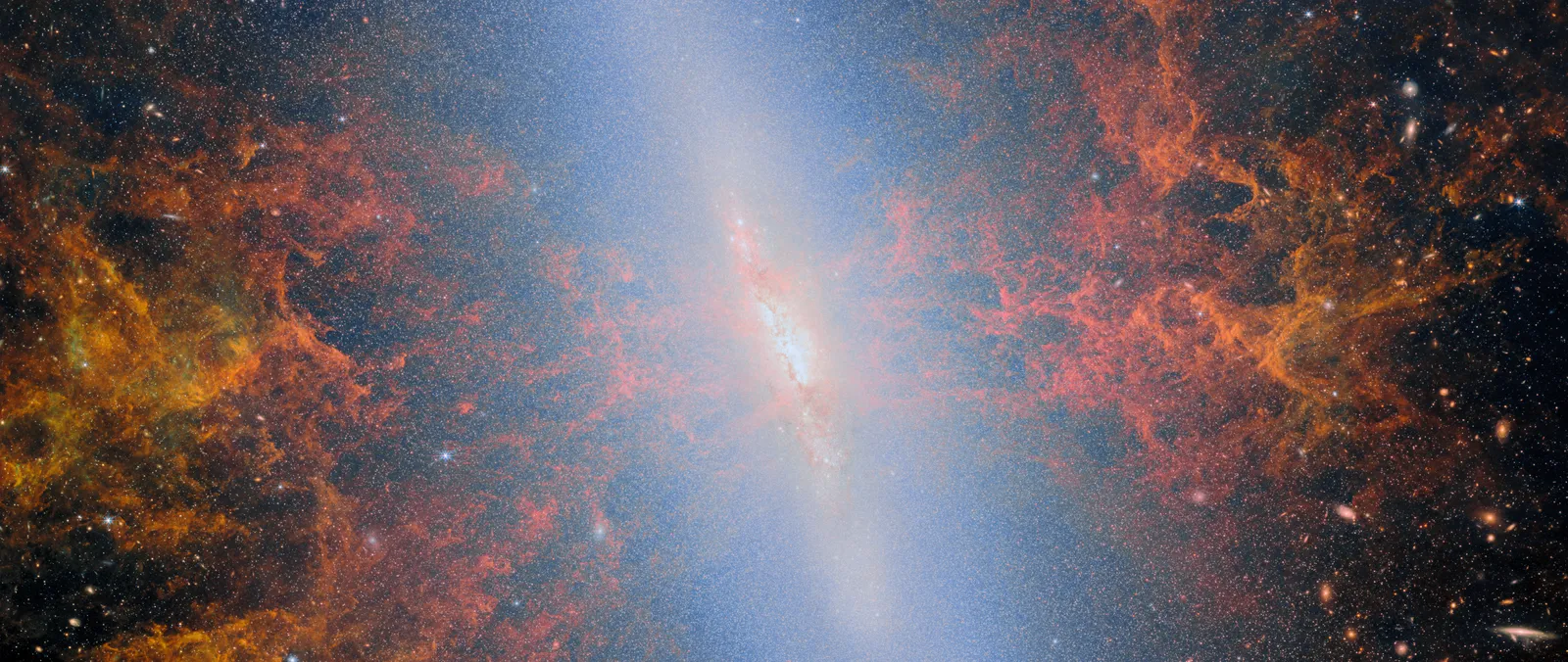
While combing through archival James Webb Space Telescope images, astronomers identified four previously unknown star clusters in the halo of M82, a nearby galaxy well known for its intense starburst activity. The discovery, made using the NIRCam instrument, is currently presented in a preprint posted to arXiv.
These objects belong to a category known as diffuse star clusters (DSCs) — systems that occupy an intermediate position between classical globular clusters and dwarf galaxies on the size-luminosity plane. This region has been barely explored so far: such objects are typically too faint for most ground-based surveys and too diffuse to easily distinguish from background sources.
What was found
Thanks to JWST's sharp resolution, researchers managed to resolve all four clusters into individual stars — a rare feat for objects at M82's distance, a galaxy located beyond the Milky Way in a neighboring group. Based on color-magnitude diagrams, the stellar populations in all four clusters turned out to be predominantly old, roughly 10 billion years.
Their chemical composition, however, is not uniform. DSC 1 is metal-poor ([M/H]≈-2), while DSCs 2, 3, and 4 are better matched by isochrones with metallicity around -0.8. This suggests the objects may have formed under different conditions or at different stages of the galaxy's history.
The team measured sizes and integrated brightness using two independent methods — curve-of-growth analysis and radial surface-brightness profile fitting. Results from both approaches agreed with each other, adding confidence to the measurements.
Cluster sizes range from 5.4 to 10.5 parsecs — noticeably larger than typical globular clusters (2-3 parsecs). In absolute magnitude, they span from -4.1 to -6.4, reaching about one magnitude fainter than the previously known M82 cluster population. The faintest of the four, DSC 3, is now the faintest star cluster candidate identified in this galaxy to date.
Why it matters
At such low luminosities, the boundary between a star cluster and a dwarf satellite galaxy becomes blurred: both types of objects can share similar sizes and brightness, and telling them apart often requires detailed kinematic or chemical data. DSC 3 approaches the range occupied by the Milky Way's ultra-faint compact satellites — objects that are themselves subject to ongoing debate about their true nature, whether they are the stripped remnants of disrupted dwarf galaxies or genuinely compact star clusters.
The main practical takeaway from the study lies in how these four objects were found. No dedicated automated search algorithm was used — the clusters were spotted simply through careful visual inspection of the images. This directly implies that similarly faint diffuse clusters are likely systematically underrepresented in existing star cluster catalogs of nearby galaxies.
What's next
The authors conclude that an archival search through JWST images of other nearby galaxies could reveal similar objects elsewhere. Since such images already exist in public archives for many galaxies in the Local Volume, a more careful re-examination of this data would not require new observing time — just thorough work with images already in hand.