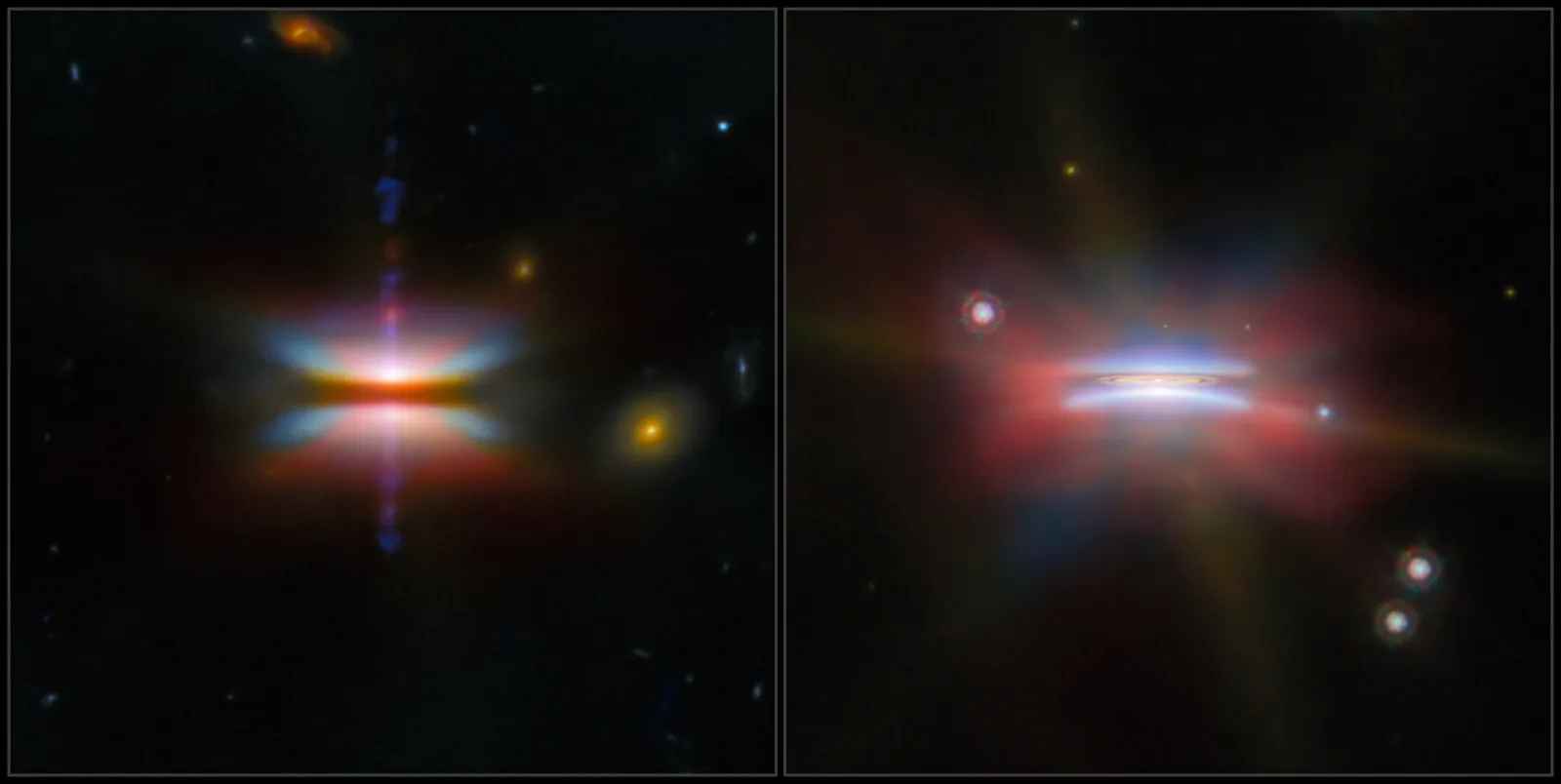
Every month, the James Webb Space Telescope team selects one image as its Picture of the Month. In April 2026, the choice fell on two objects at once — the protoplanetary discs Tau 042021 and Oph 163131. The first, also catalogued as 2MASS J04202144+2813491, lies in the constellation Taurus at a distance of 450 light-years. The second, 2MASS J16313124-2426281, sits in Ophiuchus, roughly 480 light-years away.
Both images were obtained under Webb programme #2562 (PI F. Ménard, K. Stapelfeldt), and together they offer a rare chance to see, quite literally edge-on, how future planetary systems take shape around young stars.
How Leftover Material From Star Birth Becomes a Planetary System
A protoplanetary disc forms when a clump of gas inside a molecular cloud collapses to create a star. Not all the surrounding gas and dust ends up in the star itself — the rest remains in orbit, forming a thick disc.
Over time, dust particles within this disc collide and stick together, gradually building planetesimals — the building blocks of planets. Those that never grow large enough to become full planets are left behind as asteroids and comets.
Gas that isn't incorporated into solid bodies is eventually blown away by the young star's radiation, a process that unfolds over tens of millions of years and marks the end of the disc's life. This is essentially how our own Solar System formed in the distant past, giving rise to the asteroids, comets, gas giants and terrestrial planets we know today.
By studying discs at much earlier stages elsewhere in the galaxy, astronomers reconstruct the sequence our own Solar System once went through — and start to understand why planets across the galaxy turn out so different from one another.
Edge-On Discs: Why Dust Hides the Young Star
What Tau 042021 and Oph 163131 have in common is orientation. As seen from Webb's vantage point, both discs are turned edge-on, so the bright light of the young star at the centre is almost entirely blocked by dust.
What becomes visible instead is the finest dust that has risen above the disc's midplane, glowing in reflected starlight above and below it — a faint nebula flanking the hidden star on either side.
Beyond the visual effect, which produces images resembling colourful spinning tops against black space, this geometry matters scientifically. The distribution of dust, both within the disc and above or below its plane, directly shapes where and how planets can form.
The images rely on data from Webb's NIRCam and MIRI instruments, sensitive across a broad range of infrared light. This lets astronomers track dust grains of different sizes throughout the disc: the red, orange and green hues mark varying grain sizes as well as the presence of hydrogen (H2), carbon monoxide (CO) and polycyclic aromatic hydrocarbons (PAHs).
Both images are complemented by data from the Hubble Space Telescope, which captures visible light — mostly starlight reflected off the fine, floating dust.
ALMA Spots a Gap in the Inner Ring of Oph 163131
For Oph 163131, the picture is further enriched by data from the Atacama Large Millimeter/submillimeter Array (ALMA). While Hubble and Webb see dust grains only micrometres across, ALMA detects much larger grains — roughly millimetre-sized — concentrated in the disc's central plane.
This is precisely where conditions favour continued growth of grains, potentially leading toward planet formation.
ALMA's data for Oph 163131 reveal a gap in the disc's inner ring. This could be a sign of a planet already forming and clearing dust from its orbital path — direct evidence that planet formation in this system may already be underway.
The findings are detailed in scientific papers authored by G. Duchêne and M. Villenave, which describe the structure of both discs in depth.
Together, Tau 042021 and Oph 163131 offer astronomers a glimpse of the early stages our own Solar System passed through billions of years ago — the path from a cloud of gas and dust to a full planetary system.