
In November 2025, ESA's Jupiter-bound spacecraft Juice found itself close to interstellar comet 3I/ATLAS shortly after its closest approach to the Sun. Mission teams seized the opportunity and switched on five science instruments normally reserved for studying the icy moons of Jupiter.
The data took three months to reach Earth, and analysis is still ongoing. The results remain preliminary, but they already offer a picture of how a visitor from another star system behaved during its passage past the Sun.
Juice ended up near the comet by chance
Juice, short for Jupiter Icy Moons Explorer, is on its way to Jupiter, and the encounter with the comet was not part of the original mission plan. When the team realized the spacecraft's trajectory would bring it close to 3I/ATLAS around perihelion, they decided to make the most of it.
The closest approach came at a distance of about 60 million kilometres — nearly twice the distance between Earth and the Sun. By comparison, when Juice reaches Jupiter's moons in 2031, it will pass within just a few hundred kilometres.
3I/ATLAS is a rare and unexpected visitor, its arrival came as a complete surprise. But when we realised that Juice would be close to the comet around its closest approach to the Sun, we realised what a unique opportunity this was to collect a once-in-a-lifetime dataset.Olivier Witasse, ESA Juice Project Scientist
Water is escaping from icy dust, not the nucleus
On 2 November 2025, four days after perihelion, the MAJIS instrument detected the comet releasing 2,000 kg of water vapour every second — roughly 70 Olympic swimming pools per day. For comparison, comet 67P released about 300 kg per second, while Halley's comet released up to 20,000 kg per second.
By 12 November, as the comet moved away from the Sun, its activity had not noticeably dropped. Data from 19 November is still being analysed.
Another instrument, SWI, showed that most of the vapour was coming from the Sun-facing side of the comet. Much of it, notably, did not originate directly from the nucleus but from icy dust grains that had already escaped into the surrounding coma — the gas and dust envelope around the solid core.
A separate line of investigation concerns the type of water involved. ALMA and Webb telescopes had earlier found an unusually high ratio of heavy water (HDO) to ordinary water in 3I/ATLAS, potentially pointing to formation in an extremely cold, ancient environment bathed in ultraviolet light from young stars. The SWI team is now checking whether Juice's own measurements support that picture.
The tail stretches millions of kilometres
The UVS ultraviolet spectrograph captured light from oxygen, hydrogen, and carbon atoms in the comet's gas and dust envelope. These elements were traced out to at least 5 million kilometres from the nucleus — active comet tails can sometimes reach up to 10 million kilometres.
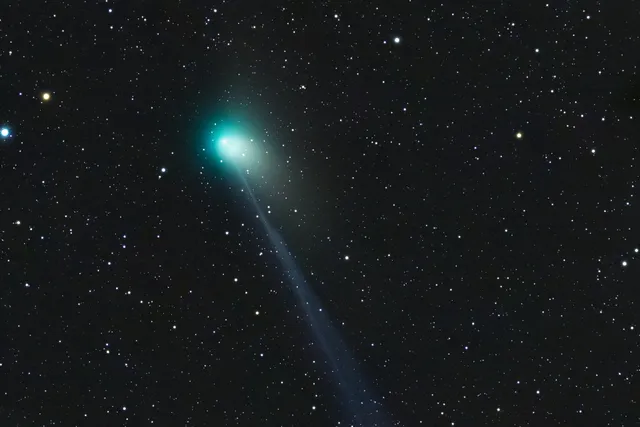
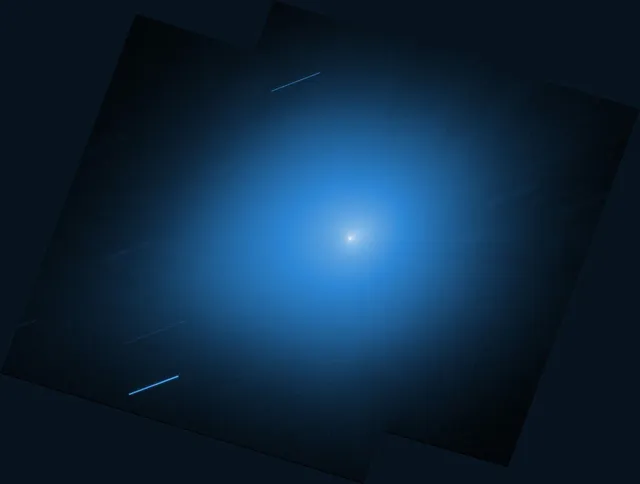
Despite being 60 million kilometres away, the JANUS camera clearly resolved the coma hiding the nucleus and two distinct tails: one pointing away from the Sun, the other trailing along the comet's path through the Solar System. Fainter structures within the coma and tails hint at interactions with solar radiation, particles, and the magnetic field — the JANUS team is examining these in more detail.
The main takeaway from these observations is straightforward: despite its interstellar origin, 3I/ATLAS behaved like an ordinary Solar System comet during its solar encounter.
A navigation camera helps refine the comet's path
NavCam, built to guide Juice around Jupiter's moons, was repurposed by ESA's planetary defence team, which used November images to refine the position and trajectory of 3I/ATLAS.
Earth-based observations had already suggested the comet arrived from the direction of the Milky Way's disc, implying it may have formed more than 10 billion years ago. NavCam offered a different viewing angle and captured the comet during periods when it wasn't visible from Earth, allowing for more precise tracking of its changing position.
Because a comet's trajectory is subtly altered by the gas and dust it sheds, the team has also begun using these trajectory measurements to estimate how much material — and what kind — the comet is leaving behind.
Analysis of the Juice data will continue for months, with instrument teams planning to publish their findings. The spacecraft's instruments will switch on again in September 2026, during a gravity-assist flyby of Earth on the way to Jupiter, where Juice is due to arrive in 2031.