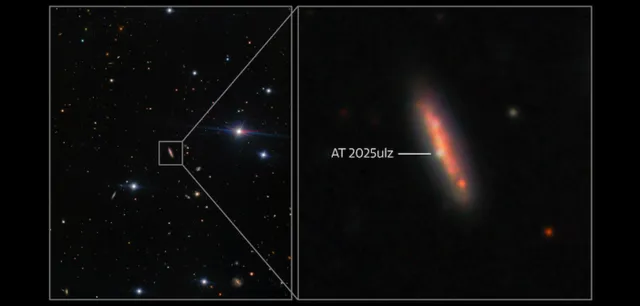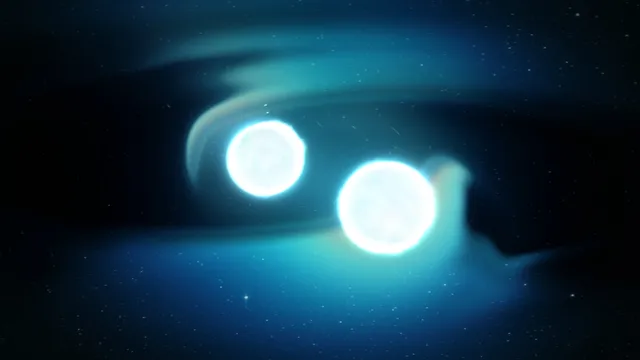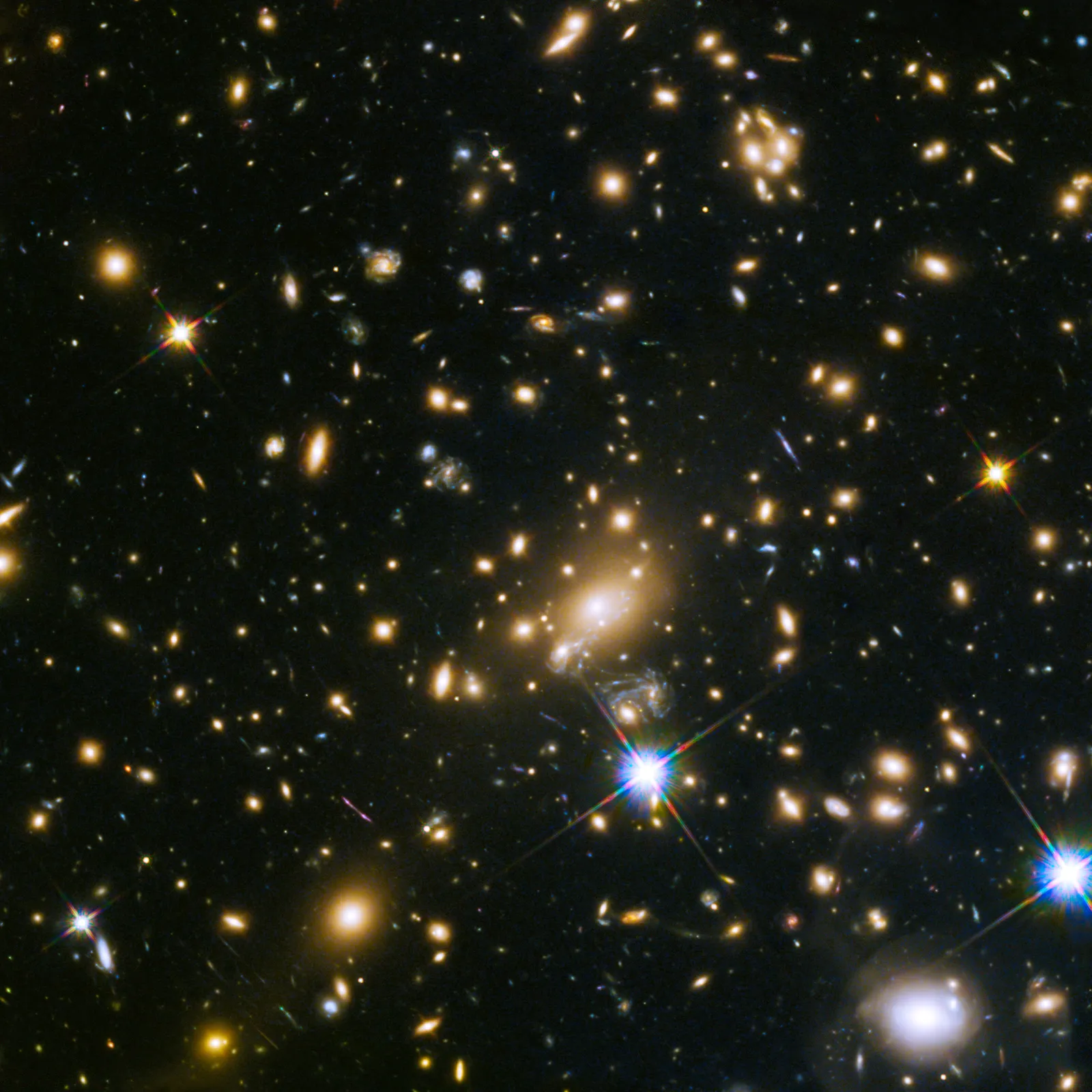
Multiply imaged, gravitationally lensed supernovae are rare even by astrophysics standards. Before SN 2025wny, only a handful of such systems suitable for cosmological measurements had ever been found. This supernova is doubly unusual: it also belongs to the superluminous Type I class, a rare category of explosions that shine tens of times brighter than ordinary supernovae.
A massive foreground galaxy happened to sit almost exactly along the line of sight between Earth and the explosion. Its gravity warped space enough to split the supernova's light into five separate images arranged around the lensing galaxy. Each image carries the same light, but it traveled a different path and arrived with a different delay.
How a gravitational lens splits an explosion's light into five copies
The principle works much like a camera lens, except the glass is replaced by the mass of a galaxy. Light rays from the supernova bend around that mass along different paths and converge on the observer from different directions, producing several copies of the same source.
The time delay between each image depends on how strongly spacetime is curved along each path, which in turn depends on the precise value of the Hubble constant — the universe's expansion rate. That is why such systems are used for time-delay cosmography: by measuring the delay between images and independently modeling the lens mass, researchers can derive an estimate of the Hubble constant that is independent of other methods, such as Cepheid distance ladders or unlensed Type Ia supernovae.
SN Winny is the first lensed supernova in a galaxy-scale system suitable for this kind of analysis, and the first lensed superluminous Type I supernova ever found.
Keck resolves all five images to sub-milliarcsecond precision
The team used the NIRC2 camera with adaptive optics on the Keck II telescope, achieving image quality of about 0.065 arcseconds — sharp enough to clearly separate all five copies of the supernova and measure their positions with high precision.
Using these astrometric measurements, the researchers built two independent models of the lensing galaxy's mass distribution, relying on two different software packages, lenstronomy and Glee. Both parameterized the mass using a singular isothermal ellipsoid, a singular isothermal sphere, and external shear — standard approaches in lens modeling.
The two models agreed closely, reproducing the observed image positions with residuals below a milliarcsecond. According to the results, the mass enclosed within the Einstein radius of the primary lensing galaxy is 4.44 × 10¹¹ solar masses, while a secondary, less massive lens contributes 0.96 × 10¹¹ solar masses.
The models also yield an effective stellar velocity dispersion for the primary lens of 277.4 km/s. This matches well with an independent spectroscopic measurement from DESI of 298 ± 37 km/s. The agreement between two independent methods — gravitational modeling and spectroscopy — supports the reliability of the derived mass.
The results are also consistent with earlier data obtained by the same team using the Large Binocular Telescope (LBT), analyzed with the same modeling codes.
Image A's excess brightness remains unexplained
One result does not fit any of the models built so far. Image A turned out to be 2 to 3 times brighter than predicted, and no smooth mass model can account for it.
The same anomaly was previously seen in the LBT observations, so the new Keck data confirm rather than contradict it. The likely explanation is mass along the line of sight that the models do not account for — small clumps of matter, too faint to detect directly, possibly made of dark matter.
If confirmed by further observations, SN Winny could become more than a tool for measuring the Hubble constant. It might also serve as indirect evidence for small-scale dark matter structures — clumps too small to be seen by any other means.