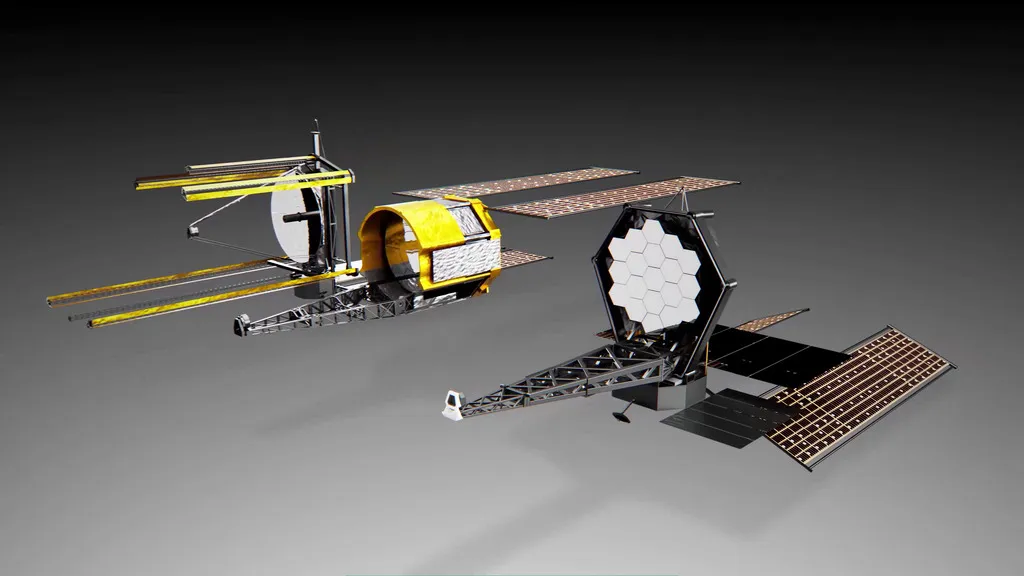
Directly photographing an Earth-sized planet around another star is one of the hardest tasks in observational astronomy. A star outshines the reflected light of its planet by billions to one, so an instrument must not just spot a faint dot but separate it from an overwhelmingly bright neighbor. The Habitable Worlds Observatory (HWO) is the telescope NASA is designing as the successor to the James Webb Space Telescope (JWST) for exactly this purpose. The mission's goal is to find and study at least 25 Earth-like planets, officially called ExoEarth candidates.
But before building the telescope, engineers need to know which design choices actually maximize scientific return. A new study led by Corey Spohn models exactly that: how mirror size, mission duration, field of view, and the number of repeat observations per planet affect the final number of worlds discovered.
An algorithm that remembers what it already learned
The authors built a new dynamic observation scheduling algorithm within EXOSIMS, a standard framework for simulating exoplanet-hunting missions. Unlike simpler approaches, this scheduler tracks how much orbital information about each candidate planet has already been gathered at any given point in the mission and uses that to forecast the probability of detecting it again.
In effect, the simulated telescope constantly decides whether to spend time re-observing an already-known candidate or to keep searching for new planets. It's a balancing act between breadth (more stars) and depth (more thorough study of planets already found).
The researchers ran thousands of combinations of four key parameters: mirror diameter (6.5 or 8 meters), dedicated survey duration for exo-Earths (2.5, 5.0, or 7.5 years), the number of observations required to confirm and characterize each planet (from 1 to 4), and the instantaneous field of regard — the patch of sky the telescope can actually point at during a given moment (from 15° to 135°).
Field of regard is decisive
The instantaneous field of regard (FoR) turned out to be one of the most important parameters in the entire design. This isn't the camera's field of view — it's the width of sky accessible to the telescope at any given time, a constraint set by the geometry of its sunshield and orbit.
The results are clear-cut: when the FoR drops below 90°, the number of detected planets falls sharply. A telescope confined to a narrow viewing cone simply cannot physically reach enough potentially habitable systems, no matter how much time it's given.
This means that what looks like a secondary engineering detail — how exactly to orient the shield blocking sunlight — directly determines the scientific payoff of a multi-billion-dollar telescope.
The cost of confirmation: minus 22% per extra look
The second critical parameter is Nchar, the number of observations needed to confirm a candidate and study its atmosphere. A single snapshot isn't enough: astronomers need to verify that a detected signal is truly a planet and not noise, and to collect enough light for spectral analysis.
Each additional observation of the same candidate costs the mission dearly in overall yield: roughly 22% fewer planets per extra round. Requiring four observations instead of one cuts the total number of exo-Earths found by about 52%.
Mission duration partially offsets this penalty. Going from one required observation to two costs 38% of the yield for a short, 2.5-year survey, but only 14% for a long, 7.5-year survey. The longer the mission, the less painful the requirement for repeat observations becomes.
A trade-off that will shape the telescope's architecture
The study, accepted for publication in JATIS as part of a special section on HWO's pre-formulation phase, arrives at a central conclusion: engineering constraints and science requirements are far more tightly intertwined than they might appear.
Survey efficiency for exo-Earths isn't a minor detail — it's a critical factor that will determine what HWO ultimately looks like: a 6.5- or 8-meter mirror, a wide or narrow field of regard, a short or long mission. Every one of these choices directly translates into how many worlds humanity will be able to see and study in the coming decades.