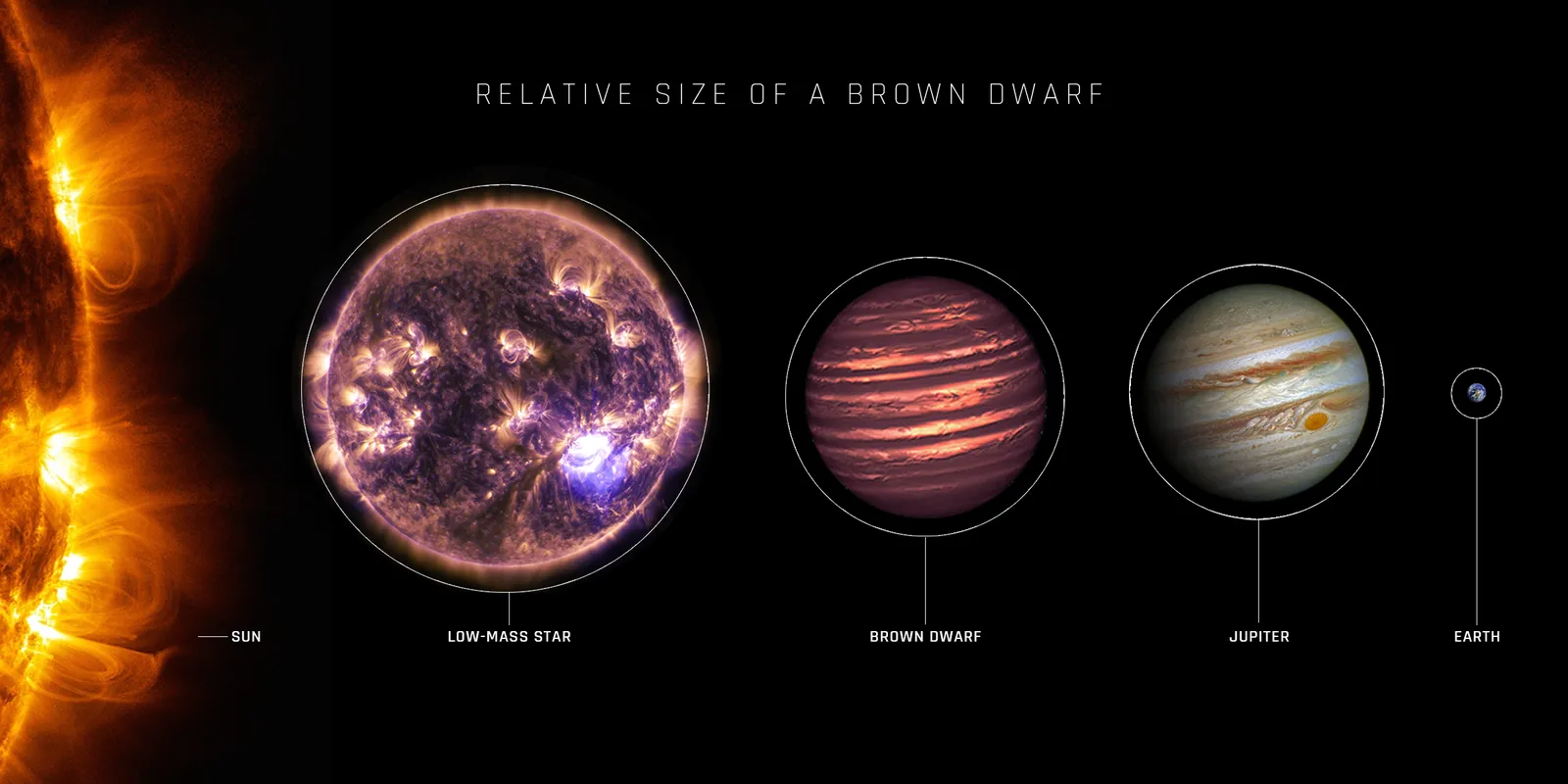
Brown dwarfs are objects that failed to become stars: they lack the mass to sustain stable hydrogen fusion. But between giant planets and brown dwarfs lies a blurred zone — the deuterium-burning limit, roughly 13 Jupiter masses. Objects at this mass can form as planets within a protoplanetary disk, as mini-stars through disk fragmentation, or end up on their orbit via gravitational capture. Mass alone cannot tell these scenarios apart.
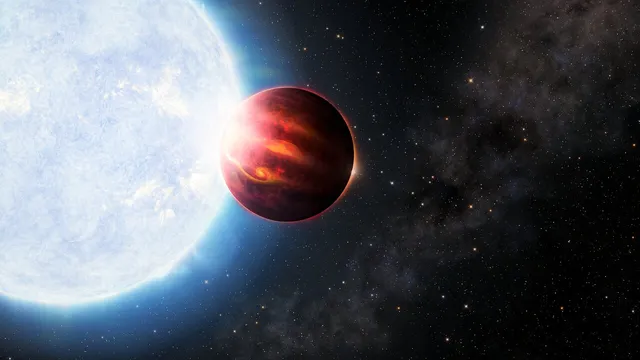
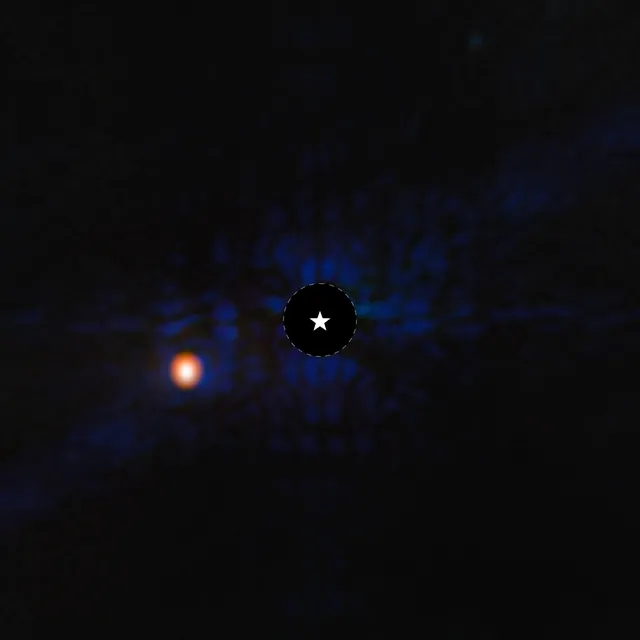
29 Cyg b — a companion to the star 29 Cygni, also known as HIP 99770 — sits precisely in this uncertain zone. Its mass is estimated at 15±5 Jupiter masses, with a mass ratio to its host star of only about 0.01. A team led by William Balmer used JWST to obtain the first direct image of this object at 4-5 µm and determine how it actually formed.
JWST's coronagraph catches the companion's faint glow
Direct imaging of exoplanets is notoriously difficult: starlight outshines a nearby companion by millions of times. The coronagraph on JWST's NIRCam instrument blocks the star's direct glare, allowing the faint signal of an orbiting object to be detected.
This is how researchers obtained the first image of 29 Cyg b in the 4-5 µm range. This window reveals molecular absorption bands — essentially chemical fingerprints of an atmosphere.
Two features stood out clearly in the spectrum: absorption from CO₂ at 4.3 µm and from CO at 4.6 µm. The ratio between these two features became the study's key diagnostic tool.
Three times more heavy elements than the star
The strength of the CO₂ feature relative to CO turned out to be disproportionately high compared to what would be expected from an atmosphere with solar composition. Comparing the observations with other published data in this wavelength range and with atmospheric models, the authors concluded that 29 Cyg b's atmosphere is enriched in heavy elements by roughly three times relative to its host star (Z_b/Z_star = 3±2).
This enrichment is not incidental. It matches the mechanism of giant planet formation through accretion: solid, metal-rich material from the protoplanetary disk — dust and icy debris — falls onto a young planet more efficiently than gas does, enriching its atmosphere with heavy elements beyond what the star itself contains.
This differs from a disk-fragmentation or gravitational-capture scenario, where a companion forms essentially as a mini-star from the same gas cloud as the primary, and its composition would be expected to track the star's own.
Orbital tilt matches the star's equator
A second, independent line of evidence came not from JWST but from ground-based interferometry. Researchers measured the star's own inclination angle using CHARA/PAVO, an optical interferometer capable of determining the shape and orientation of stellar disks with high precision.
The companion's orbit turned out to be consistent with the star's rotation axis at the 2σ level, with an inclination difference of Δi = 12±6°. In practice, this means the companion orbits nearly in the same plane as the star's equator — exactly what would be expected if it formed within the same protoplanetary disk, rather than being captured from outside at a random angle.
Taken together, the atmospheric metallicity and the orbital alignment paint a consistent picture: 29 Cyg b formed within the disk around its star through rapid accretion of metal-rich material.
What this means for the limits of planet formation
The result matters mainly because it shows that planet formation around early-type stars — more massive and hotter than the Sun — can reach masses at the deuterium-burning limit and even exceed it. Previously, objects of this mass were more often assumed to arise from stellar formation mechanisms rather than planetary ones.
The finding also matches a recently revised trend linking planetary metallicity to mass, derived from the densities of transiting planets: extrapolated to high masses, this trend predicts Z_pl/Z_star = 3.3±0.5 — a value that closely matches the measured 3±2 for 29 Cyg b.
29 Cyg b becomes the first direct observational evidence that the boundary between planets and brown dwarfs is not a hard barrier for the formation mechanism, but rather a continuum of masses across which the classical planetary accretion scenario continues to operate.
The study has been accepted for publication in the Astrophysical Journal Letters, with acceptance dated January 2026.