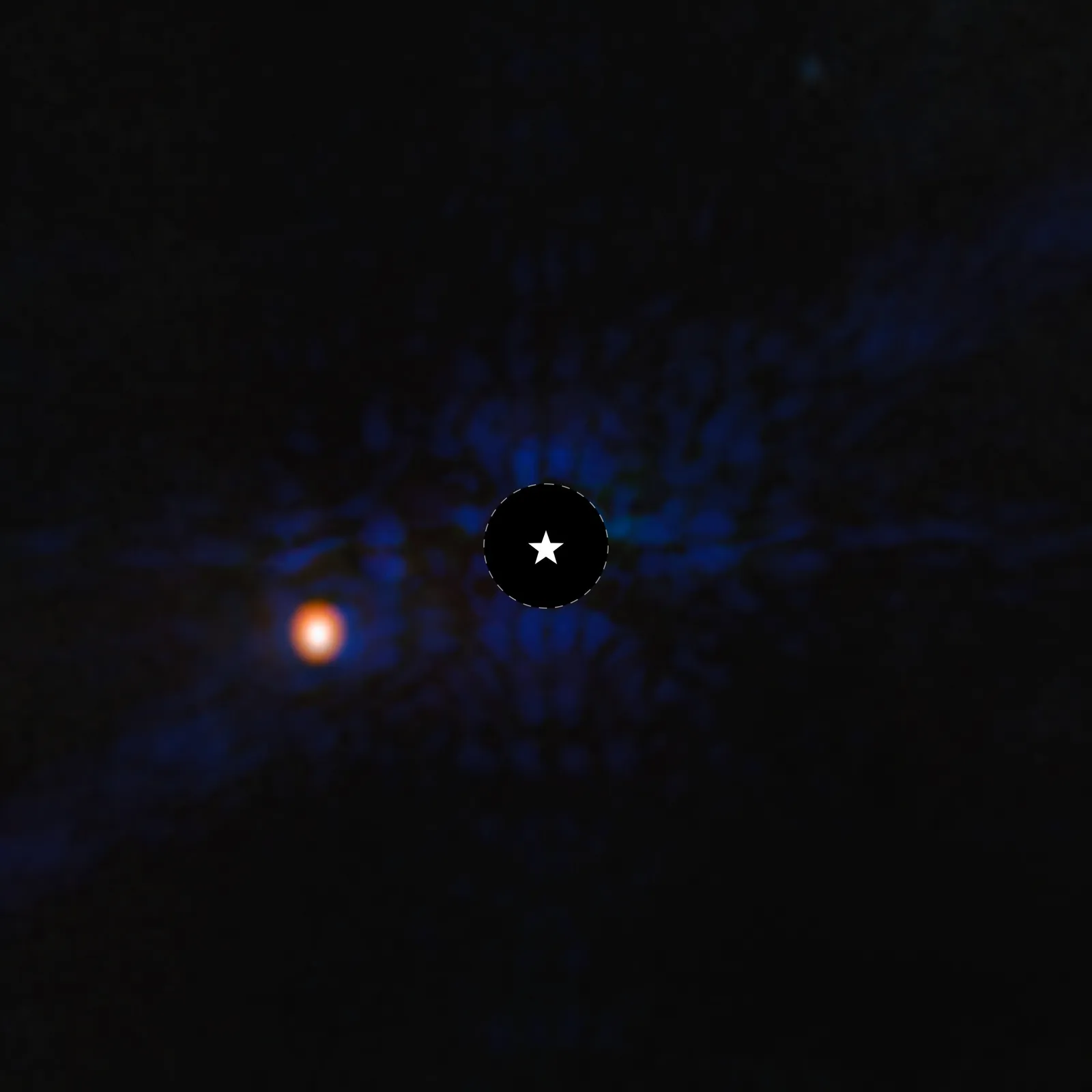
Orbiting just 11.9 light-years from Earth is a planet that, for years, could only be inferred rather than seen. ε Ind Ab was discovered in 2019 through an indirect method — by detecting the wobble it induces in its Sun-like host star. A direct image followed only in 2024, captured by JWST. Now a team led by Aniket Sanghi (Caltech) has published a new study in the Astronomical Journal that turns ε Ind Ab from a single detection into a precisely characterized world.
The planet is cold even by gas-giant standards, with a surface temperature of 275 kelvin, about 2°C. That makes it one of the coldest known exoplanetary gas giants and a rare chance to test how such planets behave billions of years after formation.
Five JWST images and a record wavelength
The new study draws on imaging in five photometric bands: two from the NIRCam instrument spanning 4-5 micrometers, and three from MIRI covering 18-25 micrometers.
The longest-wavelength of these, taken at 25.5 micrometers, is the longest-wavelength direct image of an exoplanet ever acquired.
Together, the five images form the first spectral energy distribution (SED) — the planet's brightness measured across different wavelengths — for a cold gas giant outside the solar system, spanning 4 to 25 micrometers. No comparably complete dataset had existed before for such a cold object.
Three decades of data yield a precise mass
Interpreting a planet's brightness requires knowing its mass precisely. To get there, the researchers combined three independent data sources: thirty years of radial velocity monitoring of the star (a technique that detects how a planet's gravity subtly shifts its star), absolute astrometry from the Gaia and Hipparcos missions, and relative astrometry from direct imaging, including the new NIRCam data.
This yielded a dynamical mass of 6.5 Jupiter masses for the planet, with an uncertainty of roughly +0.7/−0.6. The system's age is estimated at 3.5 billion years (± 1 billion).
Integrating the full spectral energy distribution gave the planet's bolometric luminosity: log L/L☉ = −7.23 ± 0.03 — a very low value typical of old, cold gas giants that have long since radiated away the heat left over from their formation.
Comparing mass, age, and luminosity against theoretical evolutionary models produced excellent agreement — tested for the first time in this specific regime of low luminosity, low mass, and old age. Previous tests of these models relied mostly on younger, brighter objects.
A metal-rich atmosphere and a question about clouds
The NIRCam data also allowed the team to draw conclusions about the planet's atmospheric composition. The photometry points to a metal-enriched atmosphere — an elevated abundance of elements heavier than hydrogen and helium. This is consistent with the known mass-metallicity relation observed across giant planets.
A separate puzzle concerns clouds. The image at 25.5 micrometers — a wavelength dominated by water vapor absorption — turned out slightly brighter than cloud-free atmospheric models predict. The discrepancy exceeds 1 sigma but falls short of 2 sigma, meaning it isn't yet statistically conclusive.
A model incorporating water ice clouds fits the data better than the cloud-free version. For now this remains a hint rather than a confirmed result, but such small discrepancies are often exactly what motivates the next round of observations.
The researchers explicitly describe ε Ind Ab as a benchmark object for studying the evolution of Jupiter analogs around Sun-like stars. The next step is more detailed atmospheric spectroscopy, which should either confirm the presence of water ice clouds or rule the idea out.