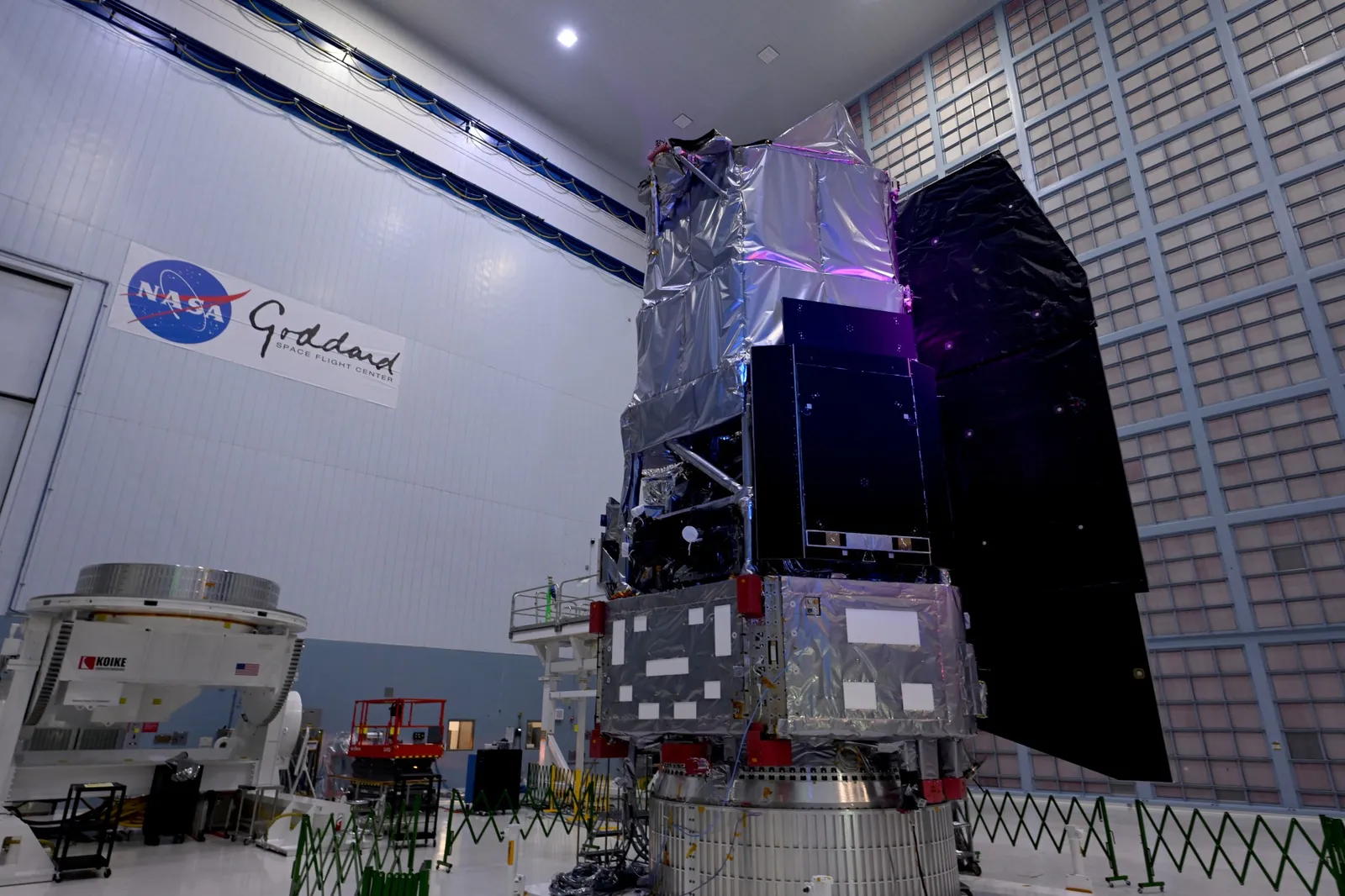
NASA has confirmed an accelerated timeline for the Nancy Grace Roman Space Telescope: launch is now targeted for early September 2026, well ahead of the agency's official commitment of no later than May 2027. The update was announced by NASA Administrator Jared Isaacman at an April 21 news conference at Goddard Space Flight Center in Maryland, where the observatory currently sits.
NASA credits the accelerated schedule to coordinated work among government, research institutions, and private industry. Isaacman put it this way:
Roman's accelerated development is a true success story of what we can achieve when public investment, institutional expertise, and private enterprise come together to take on the near-impossible missions that change the world.Jared Isaacman, NASA Administrator
Accelerated Timeline: From Goddard to Kennedy Space Center
The telescope is currently housed in Goddard's largest clean room, undergoing final checks before shipment. In June 2026, the observatory will be delivered to Kennedy Space Center in Florida for prelaunch preparations.
Launch will take place from Launch Complex 39A aboard a SpaceX Falcon Heavy rocket. NASA and SpaceX will share a specific launch date once further coordination is complete.
If the current schedule holds, Roman will launch roughly eight months ahead of the agency's official deadline. That's a rare case of a major space mission getting ahead of its own commitment date rather than pushing right up against it.
Wide Field of View, Sharp Infrared Vision
Roman's key technical advantage is combining a wide field of view with crisp infrared resolution. This lets the telescope survey vast swaths of sky in a single observation while retaining the detail typically associated with much narrower surveys.
The mission was designed with three primary science goals in mind: dark energy, dark matter, and exoplanets. But the telescope's actual observational reach extends far beyond these core objectives.
Thanks to its unprecedented sensitivity and sky coverage, astronomers will be able to use Roman to investigate nearly any cosmic phenomenon — from the large-scale structure of the universe down to individual star systems.
A 20,000-Terabyte Archive: Exoplanets, Galaxies, Stars
Over its five-year primary mission, Roman is expected to build a data archive of 20,000 terabytes — one of the largest astronomical datasets ever assembled by a single instrument.
Drawing on this archive, scientists anticipate identifying and studying 100,000 exoplanets, hundreds of millions of galaxies, and billions of stars. Rare objects and phenomena — including some never before observed — are expected to stand out as particularly valuable discoveries.
The scale of the survey means Roman's archive will keep serving researchers for years after the primary mission ends, letting them search for new patterns in already-collected observations.
Nancy Grace Roman: The Astronomer Who Built the Space Telescope Program
The telescope is named after Nancy Grace Roman, a NASA astronomer known as the "Mother of Hubble." She played a pivotal role in establishing the space telescope program itself, work that later led to the launch of the Hubble Space Telescope.
The mission is managed by NASA's Goddard Space Flight Center, with participation from the Jet Propulsion Laboratory (JPL), Caltech/IPAC, the Space Telescope Science Institute (STScI) in Baltimore, and scientists from other research institutions.
NASA says it will continue sharing updates as a specific launch date is set and prelaunch preparations move forward.