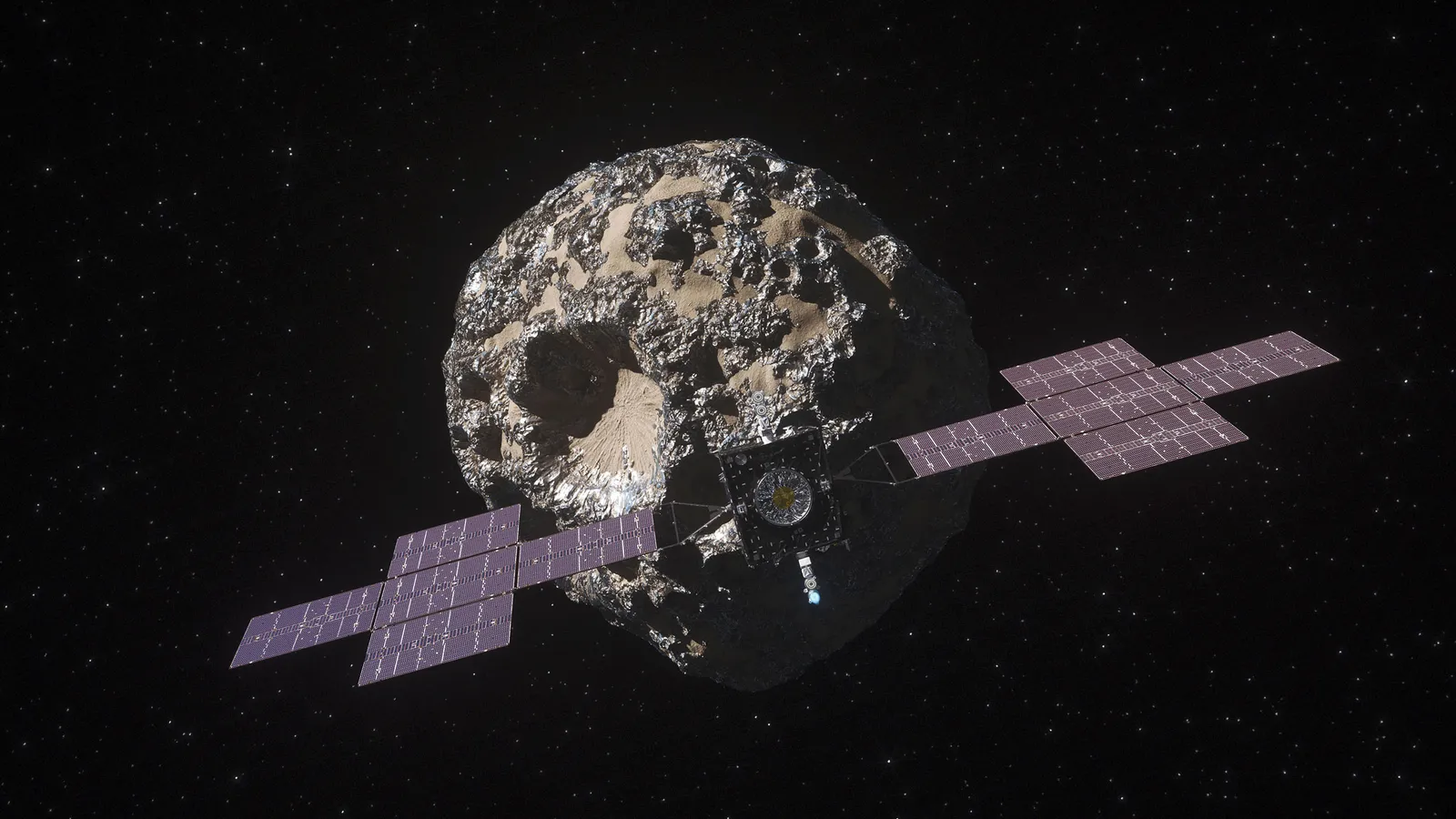
A permanent Mars colony will eventually hit a wall that recycling local soil alone cannot solve. Metals — the structural backbone of any long-term base, from habitats to rovers — are neither abundant nor conveniently available on Mars. Shipping them from Earth is possible, but every kilogram that crosses interplanetary distance costs a staggering amount in money and propellant. A team led by Serena Suriano proposes a third option: mine metals not on Earth, not on Mars, but on asteroids, and build a logistics chain connecting the asteroid belt to the Martian surface.
The paper (arXiv:2604.18664) is deliberately engineering-focused. The authors are not speculating about future mining outposts — they calculate what is achievable with technologies that already exist or are close to deployment, and what it would cost in energy and mass.
Asteroids selected by ΔV, not by size
The key parameter in interplanetary logistics is ΔV (delta-v), the change in velocity a spacecraft must perform to move from one orbit to another. The higher a mission's ΔV, the more propellant it needs on board, and the more expensive the trip.
The team selected metallic asteroids not by size or ore content but primarily by reachability: to get there and back, a spacecraft of current design had to stay within realistic ΔV limits. This narrows the candidate list to bodies that could actually be visited by existing or planned missions, without relying on hypothetical future propulsion.
The team then built visit schedules — sequences in which a spacecraft would fly to selected asteroids, extract metal, and return. For each scenario, they estimated the total mass of delivered material at various mining rates: naturally, slower mining equipment means less metal collected per trip.
Propellant from carbonaceous asteroids removes Earth dependency
A separate challenge for return trips is propellant. If every spacecraft heading to the asteroids and back to Mars has to carry fuel launched from Earth, the whole economic case for mining collapses.
The authors' proposed solution is producing propellant directly on-site, on carbonaceous asteroids, using ISRU (in-situ resource utilization) methods. Carbonaceous asteroids are known to hold volatile compounds, including water-bearing minerals, from which propellant components can be extracted with current technology.
This fundamentally changes the logic of the supply chain: a mission stops being a one-way "there and back" trip with a fixed fuel budget and becomes a system that partially resupplies itself along the way.
Optimizing three objectives at once
Building an efficient supply chain is difficult because several conflicting goals must be balanced simultaneously. The authors applied multi-objective optimization across three parameters: mission ΔV, mass of extracted metal, and mass of propellant produced on-site.
Optimizing across all three at once — rather than just one — matters because minimizing ΔV does not automatically maximize delivered metal mass, and vice versa: a trip to the cheapest asteroid in terms of fuel might turn out to be a poor performer in terms of mined mass. Different supply chain configurations produce different trade-offs among these three values, and it is from this set of options that the team drew practical scenarios.
Metal feeds 3D printing of habitats and rovers
The final part of the study addresses what to do with the metal once it reaches Mars. The authors discuss using delivered material for additive manufacturing — 3D printing — of habitats and rovers directly on the Martian surface.
The logic is straightforward: once metal has already made the trip from an asteroid to Mars, it is cheaper to print finished structures on-site than to ship pre-made parts from Earth as a separate cargo. This closes the loop — from extraction in the asteroid belt, through delivery to Mars, to the actual manufacturing of colony infrastructure.
The study does not settle on a single best supply chain configuration — there are many, according to the authors, and the choice depends on mission priorities: speed, metal volume, or propellant self-sufficiency. But the fact that such calculations can already be made using existing space transportation technologies marks a step toward turning asteroid mining from a science-fiction concept into an actual line item in the technical planning of a future Mars colony.