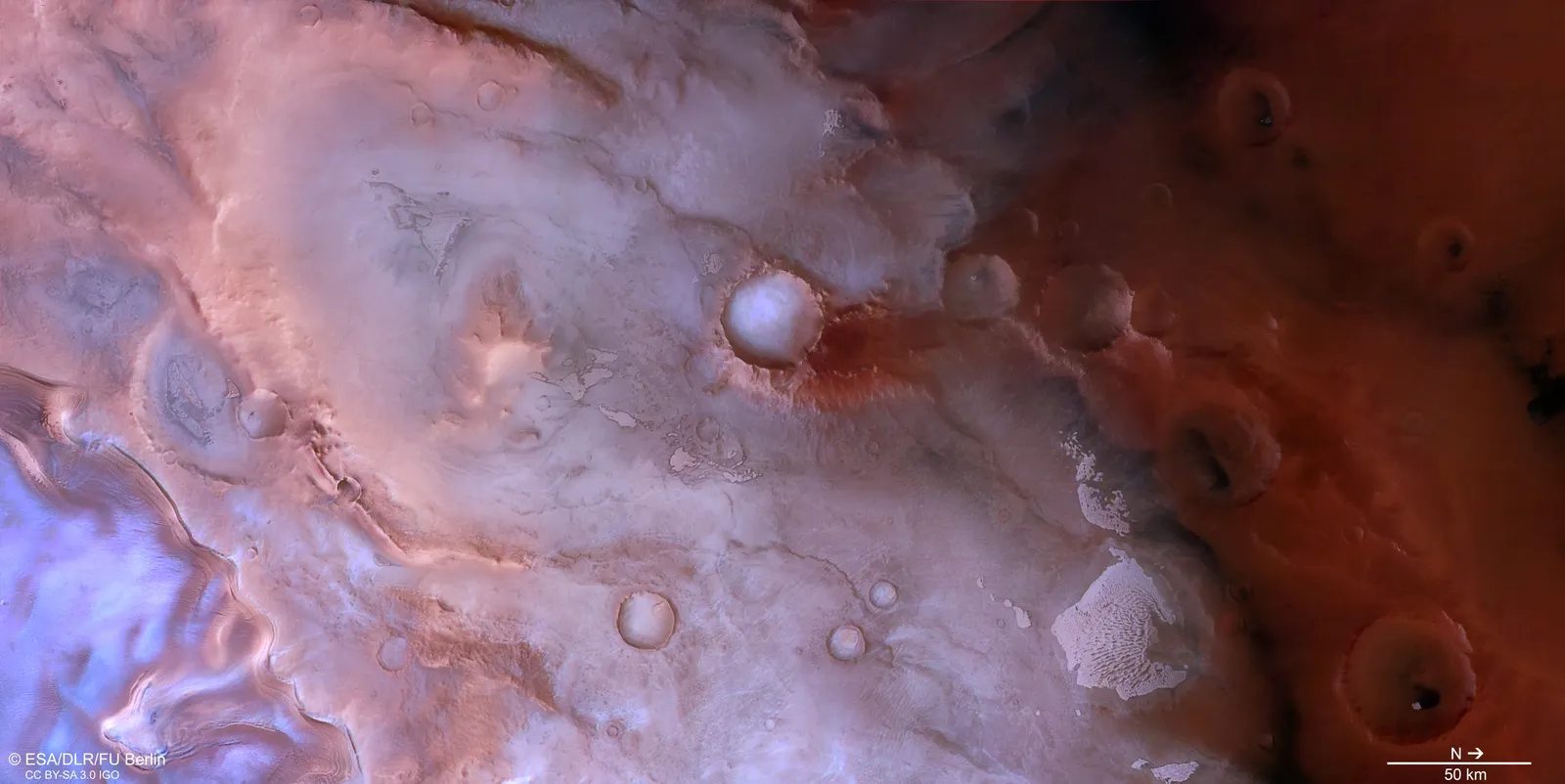
The High Resolution Stereo Camera aboard Mars Express has captured the Thyles Rupes region near Mars’s south pole in pink, purple and red tones. At first glance, this palette looks very different from the familiar ochre and brown landscapes usually associated with Mars.
The unusual appearance does not mean that Mars’s surface has turned purple. The image records a particular combination of morning illumination, airborne dust, frost and the properties of different materials on the ground. The HRSC camera observed these conditions during the Martian spring.
An icy cliff among impact craters
Thyles Rupes is a large cliff system in Mars’s southern highlands, close to the south polar ice cap. Its name combines the Latin word for a cliff with Thule, a legendary place beyond the edge of the known world in classical geography.
The rocky scarps rise more than 1 km high in some places. They extend for hundreds of kilometres across terrain densely covered with impact craters. Some craters are cut by the cliffs, meaning they formed first. Others lie on top of the structures, pointing to a long and complex geological history.
The image also includes part of a glacier connected to the south polar ice cap. On the elevation map, this pale icy feature is a raised mound, although it can appear to be a depression because of the direction of illumination. Sunlight came from the east, at the bottom of the image.
Dust, frost and volcanic minerals
The dark streaks and patches around Thyles Rupes are linked to volcanic material. It is rich in mafic minerals, meaning minerals and rocks with high amounts of magnesium and iron. They include olivine and pyroxene, which are also common in Earth’s mantle.
Paler areas are covered by carbon dioxide frost. These bluish deposits appear on the tops of dunes and inside craters. They persisted in the region even during spring, when the image was taken.
The broad purple tone comes from several effects acting together. Morning light was soft and rosy, while dust was suspended in the atmosphere. A thin layer of frost and patches where ice and dust had mixed also affected the colours. Mars’s atmosphere changes over time, so the same landscape can look different in images taken at different hours.
Ancient faults and dunes
The cliffs of Thyles Rupes are thought to have a tectonic origin. In the past, Mars’s interior cooled and the planet gradually contracted. This deformed the crust, allowing some blocks of surface material to shift and rise above others, forming steep scarps.
Modern Mars has no active tectonics comparable to those on Earth. These structures therefore preserve evidence of ancient processes that occurred billions of years ago.
Dune fields lie beside the cliffs. Winds transported sand in different directions, creating longitudinal and transverse dunes as well as crescent-shaped ridges. Their shapes help trace the interaction between wind, topography and seasonal ice.
Why it matters
The Thyles Rupes image shows that Mars’s colour depends on much more than oxidised iron, the material responsible for the planet’s familiar reddish appearance. Volcanic minerals, frozen carbon dioxide, dust and the angle of sunlight can combine to produce a very different view.
Mars Express has been operating at Mars since 2003. For more than two decades, its HRSC camera has produced colour and three-dimensional maps of the surface. These data allow researchers to study terrain height, surface materials, icy deposits and evidence of ancient geological activity at the same time.