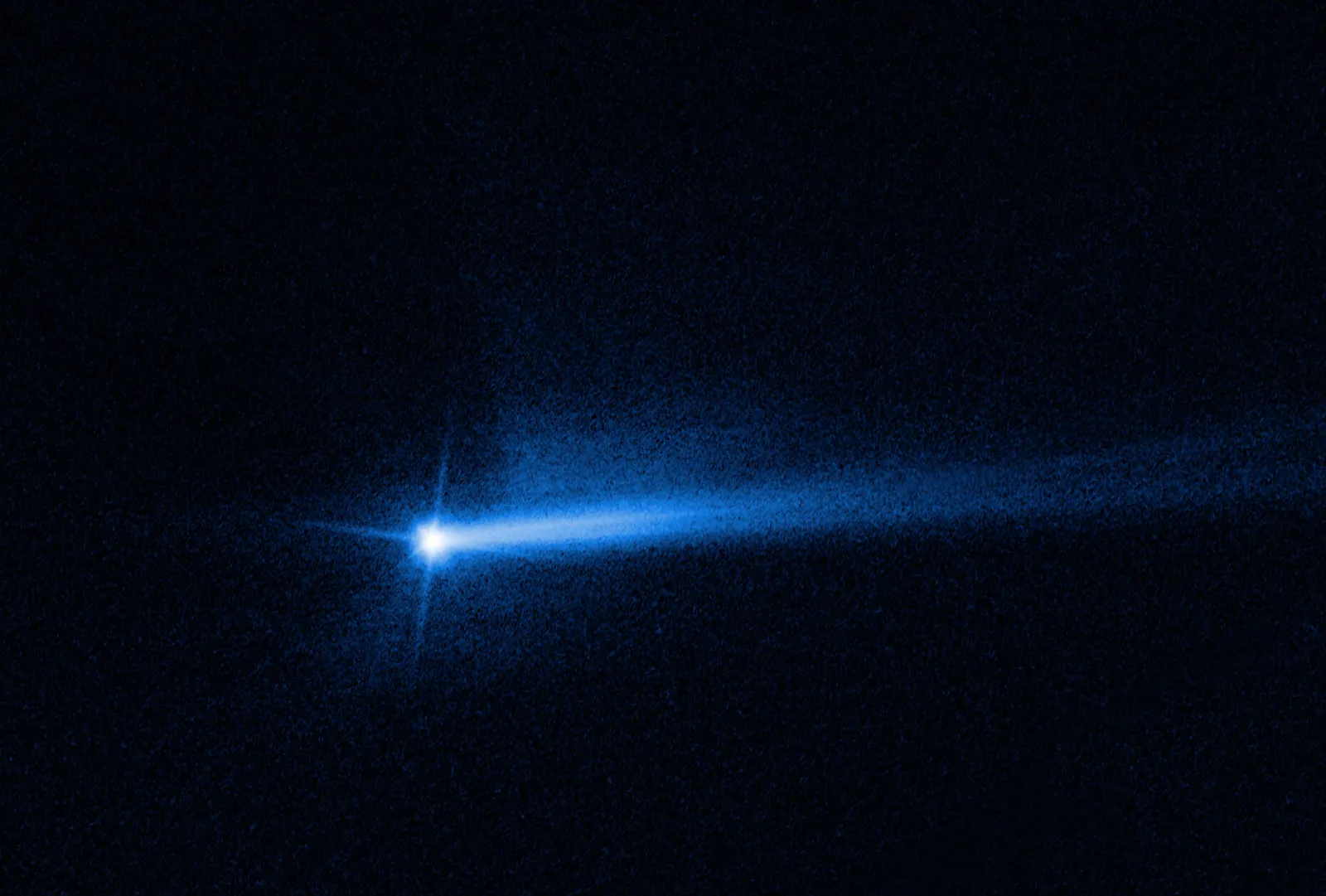
On September 26, 2022, NASA engineers deliberately steered the DART spacecraft into the asteroid Dimorphos. Dimorphos is a moonlet of the larger asteroid Didymos: the two rocky bodies are bound by gravity, forming a binary system that orbits a shared center of mass. The goal was straightforward — test whether an impact could shift a celestial body's orbit. DART became humanity's first mission to intentionally alter the motion of an object in space.
The immediate results were clear: Dimorphos' orbital period around Didymos shortened by 33 minutes, down from 12 hours. But a new study published in Science Advances goes further. Researchers showed the impact changed the orbit of the entire binary system around the Sun — the first time a human-made object has measurably altered a celestial body's path around a star.
Debris doubled the impact's push
Dimorphos measures about 170 meters across, while Didymos spans roughly 800 meters. When DART struck the smaller body, it blasted a massive cloud of rocky debris into space, reshaping the asteroid itself.
That debris carried its own momentum outward, and this is where the real surprise lies: the ejected material effectively doubled the push delivered by the spacecraft alone. Scientists call this the momentum enhancement factor, and in this case it came out to roughly two.
The combined effect was measurable even at the scale of the whole binary system. Its 770-day orbital period around the Sun shortened by 0.15 seconds. The velocity change amounted to just 11.7 microns per second — under two centimeters per minute.
This is a tiny change to the orbit, but given enough time, even a tiny change can grow to a significant deflectionThomas Statler, lead scientist for solar system small bodies, NASA Headquarters
Stellar occultations as a measurement tool
Detecting such a minuscule shift required a specific technique: tracking stellar occultations, the rare moments when an asteroid passes directly in front of a star and briefly blocks its light.
Capturing these events demands precise prediction of the asteroid's path and multiple observing stations, sometimes miles apart. Success depends on weather and exact timing, so the team relied on volunteer astronomers around the world.
Between October 2022 and March 2025, they recorded 22 such occultations. Combined with years of existing ground-based observations, this data let researchers calculate exactly how much DART had changed Didymos' orbit.
Dimorphos' density hints at its origin
Analyzing the shift in Didymos' motion also gave researchers a new estimate of both asteroids' densities. Dimorphos turned out to be slightly less dense than previously thought.
That supports the idea that the moonlet formed from rocky material shed by a rapidly spinning Didymos, which later clumped together into a loose, gravitationally bound structure known as a rubble pile asteroid.
What comes next for planetary defense
Didymos was never on a collision course with Earth, and DART could not have put it on one. But the measurable orbital change confirms that if a hazardous asteroid is spotted early enough, a kinetic impactor can nudge it off its path.
The key requirement is early detection. That is why NASA is building the NEO Surveyor telescope, managed by the Jet Propulsion Laboratory. It is the first spacecraft designed specifically to search for hazardous near-Earth objects, including dark asteroids and comets that reflect little visible light.