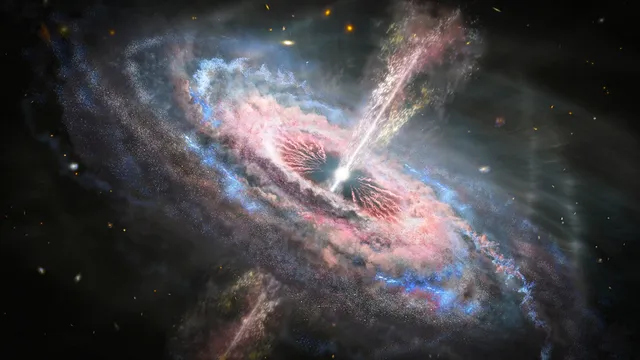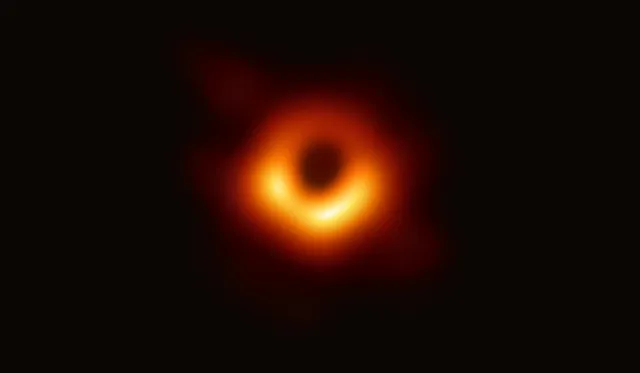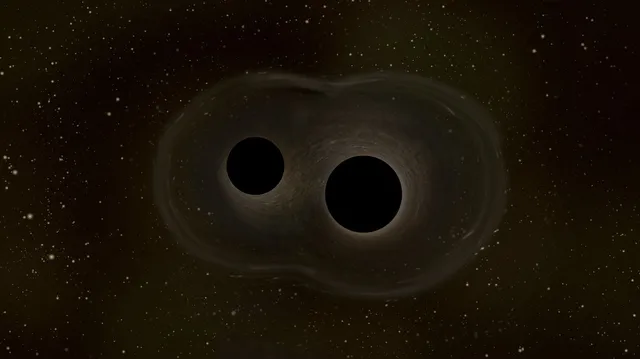
Primordial black holes may have formed in the early Universe rather than through the deaths of massive stars. Some models allow objects with masses comparable to asteroids to make up dark matter, the unseen material whose presence is inferred from its gravitational effects.
A new study used 20 years of data from the INTEGRAL X-ray observatory. The authors did not search for black holes directly. Instead, they looked for an indirect trace of their possible evaporation: additional diffuse hard X-ray emission from the Milky Way. The work has been released as a preprint on arXiv, meaning that it has not yet undergone peer review in a scientific journal.
How IBIS searched for Hawking radiation
Under the theory of Hawking radiation, black holes can lose mass very slowly. The smaller the black hole, the more intense this process should be. For primordial black holes in the lower part of the asteroid-mass range, evaporation should produce electrons and positrons.
These particles travel through the Galaxy and interact with its radiation fields. In inverse Compton scattering, an electron or positron transfers part of its energy to a photon. Ordinary Galactic light can therefore be boosted into the hard X-ray range.
This diffuse signal was sought in data from the IBIS instrument aboard INTEGRAL. The analysis relied not only on the emission spectrum, meaning its distribution across energies, but also on the signal’s shape across the sky. The distribution of dark matter in the Galaxy and the movement of charged particles should leave a spatial pattern different from that of at least part of the ordinary X-ray background.
Galactic background was the main obstacle
The hard X-ray sky is not empty. It includes emission from cosmic-ray electrons, which also scatter Galactic light. Another contribution comes from numerous accreting white dwarfs, stellar remnants that draw matter from companion stars. Many such systems are too faint to study individually, yet together they produce a noticeable background.
The authors built a physically motivated model of these components and added the expected contribution from evaporating primordial black holes. Combining spatial and spectral information allowed them to distinguish a possible dark-matter signal from astrophysical background more effectively.
The result is a set of limits on the fraction of dark matter that primordial black holes can represent across a broad mass range. The study also considers extended mass distributions, in which the objects do not all have the same mass, and models involving rotating black holes.
How solid is the result
This is not a claim that primordial black holes have been detected. The study sets limits on models: if there were too many such objects, their evaporation should produce an X-ray signal stronger than the data allow.
The main uncertainty concerns how low-energy electrons and positrons propagate through the Galaxy. Their paths determine where the extra X-ray emission should appear in the sky. The estimates are also affected by the assumed dark-matter density profile of the Milky Way.
Why it matters
Asteroid-mass primordial black holes remain among the viable candidates for dark matter. They can be tested in several ways, making hard X-ray observations a useful complement to other methods.
The strength of this study lies not only in the length of its data set, but also in its use of both the energy and direction of the emission. Better models of electron and positron propagation could make future tests more precise. For now, INTEGRAL narrows the room for models in which dark matter consists of evaporating primordial black holes.