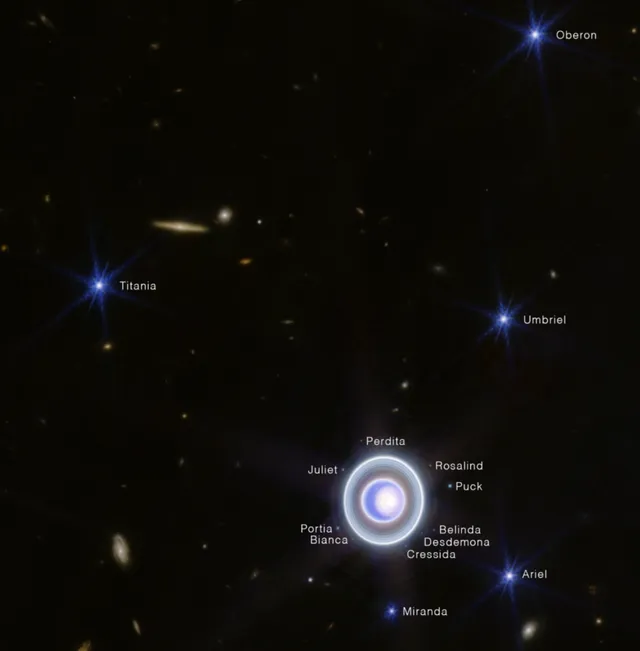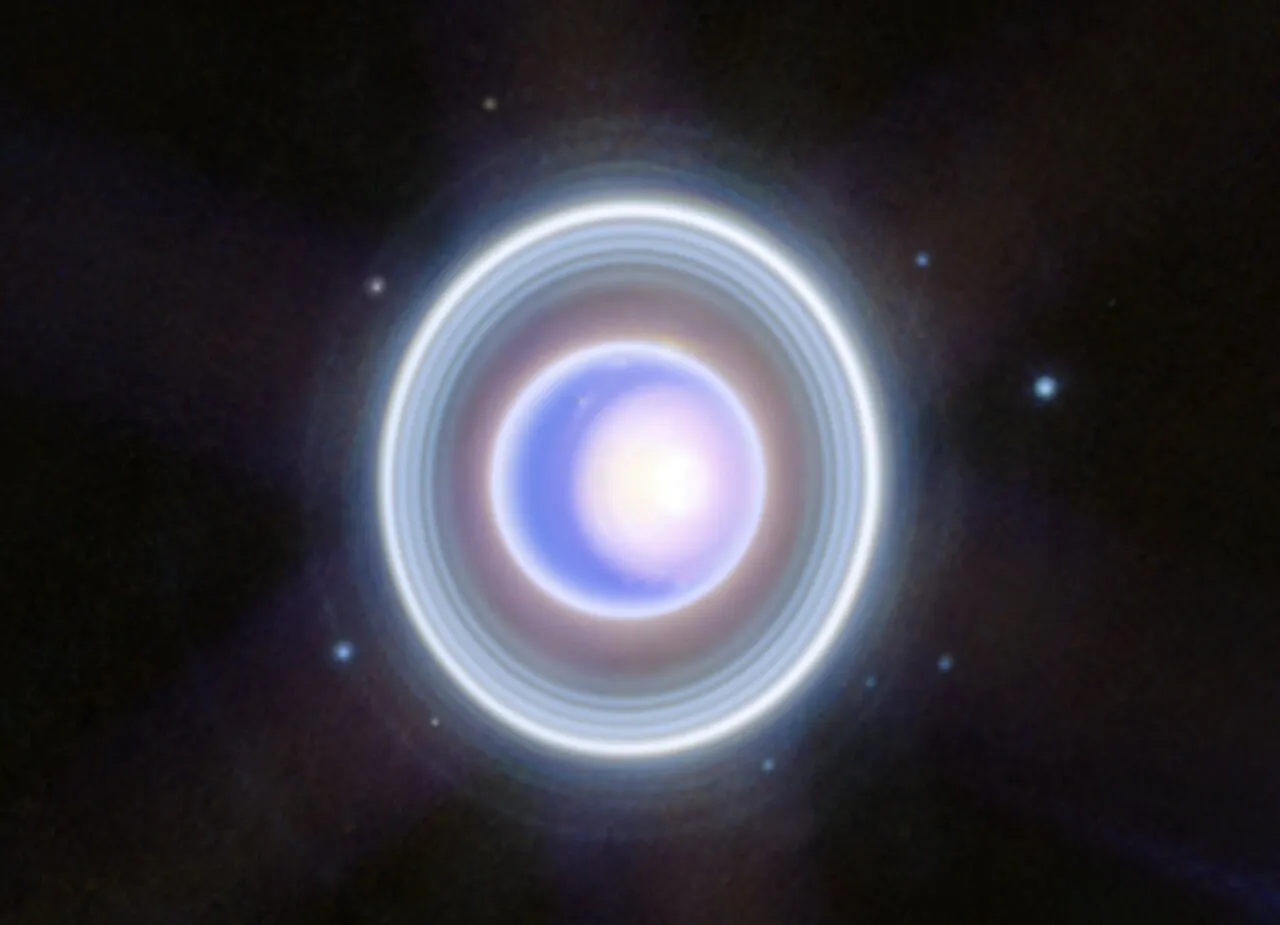
Forty years ago, Voyager 2 flew past Uranus and its moons, sending back the first detailed images of Miranda, Ariel, Umbriel, Titania, and Oberon. Its cameras captured deep valleys, smooth plains, canyons, and signs of possible cryovolcanic activity across these icy worlds — evidence of an active geologic past. But the spacecraft carried no instruments capable of determining what these surfaces were actually made of.
In the decades since, astronomers have tried to fill that gap using ground-based near-infrared spectroscopy. They detected faint signs of carbon dioxide and hints of carbon monoxide ice, with intensity varying noticeably across different regions of each moon's surface. Yet the origin of these compounds remained unclear, hampered by both the weakness of the spectral signals and interference from Earth's own atmosphere.
Two competing hypotheses
There are two explanations for the presence of carbon oxides on Uranus's moons. The first is that they are native — incorporated into the moons along with other ices and minerals when the system formed. The second is that they were produced by radiolysis: charged particles trapped in Uranus's magnetic field break apart water ice and carbon-bearing molecules on the moons' surfaces, generating new compounds, including carbon dioxide and carbon monoxide.
Telling these scenarios apart from the ground proved difficult. What was needed were observations free from atmospheric interference — exactly what the James Webb Space Telescope's NIRSpec instrument (a near-infrared spectrograph) could provide.
Webb's spectra and ice in the lab
In 2024, a team already obtained NIRSpec spectra of Ariel, revealing clear carbon dioxide bands and confirming the carbon monoxide signal that ground-based data had only hinted at. Richard Cartwright (Johns Hopkins University) and colleagues expanded this work by adding spectra of Umbriel, Titania, and Oberon.
Alongside the space observations, the researchers ran laboratory experiments measuring the spectral properties of carbon dioxide ice at very low temperatures — tens of kelvin. This allowed them to more precisely match laboratory reference spectra to the real data from the moons and better understand the physical state of the ice on their surfaces.
The comparison revealed that all four moons show spectral bands corresponding to carbon dioxide, carbon monoxide, and other carbon-bearing molecules. Their intensity differs between each moon's leading and trailing hemispheres — the sides facing forward and backward relative to orbital motion. These differences were strongest on Ariel and Umbriel.
Why this points to radiolysis — and something more
The key finding is that carbon dioxide and carbon monoxide bands are consistently stronger on the trailing hemispheres of all four moons. This matches the radiolysis hypothesis: trailing hemispheres receive a heavier bombardment of charged particles from Uranus's magnetosphere, since they face into the flow of trapped particles as the moons orbit. The band strength also decreases with increasing distance from Uranus, further supporting a radiation-driven effect tied to the planet.
At the same time, the spectra show signs of carbonate minerals, and carbon dioxide appears fairly widely across the Uranus system — suggesting that some of the material is native, independent of irradiation.
The authors concluded that both scenarios — native presence and radiolytic production — are needed to fully explain the observed data.
What comes next
The study shows that no single mechanism explains the whole picture. Carbon compounds on Uranus's moons are likely partly inherited from the system's formation and partly continuously replenished through interaction with the planet's magnetosphere. Future laboratory experiments and new JWST observations should help refine the balance between these two processes — and possibly reveal more about the ices and minerals on Ariel, Umbriel, Titania, and Oberon, worlds last imaged in detail by a single spacecraft four decades ago.