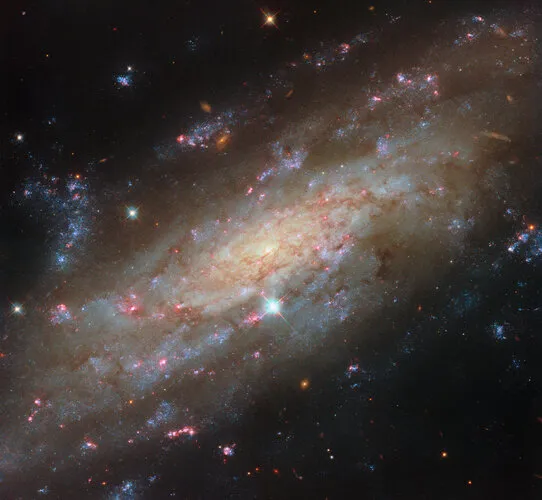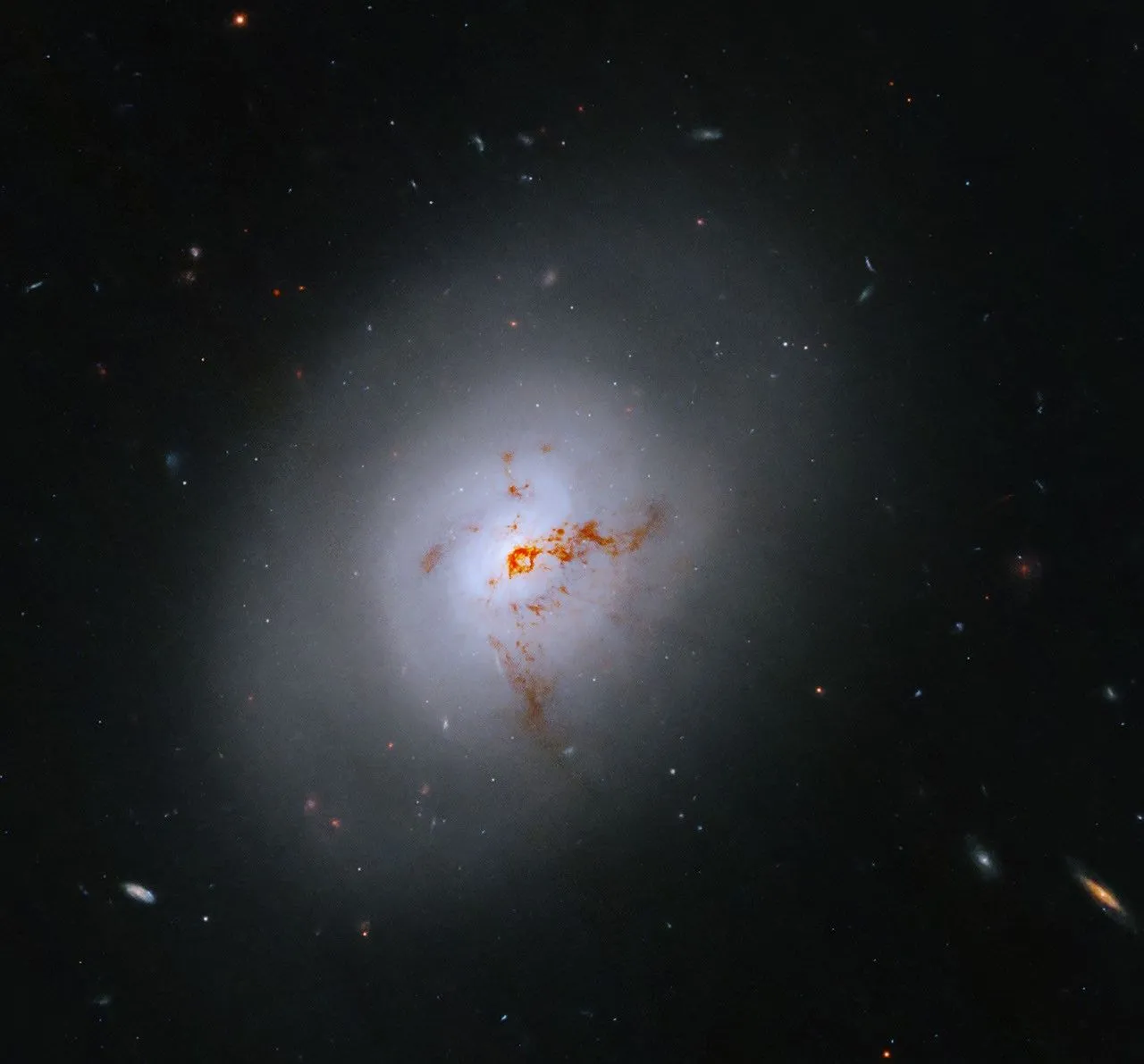
The Hubble Space Telescope has captured a new image of NGC 1266 — a galaxy that at first glance resembles an ordinary spiral, but is not one at all. The galaxy sits about 100 million light-years away, in the constellation Eridanus.
The image shows a bright center surrounded by reddish-brown clumps and filaments of dust, through which the light of distant background galaxies shines. The structure hints at spiral arms, yet NGC 1266 has no true arms at all — and that's exactly what makes it worth a closer look.
A lens-shaped galaxy without arms
Astronomers classify NGC 1266 as a lenticular galaxy — a type considered an evolutionary bridge between spirals and ellipticals.
From spiral galaxies, lenticulars inherited a bright central bulge and a flattened disk. But they lack the arms typical of spirals, and, like ellipticals, show little to no active star formation.
This transitional shape alone would make NGC 1266 scientifically interesting. But its defining feature lies elsewhere.
A rare post-starburst phase
NGC 1266 belongs to a rare class of post-starburst galaxies — ones that have already gone through an intense phase of star formation but haven't yet fully settled into a quiet elliptical state. Only about one percent of galaxies in the local universe fall into this category.
Post-starburst galaxies carry a relatively young stellar population, yet have almost no active star-forming regions left. It's essentially a snapshot of a galaxy caught mid-transition between two states.
Astronomers trace the cause to an event roughly 500 million years ago, when NGC 1266 likely underwent a minor merger with another galaxy.
That merger triggered a burst of new star formation and increased the mass of the galaxy's central bulge, while funneling a large amount of gas toward the supermassive black hole at its core, making it considerably more active.
A black hole regulating star birth
The inflow of matter turned the galaxy's nucleus into an active galactic nucleus (AGN) — a region around a supermassive black hole that radiates energy intensely. The black hole's heightened activity generated powerful jets and winds of gas along its rotation axis.
Over time, both the starburst itself and the black hole's jets depleted the galaxy's reserves of star-forming gas. Turbulence generated by these processes further prevents any remaining gas from condensing into new stars.
Observations by Hubble and other observatories show a strong outflow of gas from the galaxy, with the space between its stars appearing shocked or highly disturbed. Researchers found that surviving stellar nurseries exist only in the galaxy's core, with virtually no star formation happening beyond it.
This suggests the supermassive black hole may be suppressing star birth by stripping or ejecting star-forming gas from the galaxy. Shockwaves from this process create turbulence that disturbs the surrounding gas and dust enough to stop any remaining matter from gravitationally collapsing into infant stars.
Post-starburst galaxies like NGC 1266 serve as ideal natural laboratories for studying the complex physical processes that suppress star formation. They help astronomers better understand galaxy evolution and how supermassive black holes shape their host galaxies.