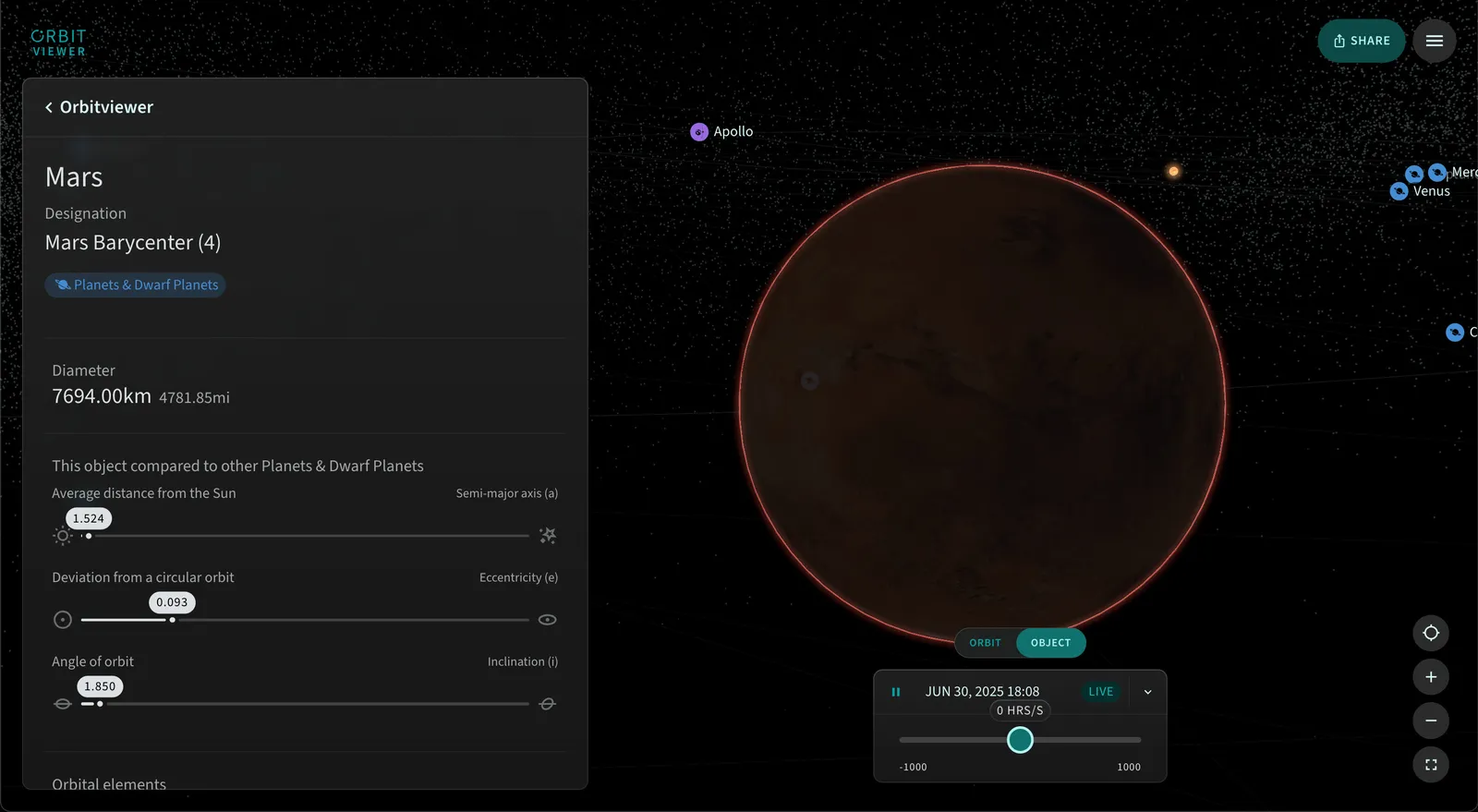
Orbitviewer is a 3D map of the Solar System from the Vera C. Rubin Observatory, built on real orbits processed by the Minor Planet Center. Planets, asteroids, comets, trans-Neptunian objects — up to a million objects at once if your computer can handle it (there's a lighter 16,000-object mode for phones). But the point isn't the count — it's what you can do with it. Here's the route.
Step one: see the swarm
Just open the site and let the scene load. What looks like fog around the Sun is tens of thousands of real asteroids, each with its own measured orbit. Spin the scene, zoom into the main belt between Mars and Jupiter. In the performance settings you can crank the object count up — and see just how "empty" space really is.
Step two: Friday the 13th, 2029
Search for Apophis. It's an asteroid over three hundred meters wide, and on Friday, April 13, 2029, it will pass roughly 31,000 kilometers from Earth — closer than geostationary satellites fly. An impact is ruled out — that's been verified many times over — but the sight will be historic: an asteroid this size hasn't come so close since long before telescopes existed. Drag the time slider to April 2029 and watch the flyby: the orbits of Earth and Apophis close in on screen until they nearly touch.
Step three: interstellar visitors
The object filters have a separate category — interstellar. There are three so far: 1I/'Oumuamua, 2I/Borisov and 3I/ATLAS. These are bodies that arrived from other star systems: their orbits aren't ellipses but open hyperbolas — they pass through the Solar System once, and forever. On the map you spot them instantly: among a million closed loops, three through-going trajectories.
Step four: watch the map grow
The interface has a discovery counter that updates as the Rubin Observatory finds new objects. And it finds them at industrial scale: in its first ~10 hours of observations — 2,104 new asteroids. In its first year, Rubin is expected to discover more Solar System objects than all the world's observatories combined over the previous 150 years. Every new dot on this map is a body humanity has only just learned exists.
Runs in the browser, mobile-friendly, no sign-up needed.