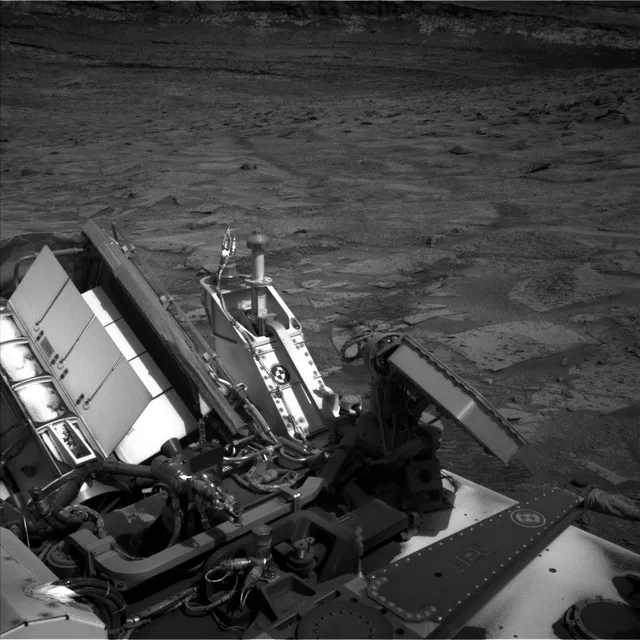
NASA's Perseverance rover continues exploring beyond the rim of Jezero Crater and has just taken a self-portrait at the westernmost point of its route after more than five years on Mars. This marks the rover's sixth selfie since landing in February 2021, and it captures not only the rover itself but the fresh trace of its recent work — a circular abrasion patch on a rocky outcrop nicknamed Arethusa.
The image was taken on March 11, 2026, the mission's 1,797th Martian day, or sol, at a location the team calls Lac de Charmes. This area lies beyond the northern rim of Jezero Crater, reached during the mission's fifth science campaign, the Northern Rim Campaign. According to project scientist Katie Stack Morgan, the rover was sitting in the "Wild West" beyond the crater rim — the farthest west point since landing in Jezero more than five years ago.
How a Martian selfie comes together
The self-portrait was assembled from 61 individual images captured by the WATSON camera (Wide Angle Topographic Sensor for Operations and eNgineering), mounted at the end of the rover's robotic arm.
To build the composite image, the arm performed 62 precision movements over roughly one hour. The camera was successively aimed at different targets — the rocky outcrop beneath the rover, the rover's own body, and the crater rim on the horizon.
That sequencing is why the animated selfie appears to show the rover first looking down at the rock, then lifting its "gaze" straight into the camera.
Arethusa: a window into Mars' ancient crust
Before the photo session, Perseverance performed an abrasion — grinding away the outer layer of rock to expose fresh material beneath the weathered surface. The target was the Arethusa outcrop.
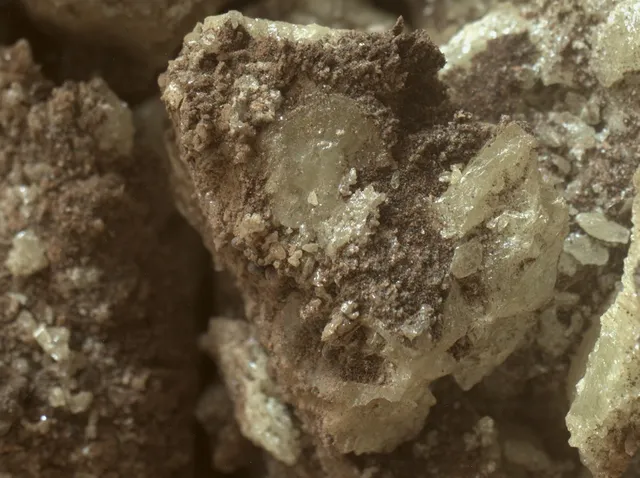
Analysis revealed the rock is composed of igneous minerals likely older than Jezero Crater itself. Igneous rocks with large mineral crystals form underground as molten rock cools slowly.
Unlike the delta's sedimentary rocks studied earlier in the mission, this site offers a window into the planet's deep ancient crust — rock roughly 4 billion years old. Findings include extrusive igneous rocks (lava that hardened on the surface) and impactites, rocks altered by meteorite strikes.
Megabreccia and a possible volcanic dike
On April 5, sol 1882 of the mission, the Mastcam-Z camera captured a panorama of the Arbot area — a mosaic of 46 images the team describes as one of the richest geological vistas of the entire mission.
The panorama reveals possible megabreccia — giant rock fragments, some skyscraper-sized, hurled by a massive meteorite impact on the plain Isidis Planitia roughly 3.9 billion years ago. The team also spotted a feature resembling a volcanic dike — a vertical intrusion of magma that hardened in place and remained standing after the softer surrounding rock eroded away over billions of years.
What I see in this image is excellent exposure of likely the oldest rocks we are going to investigate during this mission. There is a sharp ridgeline visible in the mosaic whose jagged, angular texture contrasts starkly with the rounded boulders in the foreground. We also see a feature that may be a volcanic dikeKen Farley, Perseverance deputy project scientist, Caltech
Toward Gardevarri, closing in on marathon distance
After studying Arethusa, the rover drove northwest to Arbot, where it continues analyzing rocky outcrops. The team next plans to send Perseverance south to a site called Gardevarri, which features a notably clear exposure of olivine-bearing rocks — minerals formed in cooling magma that can reveal details of Mars' volcanic history. From there, the route heads southeast toward an area called Singing Canyon, where the team hopes to gather more insight into the planet's early crust.
After more than five years of surface operations, Perseverance has abraded 62 rocks, collected 27 rock cores in its sample tubes (25 sealed, 2 unsealed), and traveled almost 42 kilometers — just shy of marathon distance (42.195 km).
According to acting project manager Steve Lee, the team always knew Perseverance's mission was a marathon, not a sprint. The rover has nearly reached that distance and, despite the dust visible on its body in the selfie, remains in excellent shape to continue exploring.