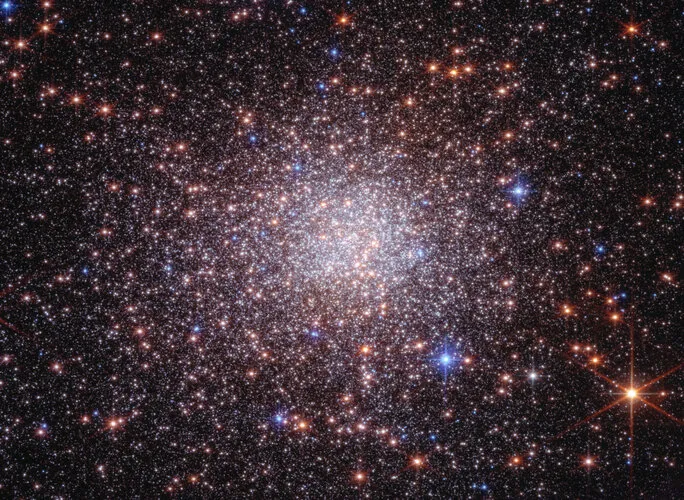
At the very center of the Milky Way, within the bulge — a dense, spherical region of old stars — sits an object called Terzan 5. Astronomer Azop Terzan discovered it in 1968, and for nearly half a century it was classified as an ordinary globular cluster: a group of stars born together from a single cloud of gas billions of years ago.
New research combining observations from the Webb and Hubble telescopes shows that Terzan 5 is something far rarer. It is not merely a cluster, but a surviving fragment of the Milky Way's primordial structure that kept its separate identity even as the bulge formed around it.
Two telescopes, one puzzle
Terzan 5 sits in a region of sky crowded with stars and thick with dust, which is why it resisted detailed study for so long.
Webb observes in infrared light, which let it pierce that dust and catch even faint stars in the cluster. This allowed the team to measure the color and brightness of nearly every star in the field of view — both genuine members of Terzan 5 and unrelated foreground stars from the bulge.
Separating the two required Hubble. Images of this region were taken over 12 years, long enough to detect the tiny apparent shifts of individual stars across the sky, known as proper motion. Stars moving together as one group are the true members of the cluster.
Four generations instead of one
A classic globular cluster contains a single generation of stars, all born at roughly the same time. Terzan 5 is different.
Back in 2009, astronomers found two distinct stellar populations here. In 2016, Hubble provided the first age estimates: one population formed about 12 billion years ago, as the Milky Way itself was assembling, the other roughly 5 billion years ago.
New Webb data, cross-referenced with Hubble's archive, refined these numbers and revealed two more generations. The cluster now shows four separate episodes of star formation: 12.5, 4.7, 3.8, and 2.5 billion years ago.
Two generations could still be explained by a collision with another gas cloud that triggered a second burst of star formation. Four distinct generations rule that scenario out.
Webb's new near-infrared observations, cross-referenced with Hubble's archival observations, have given us a much clearer picture of the history of Terzan 5.Giorgia Zullo, University of Bologna
Why the gas never escaped
The puzzle is where Terzan 5 kept finding raw material for new stars. When massive stars explode as supernovae, they eject heavy elements along with leftover gas and dust. In most clusters, this material simply disperses — supernova explosions carry enough energy to push it out of the system entirely.
Terzan 5 turned out to be massive enough to hold onto that ejected material with its own gravity. Instead of escaping, the gas became building blocks for the next generation of stars. Measurements of stellar composition made at the Keck Observatory and the Very Large Telescope confirm this: each generation contains progressively more heavy elements, effectively a fossil record of successive enrichment by supernovae.
A bulge fossil fragment
Current models suggest galactic bulges formed from separate clumps of gas born within the disks of young galaxies. These clumps migrated toward the center and merged there. Most of them dissolved in the process, blending into a single, well-mixed bulge structure.
Terzan 5 is an exception. It retained enough mass and cohesion to avoid merging with the rest, surviving to the present day in a nearly unchanged state. Astronomers have proposed a new term for such objects: a "bulge fossil fragment."
So far, only one other known object fits this description — Liller 1, a cluster that also contains multiple stellar generations and was previously classified as globular. A team led by Francesco Ferraro plans to examine 40 to 50 more clusters orbiting within the bulge to determine how many of them are, in fact, fossil fragments rather than true globular clusters.
The implications reach beyond the Milky Way. Webb has already found examples of "clumpy" galaxies in the early Universe, including the Firefly Sparkle galaxy, where star formation also proceeds in separate gas clumps. If Terzan 5 is indeed the remnant of such a clump, it may offer direct evidence for how the central bulges of galaxies formed throughout the Universe.