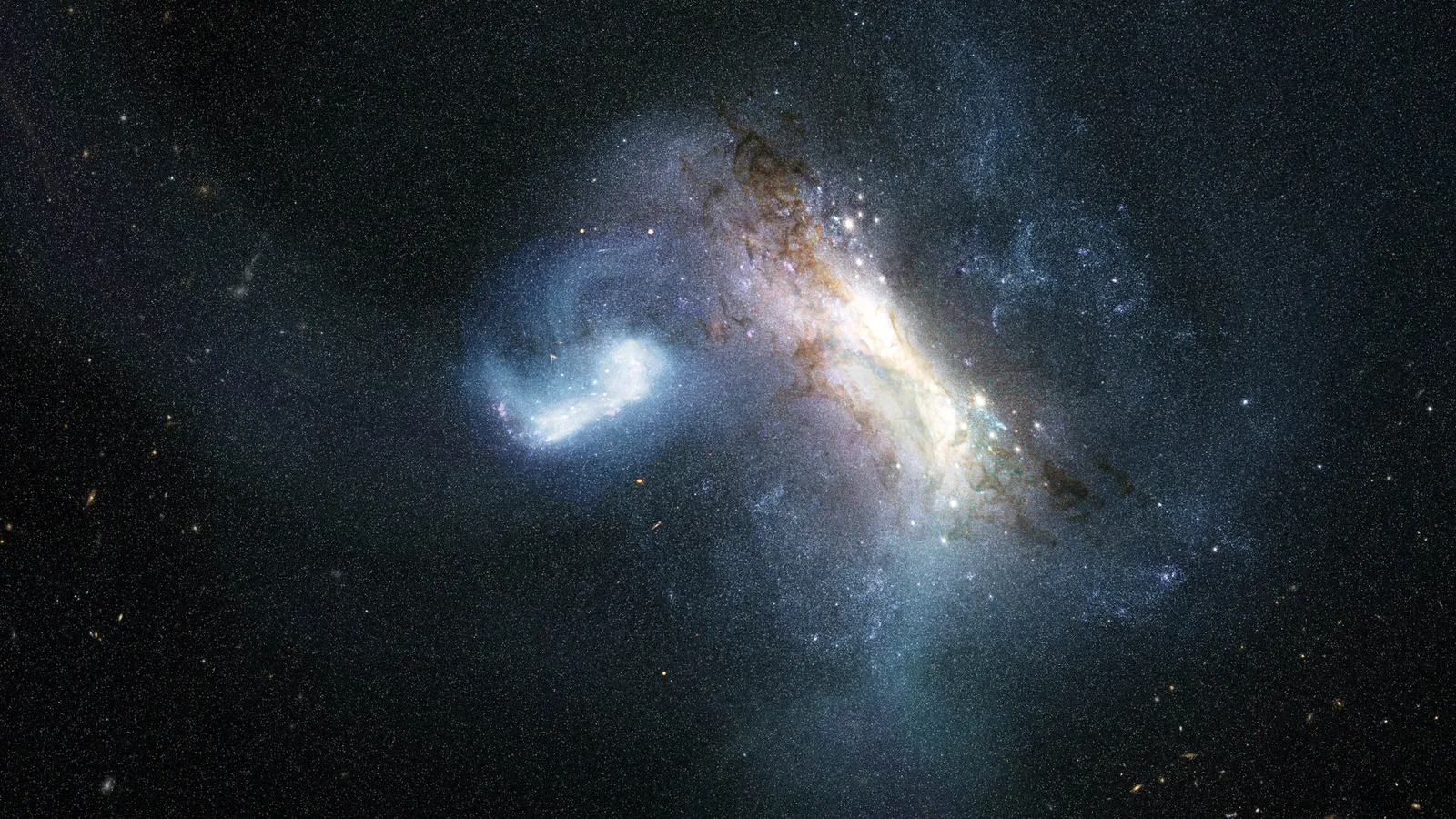
The Milky Way, our home galaxy, has never been a static structure. It grew not only by forming new stars from gas clouds, but by devouring smaller galaxies — along with their stars, gas and dark matter. The most famous of these episodes is the ongoing merger with the Sagittarius dwarf galaxy, which began more than 6 billion years ago and continues today. Earlier still, around 10 billion years ago, the Milky Way absorbed a galaxy called Gaia-Sausage-Enceladus, an event that reshaped the structure of our galaxy's stellar disc.
But that wasn't the earliest chapter. Observations and simulations had long hinted at an even bigger merger that preceded both of these events, though its details remained heavily debated. A new study led by Davide Massari of the Astrophysics and Space Science Observatory of Bologna, built on data from the Hubble Space Telescope and ESA's Gaia mission, now gives that ancient event a clear shape. The merger happened roughly 11.8 billion years ago — just 2 billion years after the Big Bang, and 1.8 billion years earlier than anything confirmed before.
Globular clusters as archaeological layers
The farther back researchers try to look, the harder it becomes to reconstruct events. The young Milky Way was much smaller and closer in size to the galaxies it collided with. It was also more chaotic, and traces of ancient mergers may have been erased over billions of years.
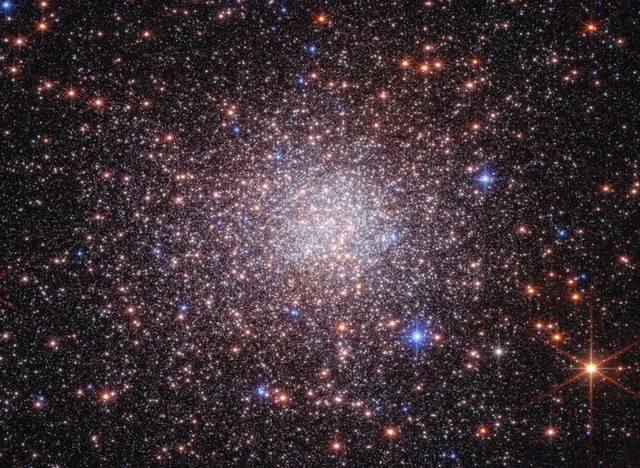
It's into this murky past that Hubble peered, focusing on globular clusters — dense, roughly spherical collections of tens of thousands to millions of stars. These clusters hold some of the galaxy's oldest stars and can preserve the imprint of stars gathered from other galaxies throughout the Milky Way's history.
The team analysed Hubble observations of 39 globular clusters within the inner 20,000 light-years of our galaxy, where traces of the earliest mergers should be preserved. Initially, researchers expected to find only two groups: clusters born within the young Milky Way itself, and those collected from the Gaia-Sausage-Enceladus merger about 10 billion years ago.
Thanks to the high resolution and depth of Hubble imaging, we could measure the age and the metal content of these clusters with unprecedented precision. Coupled with measurements from Gaia, this made it possible to distinguish a population of globular clusters that are different from the others. These are the clusters that were born in LKH, and they tell us when that galaxy was devoured by ours, and how massive it wasChiara Zerbinati, University of Bologna
A third population and the dwarf galaxy LKH
Precise measurements of age and metallicity — the abundance of elements heavier than helium — revealed a distinct third group of globular clusters. This group is older than clusters gained from Gaia-Sausage-Enceladus, but younger than clusters born directly within the Milky Way, regardless of their metal content. That intermediate age points to a separate and earlier merger event.
The galaxy behind these clusters was named Low-energy-Kraken-Heracles, or LKH, honouring three earlier papers that argued for such an early merger. The team estimates LKH held roughly 500 million solar masses worth of stars — a significant fraction of the Milky Way's total mass at that early stage of its development.
A merger of this scale, occurring so early in the galaxy's formation, has real implications for how we understand the Milky Way's assembly.
What this changes
Some earlier studies argued that the earliest phases of the Milky Way's evolution were shaped only by stars born within the galaxy itself, without meaningful outside contribution. The new work shows the opposite: stars born in external galaxies played a notable role from the very first stages of our galaxy's formation.
The team isn't stopping with LKH. Researchers plan to continue studying globular clusters, including ones never examined in detail before, to reconstruct a complete timeline of the major mergers across the Milky Way's history.
Hubble is observing globular clusters that have never been studied before, and this will help us characterise the merger events that are far back in time in the Milky Way galaxy's historyFernando Aguado-Agelet, University of Vigo and University of La Laguna
The story of our galactic home turns out to be more complicated than it seemed just a few years ago. And judging by the team's plans, this is far from the final chapter.