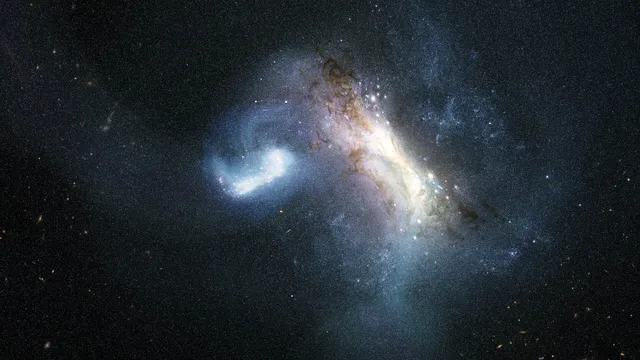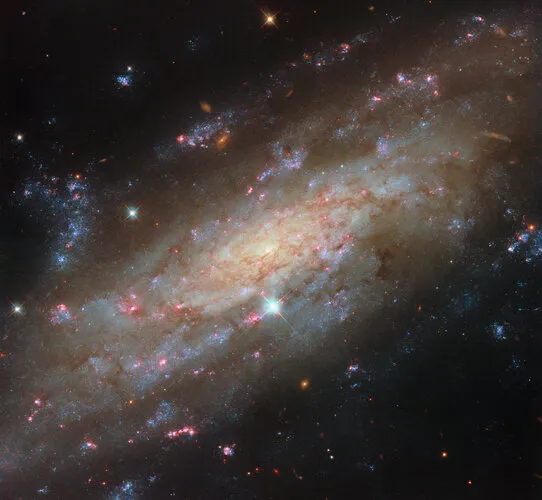
The Hubble Space Telescope has delivered a new image of the spiral galaxy NGC 3137, located in the constellation Antlia (The Air Pump). It sits 53 million light-years from Earth — practically next door by cosmic standards. That proximity makes NGC 3137 a convenient target for studying how stars are born and fade within spiral disks.
The image comes from an observing programme covering 55 nearby galaxies. Its goal is to trace the full life cycle of star clusters, from their earliest formation stages to the ancient populations that emerged in the early years of their host galaxies. NGC 3137 was not chosen at random — it belongs to a galaxy group that closely resembles our own cosmic neighborhood.
The NGC 3175 group as a mirror of our galactic home
NGC 3137 travels through space together with the NGC 3175 galaxy group, which astronomers consider an analogue of the Local Group — the very cluster of galaxies that includes the Milky Way.
The resemblance is structural. Like the Local Group, the NGC 3175 group contains two large spiral galaxies. Here, the roles played by the Milky Way and Andromeda belong to NGC 3137 and NGC 3175, which Hubble has also observed. A collection of smaller dwarf galaxies orbits around these two giants.
The exact number of dwarf galaxies in the NGC 3175 group remains unknown. Researchers have already identified more than 500 candidates, though the final count is still being refined. By studying the dynamics of this neighboring system, astronomers gain an additional reference point for understanding how the Local Group itself — including the Milky Way — is structured and evolves.
A black hole and dust clouds at the galaxy's core
The image was assembled from observations across six different color bands, revealing several layers of the galaxy's structure at once.
At the center of NGC 3137 lies a black hole estimated at roughly 60 million solar masses. It is encircled by a network of fine dust clouds that give the galaxy's core its hazy appearance.
NGC 3137 is seen from a highly inclined angle. This perspective offers a unique view of its loose, feathery spiral structure — less sharply defined than in some classic spiral galaxies, but rich in intertwined detail. The image also captures a few foreground Milky Way stars that happened to photobomb the shot, along with a scattering of far more distant background galaxies.
Star clusters as a key to galactic life
The true stars of the image are the clusters scattered across the disk of NGC 3137. The disk appears yellowish near the center, where older, cooler stars dominate, and turns bluer toward the outskirts, where younger, hotter stars are concentrated.
Among them stand out dense clusters of bright blue stars and glowing pink-red gas clouds. These mark regions of active star formation, where hot young stars remain wrapped in the nebulae that gave birth to them.
These clusters are precisely what drew Hubble's attention through observing programme #17502, led by D. Thilker. Researchers are studying them across 55 galaxies to compare different stages of stellar life — from stars still in the process of forming to the ancient stellar populations that grew up in the early years of their host galaxies. With its favorable tilt and rich population of clusters, NGC 3137 has become one of the most informative targets in this survey.