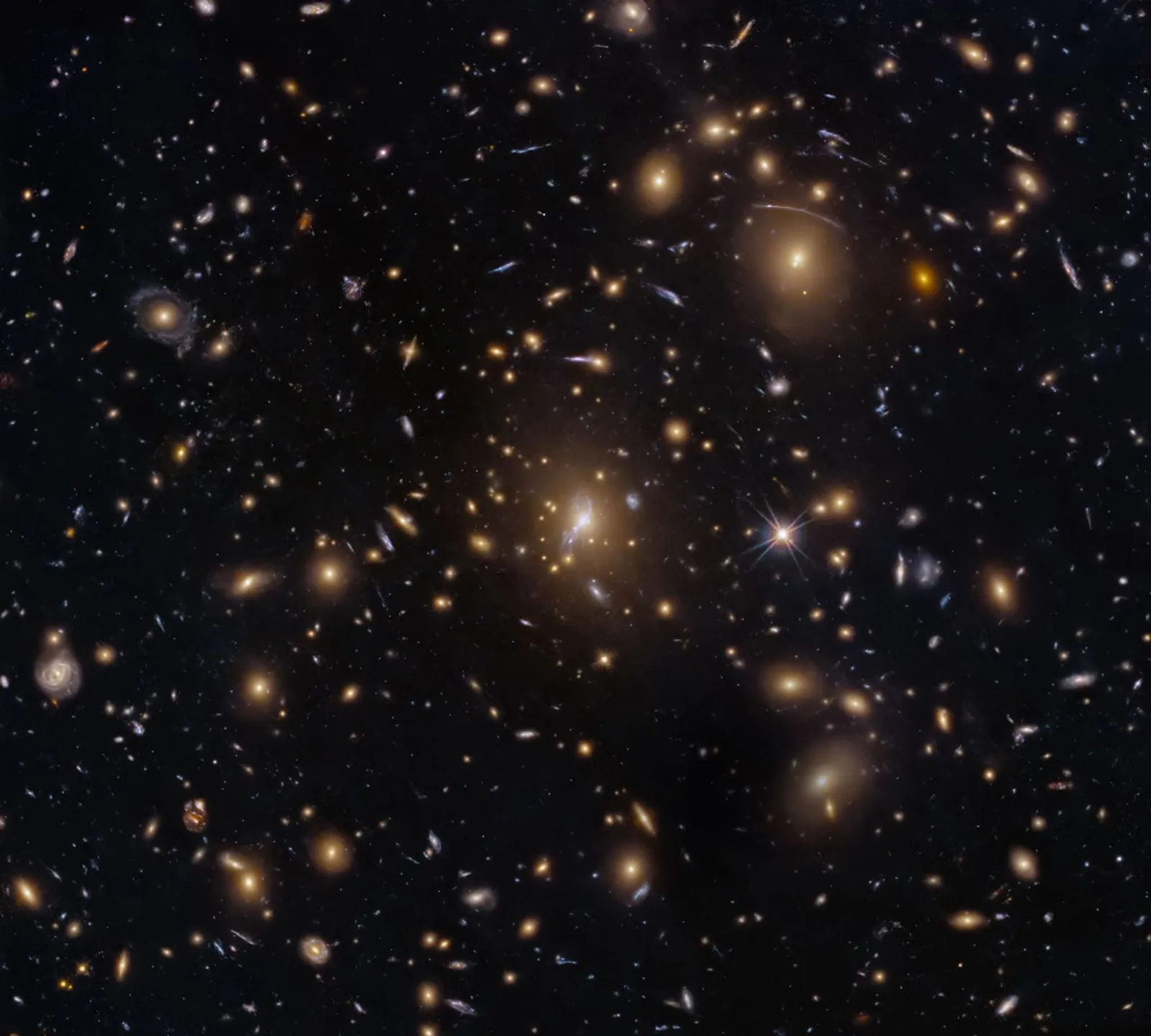
A new Hubble Space Telescope image captures galaxy cluster MACS0329-0211 — dozens of galaxies gathered in a single frame, resembling a swarm of bees returning to their hive. This is more than a snapshot of a random patch of sky: clusters of this scale serve as key markers for understanding how the universe's large-scale structure formed and evolved.
Beyond the cluster itself, the image is notable for something else — gravitational lensing, an effect that turns a massive cluster into a natural telescope capable of revealing galaxies from the earliest epochs of the cosmos.
Elliptical, lenticular, and spiral galaxies in a single frame
The image reveals a striking variety of galaxy shapes within MACS0329-0211. Large, oval-shaped elliptical galaxies stand out — older stellar systems lacking a defined arm structure.
Alongside them are thin, elongated lenticular and spiral galaxies seen edge-on. Due to the viewing angle, they appear as narrow streaks of light.
The frame also includes spiral galaxies seen face-on, their curving arms clearly visible. This mix of galaxy types within one cluster is typical of such objects and lets astronomers study how different galaxy classes coexist in a dense gravitational environment.
Arcs of light from galaxies that aren't actually there
The most intriguing part of the image sits at its edges. In the upper-right quadrant, faint curved arcs of light are visible. These aren't individual cluster members — they're images of much more distant galaxies whose light has been bent by MACS0329-0211's gravity.
This phenomenon is called gravitational lensing. The cluster's mass is so large that it warps the space-time around it, bending, stretching, and magnifying light rays from galaxies far behind it — much like a lens focuses an image.
The largest of these arcs appears above a bright elliptical galaxy in the upper part of the frame. This natural magnification lets astronomers glimpse details of objects that would otherwise be too faint and distant to observe directly.
Near the center of the image, several bright-white intersecting lines form a shape resembling a distorted figure eight. This may be another distant galaxy whose light was magnified and warped by the cluster's gravity.
Observations from a survey of X-ray bright galaxy clusters
The MACS0329-0211 image was taken as part of an observing program focused on galaxy clusters that shine brightly in X-rays. Such clusters typically contain large amounts of hot intergalactic gas and rank among the most massive structures known.
The image was assembled using Hubble's two main cameras — the Advanced Camera for Surveys (ACS) and the Wide Field Camera 3 (WFC3). Together, they gathered data in visible and infrared light.
Hubble's ability to cover such a broad spectrum of light makes it a valuable tool for understanding the nature of galaxy clusters — from mapping their mass distribution to using gravitational lensing to uncover the history of the universe's earliest galaxies.