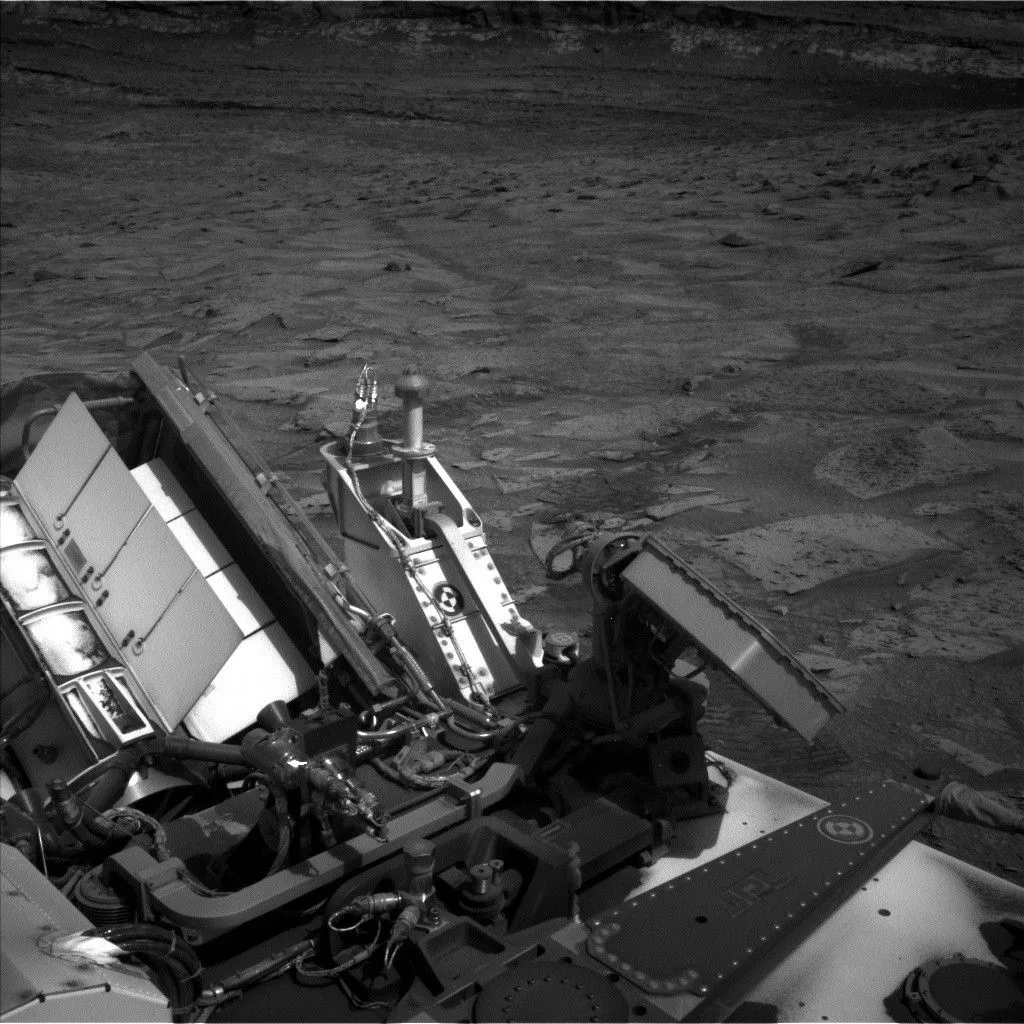
NASA's Curiosity rover has spent the past week driving toward a small crater roughly 10 meters (32 feet) across, located inside Gale Crater. The mission team has informally named it "Antofagasta," after a Chilean city on the edge of the Atacama Desert — one of Earth's driest regions and a frequent analog for Martian terrain.
Orbital images suggest the crater is less than 50 million years old, making it geologically young by Martian standards. That means rocks exposed by the impact have spent relatively little time bathed in the surface radiation that destroys organic molecules over time. This is exactly why the site has caught the team's attention: it could hold chemistry better preserved than anything Curiosity has found so far.
A Crater as Nature's Drill
Impacts from asteroids or meteorites act as a free geological tool on Mars. The blast excavates material that would otherwise remain buried, exposing rocks through crater walls and ejecta that the rover's own drill could never reach on its own.
Curiosity has already discovered hardy organic molecules that survived billions of years of Martian history. The open question is whether an even larger reservoir of complex chemistry lies deeper below, shielded from radiation until an impact brought it closer to the surface.
For Antofagasta to answer that question, several conditions need to align. The crater has to be large enough to have excavated genuinely deep rock. Its age has to check out as young, matching the orbital estimate. And among the ejected material, the team needs to find a rock confidently excavated from depth that also meets the physical requirements of Curiosity's drill.
That's a long list of "ifs," as the team itself acknowledges. But the chance to check them all in person was too compelling to drive past.
Honeycomb Textures Along the Route
The journey itself has already proven interesting. Many of the rocks Curiosity drove over are covered in a striking pattern: thousands of honeycomb-shaped polygons crisscrossing the surface across several meters.
The rover has spotted similar polygon textures before, but never quite this abundant. In Mastcam mosaics, the honeycomb pattern stretches across the ground in a continuous field rather than isolated patches.
The team collected extensive images and chemical data to help distinguish between competing hypotheses about how these textures formed. No conclusion has been reached yet — the data is still being analyzed.
Watching the Sky Before Dust Season
Alongside the geological work, Curiosity kept monitoring Mars' atmosphere. The rover searched for dust devils and imaged the horizon to characterize atmospheric haze.
It's routine but valuable work: Mars is heading into its summer months, which predictably bring increased atmospheric dust. These observations help build a consistent picture of the planet's seasonal climate changes over time.
New data from the drive should reach Earth by Tuesday morning. If everything goes as planned, Curiosity will already be parked on the rim of Antofagasta, sending back the first ground-level images of its interior.
Antofagasta could help us answer this question... but only if the crater is big enough to have excavated deep rocks, if it really is relatively young, and if we are able to find a rock we are confident was excavated from depth that also meets the physical requirements for Curiosity's drillAbigail Fraeman, Deputy Project Scientist, NASA JPL