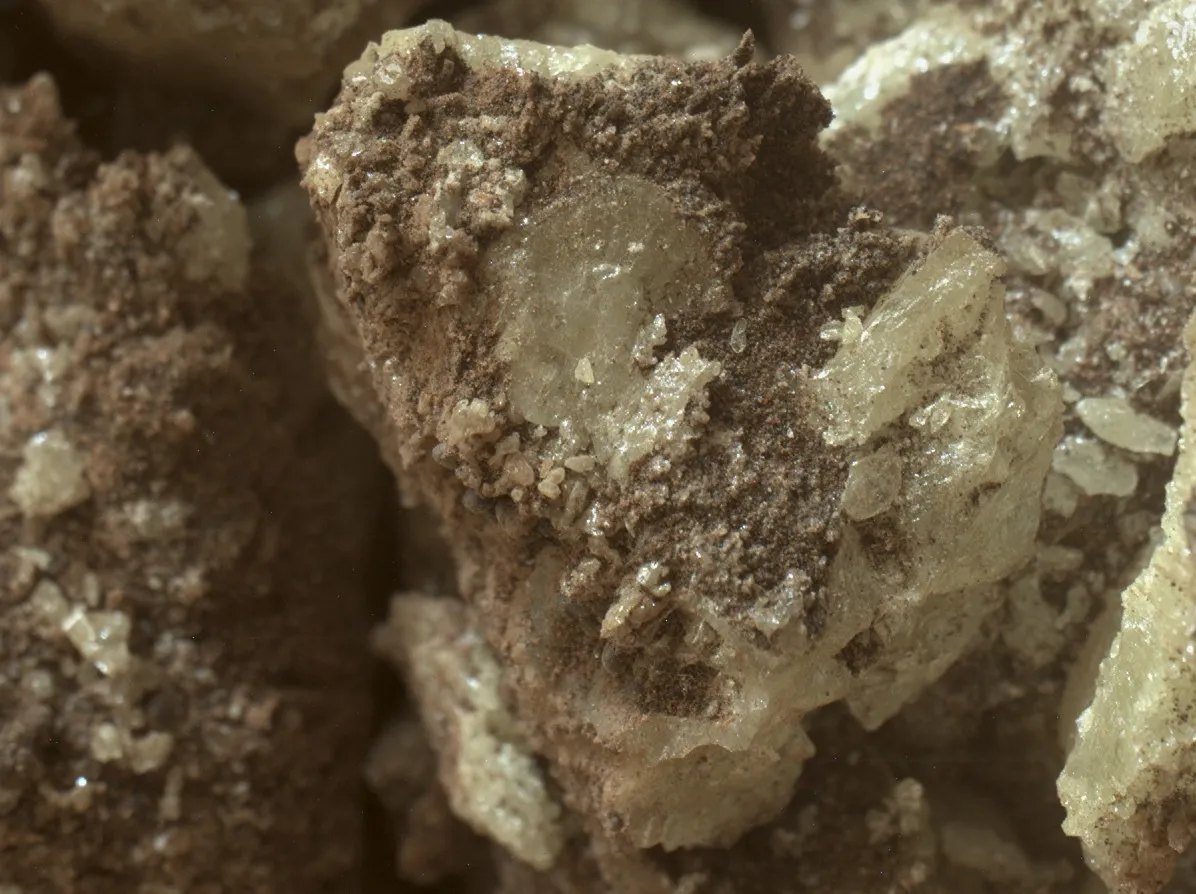
NASA's Curiosity rover has been exploring Gale Crater on Mars since 2012, searching for signs of water and past habitable conditions. On May 30, 2024, it made a discovery it wasn't looking for: the rover drove over a rock and crushed it under its own weight. Inside were crystals of pure sulfur — the first ever found in the history of Mars exploration.
The find happened by accident, and that's part of what makes it notable. Curiosity wasn't drilling or specifically analyzing the rock — it simply rolled over it while moving along its route. Several days later, the rover returned to the fragments and photographed them with a camera mounted on the end of its robotic arm.
A crushed rock reveals crystals
After the rock split open beneath the rover's wheel, scientists on Earth received an image of the fragments. The pieces show a crystalline structure — the characteristic appearance of sulfur in its pure form.
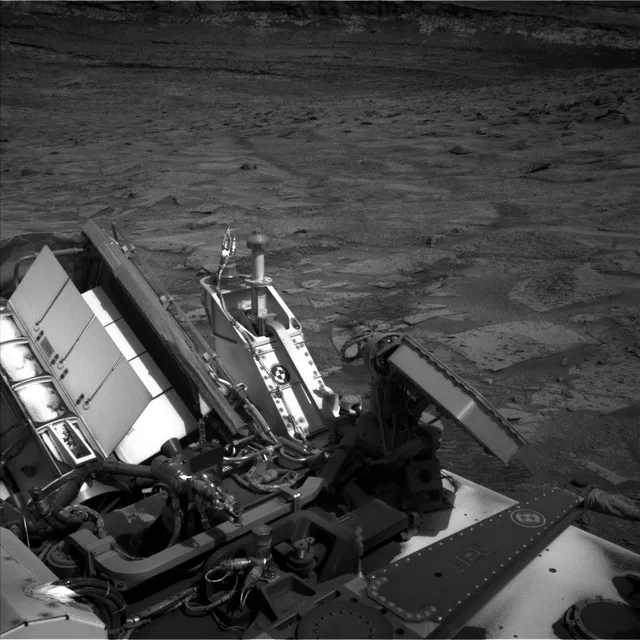
The camera on the end of Curiosity's robotic arm is designed for close-up imaging, allowing researchers to examine the texture and shape of minerals almost as if looking through a magnifying glass. That's the camera that captured the image of the sulfur crystal fragments.
Researchers emphasize this is the first time elemental sulfur — the pure chemical element rather than a compound — has been found on Mars. Earlier missions had only detected sulfur bound to other elements as part of larger minerals.
Why pure sulfur is rare on Mars
The distinction between a compound and a pure element matters a great deal to geologists. Sulfur compounds form through many chemical processes and are found relatively often on Mars. Free, elemental sulfur, on the other hand, requires specific formation conditions.
That's why the discovery drew enough attention to warrant a paper in the journal Science. The presence of pure crystals points to a particular geological mechanism that was once active on Mars.
A volcanic origin hypothesis
The authors of the Science paper offer an explanation: the crystals formed roughly 3 billion years ago. According to their proposal, magma deep beneath the surface released fluids or gases. These fluids rose toward the surface and deposited sulfur there.
This remains a hypothesis, not a settled conclusion. But it fits the broader picture of early Mars, when active geological processes tied to volcanic activity and fluid movement were still shaping the planet beneath its surface.
The discovery of pure sulfur doesn't dramatically change our picture of Mars, but it adds a concrete detail to the reconstruction of its past. It shows that processes which shaped the planet's surface billions of years ago left traces that can survive to the present day — waiting for a rover's wheel to accidentally crack open the right rock.