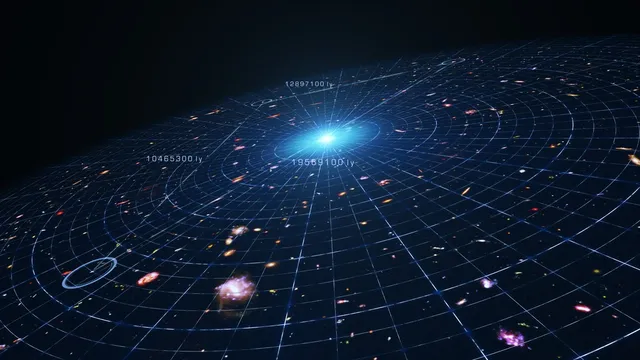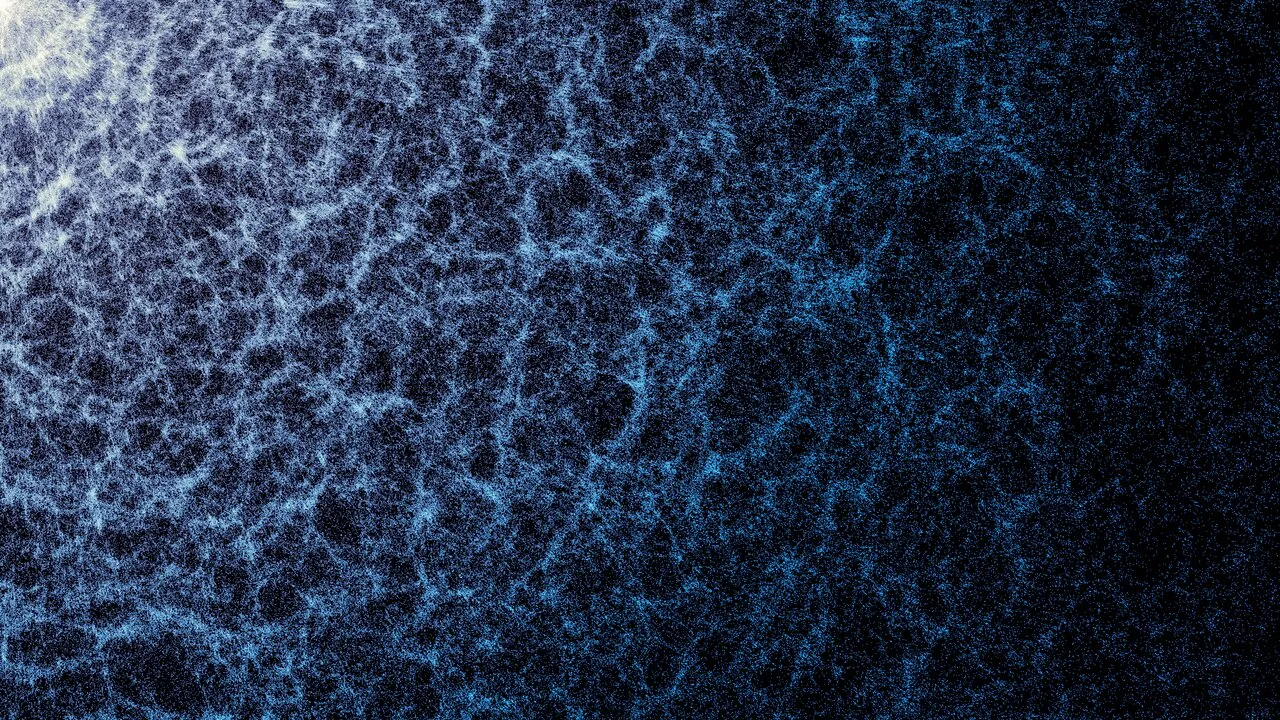
The Dark Energy Spectroscopic Instrument (DESI) has completed its five-year observation program ahead of schedule. The result is the largest high-resolution three-dimensional map of the Universe ever assembled.
The instrument sits on the 4-meter Nicholas U. Mayall Telescope at Kitt Peak National Observatory in Arizona, part of NSF NOIRLab. The project is managed by Lawrence Berkeley National Laboratory and funded by the U.S. Department of Energy Office of Science.
How 5,000 fiber-optic eyes build a map of the Universe
DESI is equipped with 5,000 fiber-optic sensors, each able to aim independently at a single object in the sky. Roughly every 20 minutes, the instrument locks onto a new patch of sky and collects light that has traveled toward Earth for billions of years.
The original plan was to capture 34 million galaxies and quasars over five years. The actual result exceeded that target: more than 47 million galaxies and quasars, plus 20 million stars — six times more cosmological data than all previous sky surveys combined.
Quasars are extremely bright yet extremely distant objects, each powered by a supermassive black hole at its core. Their brightness is what allows their light to be captured even from billions of light-years away.
Why galaxy clustering reveals dark energy
DESI's central goal is studying dark energy, the mysterious component that makes up roughly 70% of the Universe and drives its accelerating expansion.
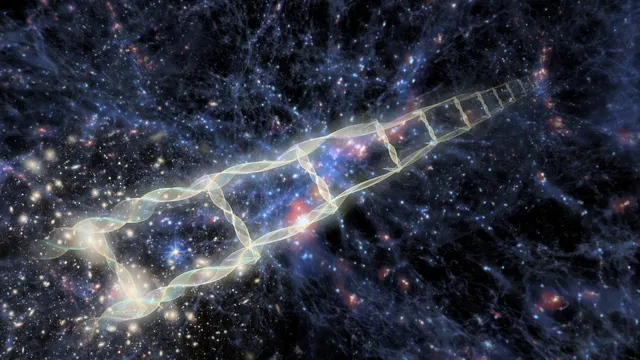
The method relies on comparison: how galaxies clustered in the past versus how they are distributed today. That difference reveals dark energy's influence across 11 billion years of cosmic history.
Analysis of the first three years of data produced an unexpected hint: dark energy might not be a fixed quantity, the so-called cosmological constant assumed for decades, but could instead evolve over time. If the full five-year dataset confirms this trend, it would reshape ideas about the Universe's ultimate fate, which depends on the balance between matter and dark energy.
After finding hints that dark energy might deviate from a constant, potentially altering that fate, this moment feels like sitting on the edge of my seat as we analyze the new map to see whether those hints will be confirmedStephanie Juneau, NOIRLab
First results from the analysis of the complete five-year dataset are expected in 2027.
A pandemic and a wildfire along the way
The path to completion wasn't smooth. In 2020, final testing of the instrument was interrupted by the COVID-19 pandemic.
In 2022, the Contreras Fire swept across Kitt Peak, where the telescope stands. Thanks to the efforts of firefighters and observatory staff, the telescope itself was not damaged, though recovery was slowed by monsoons and mudslides.
Despite these setbacks, the team finished the survey ahead of schedule, with far more data than originally expected.
The map will grow another 20% by 2028
DESI's work isn't over. Observations will continue through 2028, expanding the map's area by about 20% — from 14,000 to 17,000 square degrees of sky. For comparison, the Moon covers about 0.2 square degrees, while the full sky spans over 41,000.
The expanded map will cover regions that are harder to observe: areas closer to the plane of the Milky Way, where bright nearby stars obscure more distant objects, and more southern regions, where the telescope must look through a thicker layer of Earth's atmosphere.
The team also plans to revisit the already-surveyed area, but focus on a new set of objects: distant, faint "luminous red galaxies." This will produce a denser, more detailed map of regions already studied.
Researchers will also examine dwarf galaxies and stellar streams — bands of stars torn from smaller satellite galaxies by the Milky Way's gravity. The goal is to better understand dark matter, the invisible form of matter that makes up most of the Universe's mass but has never been directly detected.
More than 900 researchers, including 300 PhD students, from over 70 institutions worldwide contribute to the project.