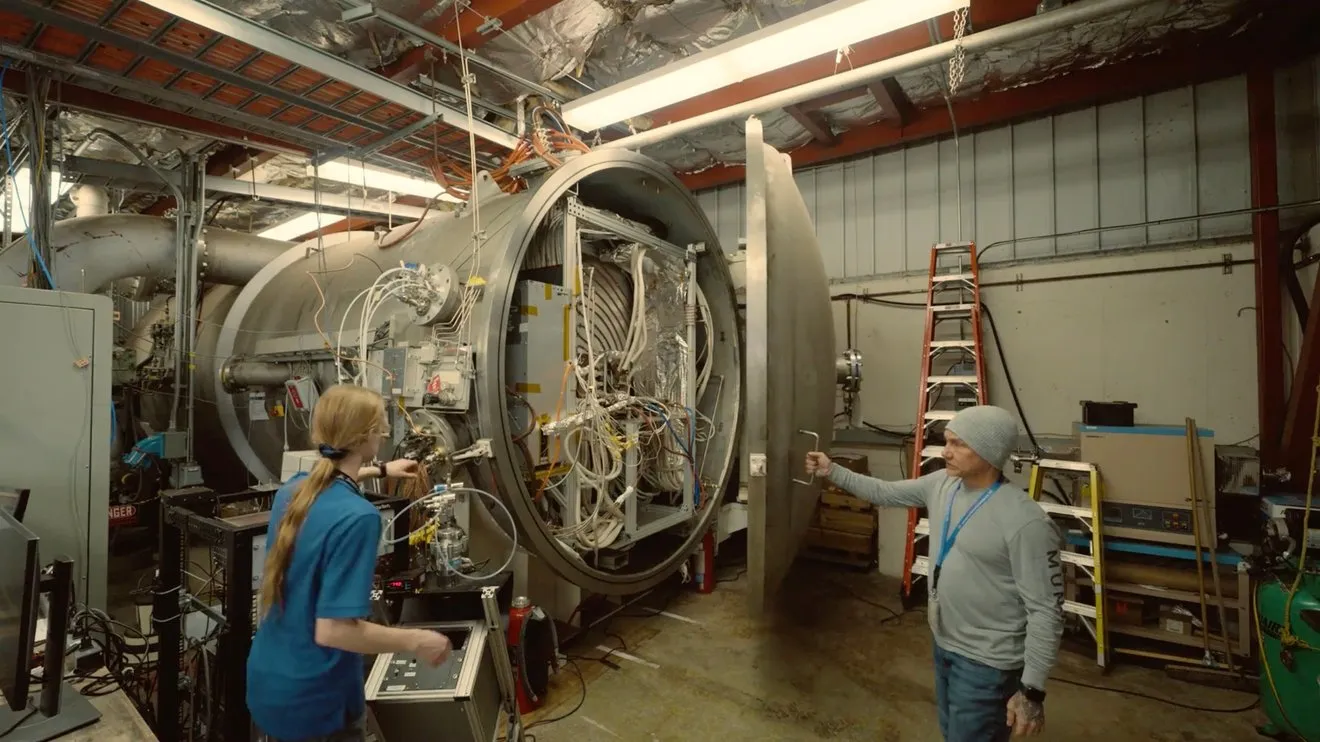
Mars remains NASA's central destination for future crewed missions, and on February 24, 2026, the agency took a step toward a new propulsion system that could get astronauts there. At the Jet Propulsion Laboratory (JPL) in Southern California, engineers fired up a prototype electromagnetic thruster running on lithium metal vapor for the first time in years. The test took place inside a specialized vacuum chamber and set a new record for electric propulsion power in the United States.
The thruster reached 120 kilowatts — the highest power level ever achieved by an electric propulsion system in the country. By comparison, NASA's Psyche spacecraft, which currently flies the most powerful electric thrusters of any agency mission, uses a system more than 25 times weaker. Data from this first firing will now inform an upcoming series of tests.
How a magnetoplasmadynamic thruster accelerates plasma
The technology is called an MPD thruster, short for magnetoplasmadynamic. Unlike conventional electric thrusters, which rely on solar power and accelerate propellant electrostatically, MPD engines work differently: high electric currents interact with a magnetic field to electromagnetically accelerate lithium plasma.
Electric propulsion in general uses up to 90% less propellant than chemical rockets. In exchange, it doesn't deliver a strong instant push but produces a gentle, continuous force. Over time, that force builds up enormous speed — Psyche's thrusters, for instance, accelerate the spacecraft to 200,000 km/h.
The MPD concept has been studied since the 1960s, but no such thruster has ever flown an actual space mission. The JPL test took place inside a specialized, water-cooled vacuum chamber roughly 8 meters long, built specifically to safely test metal-vapor thrusters at power levels reaching into the megawatt class.
Five ignitions at 2,800 degrees Celsius
During the test, the thruster was fired five times. The tungsten electrode at its center glowed white-hot, reaching temperatures above 2,800 °C, while the nozzle-shaped outer electrode emitted a bright red plasma plume.
James Polk, a senior research scientist at JPL who has studied lithium-fed MPD thrusters for decades and previously worked on the Dawn and Deep Space 1 missions, described the test as the culmination of years of preparation.
Designing and building these thrusters over the last couple of years has been a long lead-up to this first test. It's a huge moment for us because we not only showed the thruster works, but we also hit the power levels we were targetingJames Polk, JPL senior research scientist
The main challenge going forward is durability — proving the hardware can withstand such extreme temperatures over many hours of continuous operation.
How much power a Mars mission would need
The team's near-term goal is to reach 0.5 to 1 megawatt of power per thruster. That would already be a major jump from the current 120 kilowatts, but it's still an intermediate milestone.
A crewed mission to Mars, by the team's estimate, would require 2 to 4 megawatts of total power, multiple MPD thrusters operating together, and more than 23,000 hours of continuous operation. Paired with a nuclear power source, thrusters like this could significantly reduce a spacecraft's launch mass and help deliver the payloads needed for a human expedition to the Red Planet.
The project is being developed jointly by JPL, Princeton University in New Jersey, and NASA's Glenn Research Center in Cleveland. The work, underway for two and a half years, is funded by NASA's Space Nuclear Propulsion project, which since 2020 has been developing a megawatt-class nuclear electric propulsion system for human Mars missions, focusing on five critical technology elements. The electric propulsion subsystem is one of them.