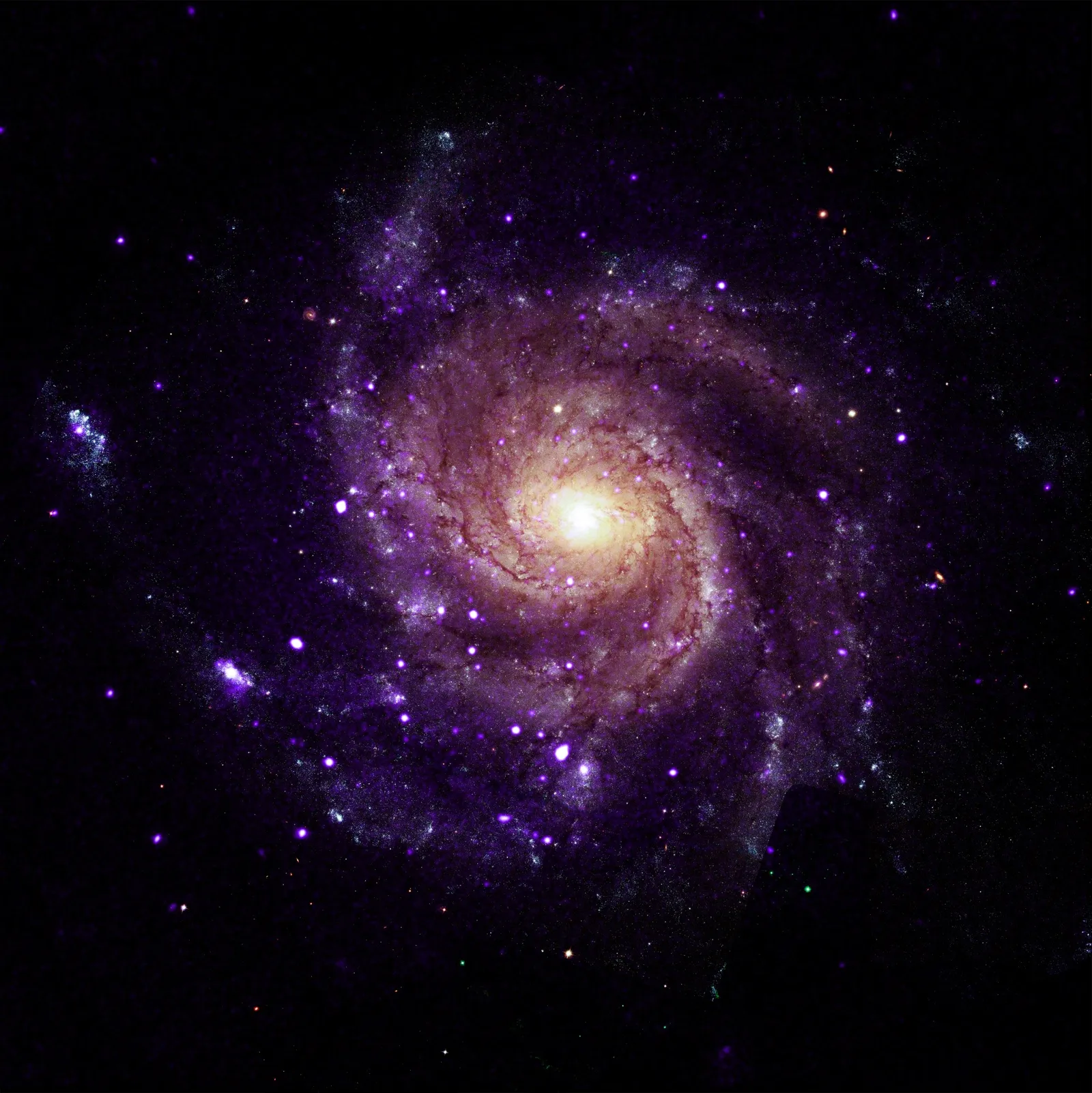
NASA's Chandra X-ray Observatory keeps delivering surprises even in well-studied corners of the sky. A new image released on September 9, 2026, shows the galaxy M101 — the Pinwheel Galaxy — combining X-ray and optical data. Behind this image is a study in which astronomers found objects with a strange combination of emission: faint, low-energy X-rays paired with intense ultraviolet radiation.
The work was led by M. Muhibullah of the University of Alabama. The X-ray data came from Chandra, while the optical image came from the Hubble Space Telescope. Combining these two datasets revealed objects that would otherwise have gone unnoticed: too faint in X-rays alone, yet too bright in ultraviolet to fit familiar categories of sources.
What Chandra's Data Revealed
Researchers analyzed X-ray emission from objects across several galaxies, including the Pinwheel. What makes this unusual is the combination of signals itself: low-energy X-ray photons typically point to relatively "cool" processes, while strong ultraviolet emission signals very hot, energetic sources. Seeing both signals at once from the same objects is not typical.
The source doesn't provide a detailed physical model for these objects or specify exactly how many were found or their precise type. What is known is that astronomers consider the finding significant: according to them, these objects could help shed light on not one but two long-standing, unresolved problems in astrophysics. Which two problems exactly, the source doesn't say.
Why the Pinwheel Galaxy Matters
M101 is one of the most famous spiral galaxies in the northern sky. It sits roughly 21 million light-years from Earth in the constellation Ursa Major and is oriented nearly face-on toward us, making it a convenient target for studying spiral arm structure, star-forming regions, and compact X-ray sources within it in detail.
Because of its relative proximity and favorable viewing angle, the Pinwheel is regularly observed with a range of instruments, from ground-based telescopes to space observatories. This isn't the first study combining Chandra and Hubble data for this galaxy, but this particular work drew attention to a new category of sources with an unusual spectral signature.
Why It Matters
X-ray astronomy traditionally helps locate the most energetic processes in the universe: supernova remnants, accretion disks around black holes and neutron stars, hot gas in galaxy clusters. Objects combining low-energy X-rays with strong ultraviolet light fall outside these familiar categories, so their nature remains an open question for now.
If the researchers' hypothesis holds up, these objects could become a link between two separate areas of astrophysical research. But for now, this remains just a hypothesis that needs confirmation. The likely next step is searching for similar objects in other galaxies and analyzing their spectra in more detail to understand what physical processes drive this unusual combination of emission.
For now, the main result is the discovery itself: in the well-studied Pinwheel Galaxy, observed dozens of times before, a class of objects previously overlooked has turned up. It's a reminder that even the most familiar patches of sky can hide details that only emerge when different types of data are carefully combined.