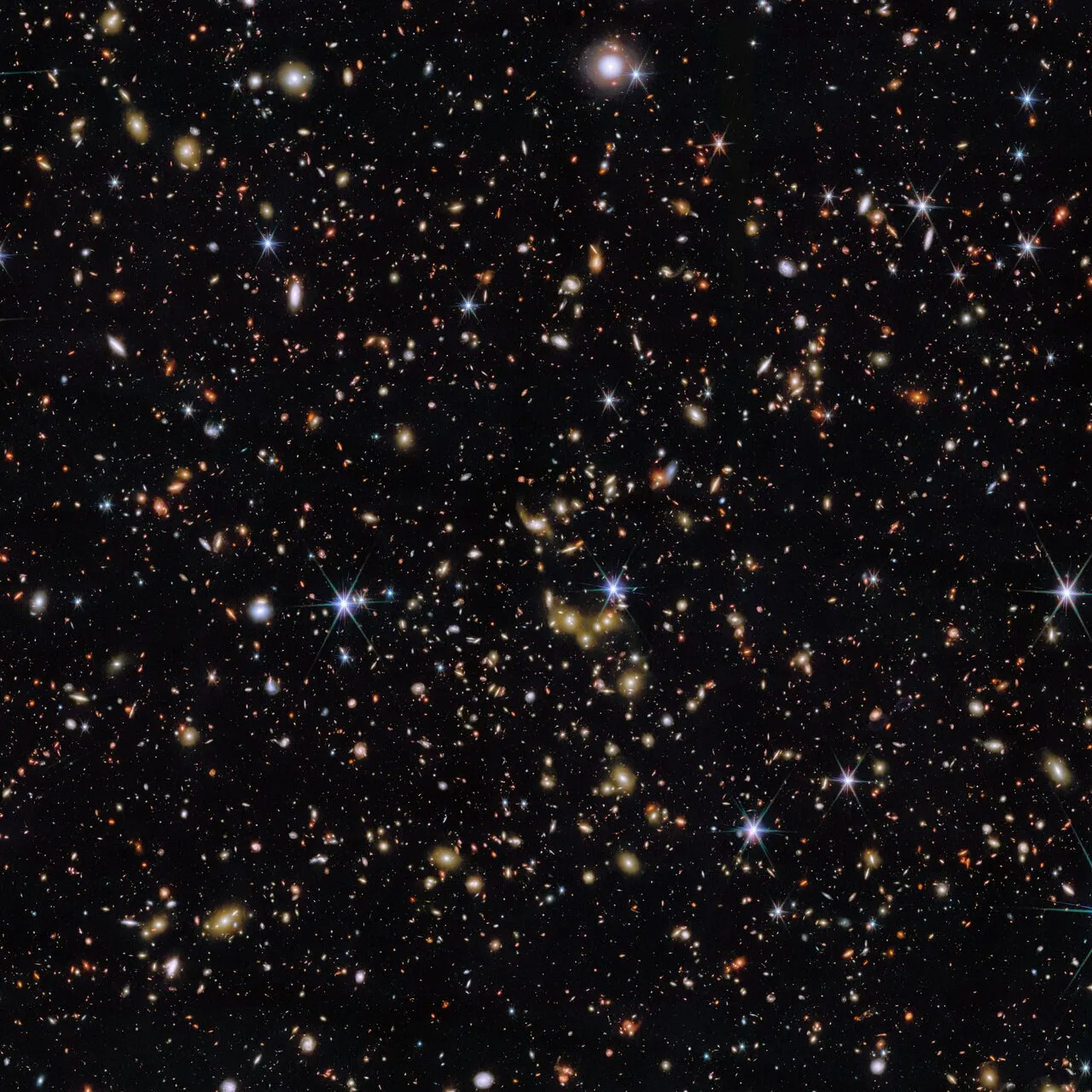
Astronomer Mingyu Li cross-matched source catalogs in the COSMOS field — one of the most thoroughly studied patches of sky — comparing radio telescope data with JWST imaging. The goal was straightforward: find objects that shine brightly in radio but stay invisible in infrared. Such a mismatch hints at distant, dust-shrouded galaxies hidden from optical and even infrared instruments. Among thousands of sources, only one object met every criterion.
That object is the sole entry in the entire catalog undetected in any JWST band, near-infrared or mid-infrared. Yet in radio it is clear and consistent, from 144 MHz on LOFAR up to 3 GHz on the VLA. The result was published in Research Notes of the AAS in March 2026.
Cross-matching catalogs as a search method
Li's work rests on a systematic comparison of radio catalogs against JWST source catalogs in COSMOS. The underlying idea builds on a long-standing hypothesis: the most powerful, most distant radio sources from the epoch of reionization should be hiding inside galaxies so thickly coated in dust that they barely emit at optical or near-infrared wavelengths.
The author checked every available image: HST, Chandra, Herschel, ALMA — none of them detected the object. Radio data remain the only window into its existence. That uniqueness is why the author calls it the "only JWST-dark radio source" in the entire field.
An unbroken spectrum points to synchrotron emission
The object is only marginally resolved — telescopes see not a sharp point but a slightly smeared blob, making its true size hard to pin down. Its radio spectrum is steep and unbroken, showing no sign of a break or absorption at lower frequencies.
That spectral shape is a classic signature of synchrotron emission: charged particles spiraling along magnetic field lines radiate across a broad range of frequencies. The absence of absorption between LOFAR and VLA frequencies means there is no dense plasma along the line of sight cutting off the low-frequency end of the spectrum.
Two competing explanations
The author lays out two possible explanations for the object's nature.
The first option is a massive galaxy from cosmic dawn, so densely wrapped in dust that even JWST — the most sensitive infrared telescope currently operating — cannot see through it. If true, this would rank among the most powerful known radio sources at such distances.
The second scenario is a detached radio lobe: a plasma jet launched by an active galactic nucleus whose host galaxy sits elsewhere in the field, physically separated from the observed radio position. In that case, the infrared non-detection has a simple explanation — there is no stellar population at that exact spot to shine, only a cloud of ejected plasma.
Distinguishing between these two scenarios is not yet possible. It would require further observations, including a search for a faint nearby source that could be the missing host galaxy.
What this means for future searches
The author stresses that the object marks a new corner of discovery space, reachable only where deep radio surveys intersect with JWST's infrared sensitivity. No previous combination of instruments has reached comparable depth in both regimes at once.
The paper itself is short — three pages in the Research Notes of the AAS format, with a single figure. It reads more like a signal to the community than a finished investigation: similar objects may exist in other survey fields, and applying the same cross-matching method systematically could turn up more candidates of this kind.