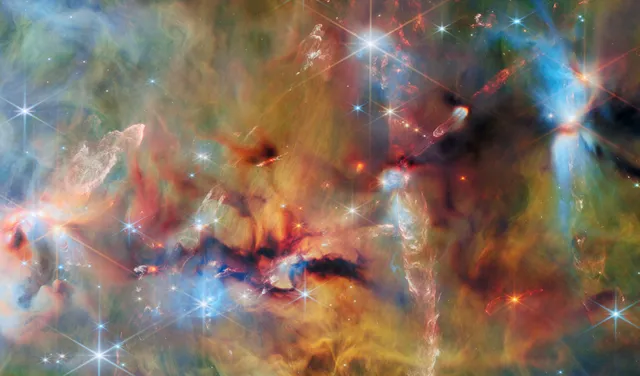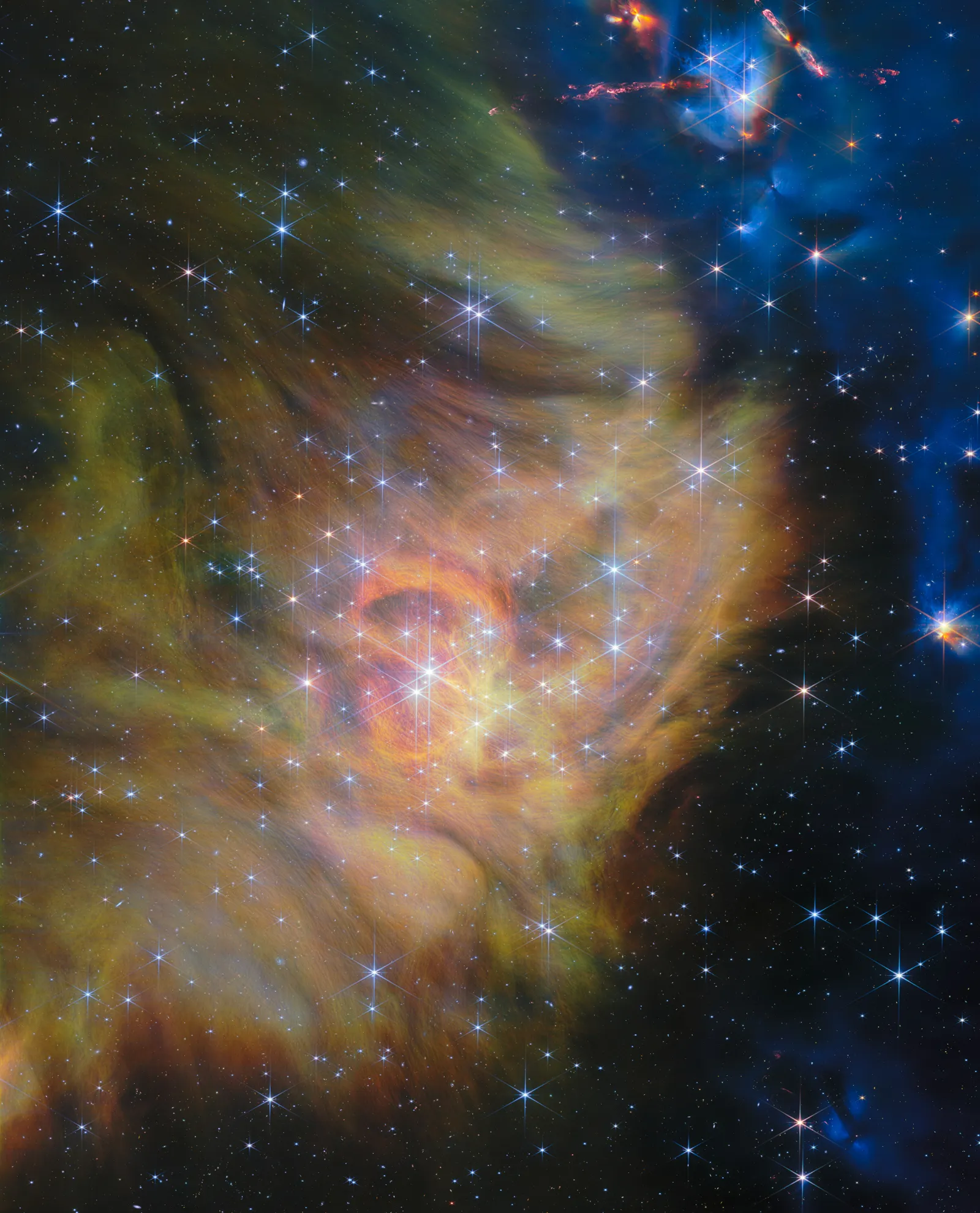
The James Webb Space Telescope has captured one of the largest images the mission has ever released to the public — a sweeping panorama of the stellar nursery IC 348 in the constellation Perseus, 1000 light-years from Earth. But the real value of this observation lies not in its scale, but in what researchers managed to spot within it: brown dwarfs with masses just twice that of Jupiter, the lightest known to science.
IC 348 is an active star-forming region. Here, cold clouds of molecular hydrogen gas collapse under their own gravity, giving birth to stars of wildly different sizes — from massive stars that live only a few million years before ending in core-collapse supernovae, to the smallest, longest-lived stars capable of powerful stellar storms.
What a brown dwarf actually is
The smallest true stars weigh in at around 8% of the Sun's mass. Below that threshold lies a distinct class of objects — brown dwarfs. They form the same way stars do, through the collapse of a molecular cloud, but their cores never get hot enough to fuse hydrogen into helium. Many briefly burn deuterium (heavy hydrogen) early in their lives, but that doesn't make them stars in the full sense.
The question driving the research was simple to ask but hard to answer: how small can an object born from the star-formation process actually get? In other words, where is the line between a brown dwarf and something closer in mass to a planet?
What the new observations found
The same research team first probed IC 348 with Webb back in 2022, discovering brown dwarfs with masses of just 3 to 4 Jupiters — already a record low at the time. The team then pushed further, searching for even smaller objects.
In 2024, astronomers used Webb's NIRCam camera to capture the warm glow of young brown dwarfs and newborn stars — the very light that forms this new image of IC 348. Candidates were selected based on their colour and brightness, and then followed up in 2025 with the NIRSpec spectrograph, an instrument provided by the European Space Agency that allows precise mass estimates from an object's spectrum.
The result exceeded expectations: brown dwarfs with masses as low as two Jupiters, or 0.19% of the Sun's mass. These are the lightest brown dwarfs known today, and their existence challenges current models of star formation — it's unclear how the collapse of a gas cloud can produce objects of such low mass.
Discs around dwarfs and a hydrocarbon signature
The observations delivered two further surprises. One of the lightest newly found brown dwarfs shows signs of a disc — meaning that around an object whose mass approaches that of a planet, planets themselves could theoretically be forming.
The second finding concerns atmospheric chemistry. In the spectra of IC 348's brown dwarfs, researchers found a feature attributed to hydrocarbons — molecules made only of hydrogen and carbon atoms. This feature had previously been seen only in the atmospheres of the lowest-mass brown dwarfs, suggesting these extreme objects might occupy a spectral class of their own.
Protostars and jets in the corner of the frame
Besides the brown dwarfs, the upper-right corner of the image holds a cluster of protostars — objects at an even earlier stage of formation. Several are accompanied by Herbig-Haro objects, glowing regions created when jets from a growing young star slam into surrounding gas and dust.
The long, narrow object oriented horizontally in that corner is HH 797, previously featured as a Webb Picture of the Month. A closer look reveals it's actually two protostars with nearly parallel outflows. Just to the right sits HH 211, a propeller-shaped source with both narrow jets and broader outflows, also showcased in an earlier image release.
Why it matters
Finding brown dwarfs as light as two Jupiter masses pushes the known lower limit of star-formation products into new territory. If such lightweight objects really do form the same way stars do — through the collapse of a molecular cloud — that demands scrutiny, and possibly revision, of theoretical models describing how small this process can go. The detected hydrocarbon signature and the disc around one of the lightest dwarfs raise further questions about the nature of objects sitting right at the boundary between stars and planets.
The data behind this study come from Webb observing programme #4866, led by principal investigators K. Luhman and C. Alves de Oliveira. The programme aims to study the lowest-mass objects created by the star-formation process, to understand how populations of planetary-mass objects like brown dwarfs vary between different star-forming regions, and to probe the origins of the hydrocarbon feature seen in the lowest-mass brown dwarfs.