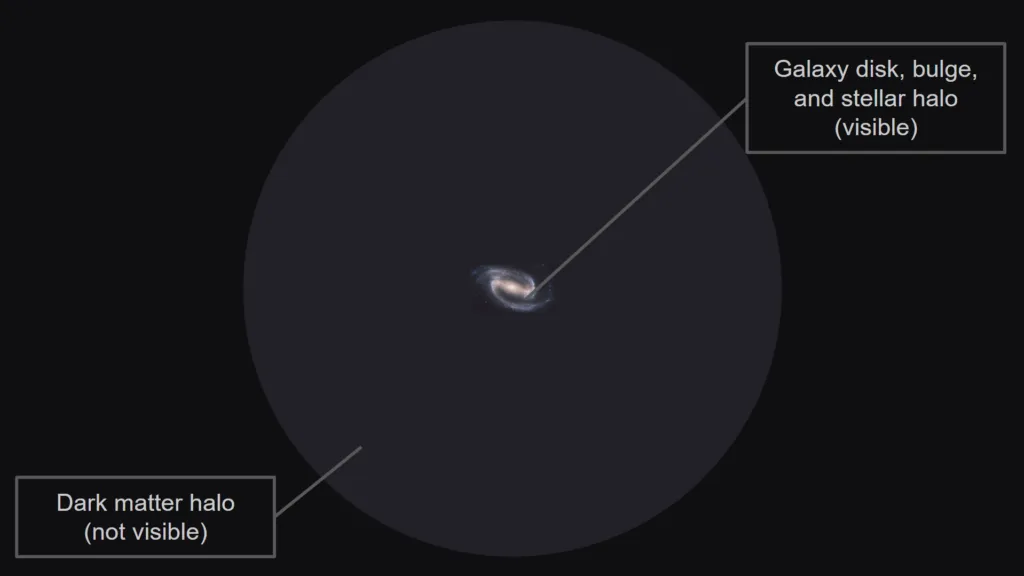
Every galaxy we see in pretty images — with bright spiral arms and dust lanes — is only the visible tip of a much larger object. Surrounding the luminous part of any galaxy is a dark matter halo, an invisible sphere that extends tens of times farther than the starry disk. Dark matter emits no light and interacts with other matter almost exclusively through gravity, but that gravitational pull is itself one of the strongest lines of evidence that dark matter exists.
A dark matter halo assembles first, and only afterward does it pull in gas. That gas cools, collapses, and eventually forms stars — giving rise to the familiar galaxy. But what if a halo isn't massive enough? In that case it can't efficiently cool the gas it captures, and stars simply never form. Galaxy formation theory predicts that such a low-mass halo could instead retain a cloud of neutral hydrogen known as a RELHIC (reionization-limited HI cloud) — essentially a "failed galaxy," sometimes also called an optically dark galaxy.
Hunting for the invisible
Since a RELHIC contains no stars, it can't be seen with ordinary optical telescopes. The only way to detect one is through radio observations, since neutral hydrogen emits at the characteristic 21-cm wavelength — the brighter this emission, the more hydrogen is present. Before this study, the most convincing RELHIC candidate was Cloud-9, discovered in 2023. Candidates are scarce, which makes the discovery of two new objects at once particularly notable.
The new candidates were detected by China's FAST telescope (Five-hundred-meter Aperture Spherical Telescope) — the same instrument that found Cloud-9. The observations targeted the area around galaxy M51, better known as the Whirlpool galaxy. In the FAST data, researchers identified six small hydrogen clouds, distinct from M51's own large gas envelope.
Three criteria, two winners
To test whether these clouds were genuine RELHICs — rather than, say, gas fragments torn away from M51 by gravity — the authors applied three criteria derived from theoretical models:
— no visible stellar counterpart (the basic definition of a RELHIC);
— a compact, regular shape (an elongated or irregular shape would more likely indicate gas violently stripped from M51's disk);
— a small spread of gas velocities within the cloud (a large velocity variation across the cloud would also suggest motion inherited from a stripping event).
The team searched for visible companions in the DESI Legacy Imaging Survey, eliminated elongated clouds using the hydrogen distribution measured by FAST, and measured velocity spread through the width of the 21-cm line (an effect known as Doppler broadening). Of the six candidates, only two — named Cloud N and Cloud S — satisfied all three requirements.
What the model comparison revealed
The authors then compared the observed hydrogen density profiles (how gas density changes with distance from the cloud's center) of Cloud N and Cloud S with theoretical RELHIC profiles. The match was good. From the best-fit model, they estimated a dark matter halo mass of roughly 3.7 billion solar masses for both clouds. The total hydrogen mass of both clouds was also consistent with RELHIC predictions.
What could complicate the picture
Despite the agreement, the authors are careful to list several factors that keep Cloud N and Cloud S from being confirmed as true RELHICs just yet.
First, the gas in Cloud N shows a fairly ordered velocity structure resembling rotation — not typical for a hypothetical RELHIC. However, comparison with a simulated population of dark galaxies showed that Cloud N isn't an obvious outlier after all.
Second, FAST's resolution isn't high enough to resolve the detailed shape of the clouds. So it remains uncertain whether Cloud N and Cloud S truly have a regular shape, or whether they're secretly elongated or irregular, like gas stripped from M51.
Third, the optical images used in the study might simply have missed a very faint stellar population within these clouds. A handful of extremely dim stars wouldn't contradict the findings, but also wouldn't be detectable in the current data.
What comes next
The authors propose follow-up observations with the VLA (Very Large Array) radio telescope, which would provide higher resolution and allow a more precise determination of the clouds' shapes. In parallel, imaging with the Hubble Space Telescope could reveal even the faintest stellar population, if one exists. For now, Cloud N and Cloud S remain only candidates for RELHIC status — twin clouds found near the galaxy M51. But if confirmed, they would offer direct evidence that low-mass dark matter halos really can stay "empty" — trapping gas without ever lighting up a single star.