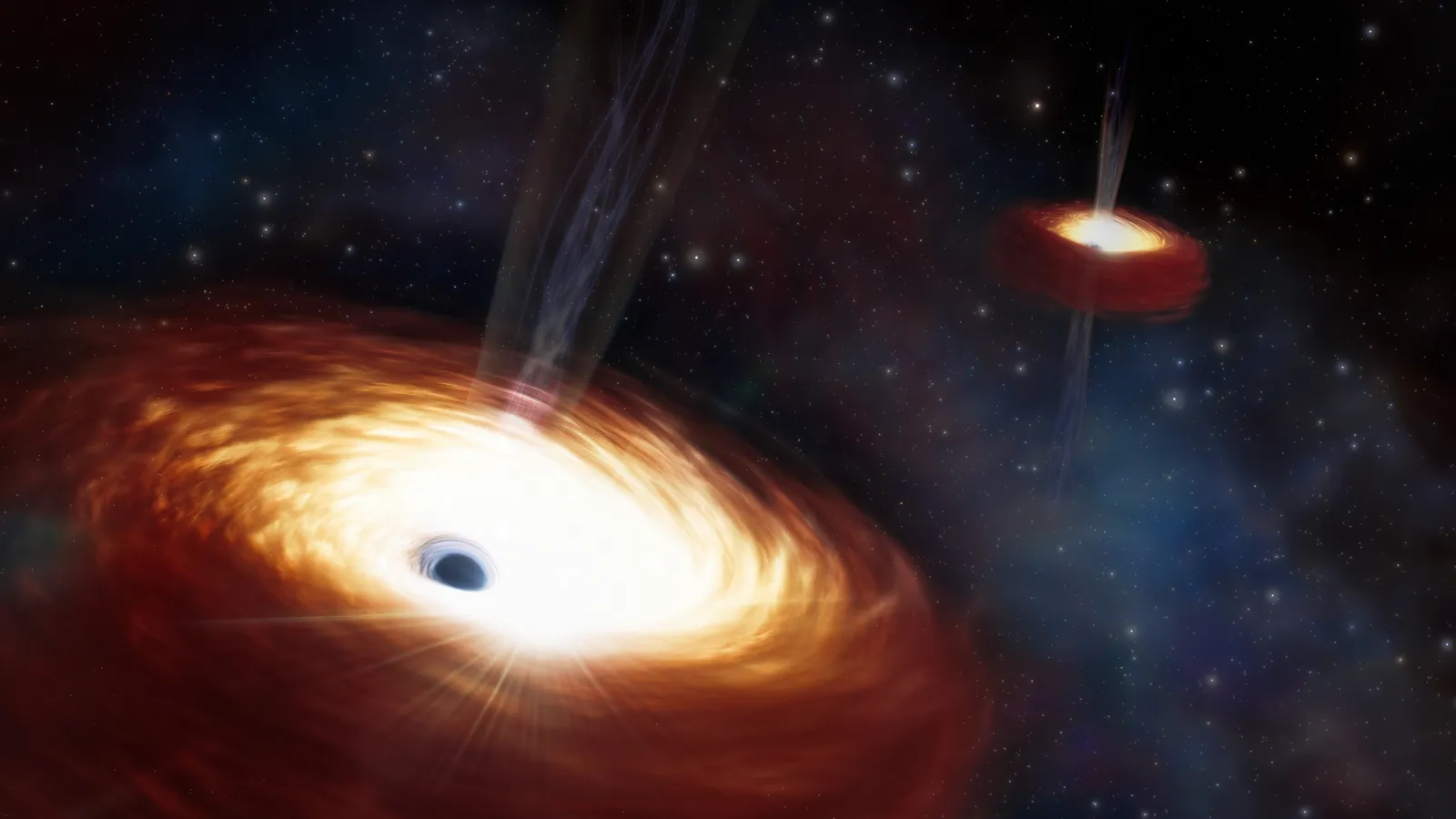
Astronomers have directly imaged a pair of supermassive black holes separated by less than a parsec — the tightest binary of its kind ever resolved. The discovery was made using the Very Long Baseline Array (VLBA) in NGC 5044, the central galaxy of the X-ray brightest galaxy group known.
Binary active galactic nuclei (AGN) consist of two supermassive black holes hosted in a single galaxy, both simultaneously accreting surrounding gas and radiating energy. Such systems are considered key to understanding how galaxies merge and evolve over cosmic time, and they represent prime targets for experiments searching for low-frequency gravitational waves.
What exactly was found
Observations were carried out at four frequencies — 4.9, 8.4, 15.2, and 23.6 gigahertz. At each frequency, two separate compact radio sources appeared at the heart of NGC 5044. Both display flat radio spectra and vary in brightness over time — classic signatures of active accretion onto a black hole.
The separation between the two sources is just 0.38 parsecs — roughly 1.2 light-years. For comparison, that's far less than the distance from the Sun to its nearest stellar neighbor. Previously, the only directly and reliably confirmed parsec-scale binary AGN showed a much wider separation between components. The new pair beats that record by roughly an order of magnitude.
What was known before
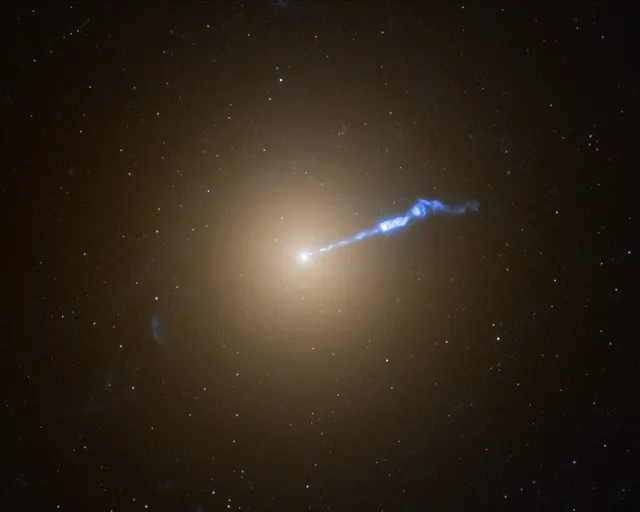
NGC 5044 had already drawn attention for its radio jets — narrow streams of emission launched from the active nucleus. These jets are oriented nearly perpendicular to two older outbursts of activity previously detected in the same galaxy. That geometry was hard to explain without assuming the primary black hole's jet axis had dramatically shifted direction over time.
Overall, binary AGN remain an extremely rare observational phenomenon. Before this work, only a handful of systems had been confirmed with separations of a few hundred parsecs. Just one pair — in an elliptical galaxy at the center of a galaxy cluster — had been directly and visually confirmed at parsec scale.
Why it matters
The new discovery offers an alternative explanation for the puzzling jet geometry in NGC 5044: the older outbursts may have come from a secondary, rather than the primary, black hole. In that case, there's no need to invoke a mechanism reorienting the primary jet's axis — it's enough to recognize that two independent radiation sources are at work simultaneously in the galaxy.
The older outbursts may have been powered by jets from the secondary core, without invoking any reorientation of the primary jet axis
Systems with black hole separations under a parsec represent the penultimate stage before final merger, when the pair sits at the edge of the regime accessible to gravitational-wave detectors. A direct image of such a tight pair offers a rare chance to test what a binary black hole system looks like right before merging.
The authors also note that comparison with other known systems points to massive, cluster-central elliptical galaxies as promising targets for further searches for binary supermassive black holes. The study is published as a preprint on arXiv, with data obtained using the Very Long Baseline Array (VLBA).