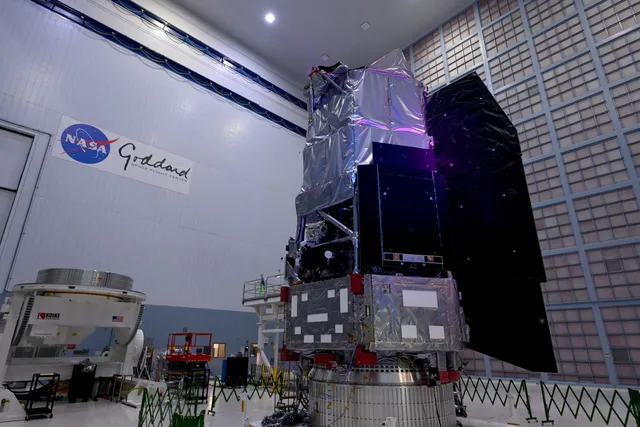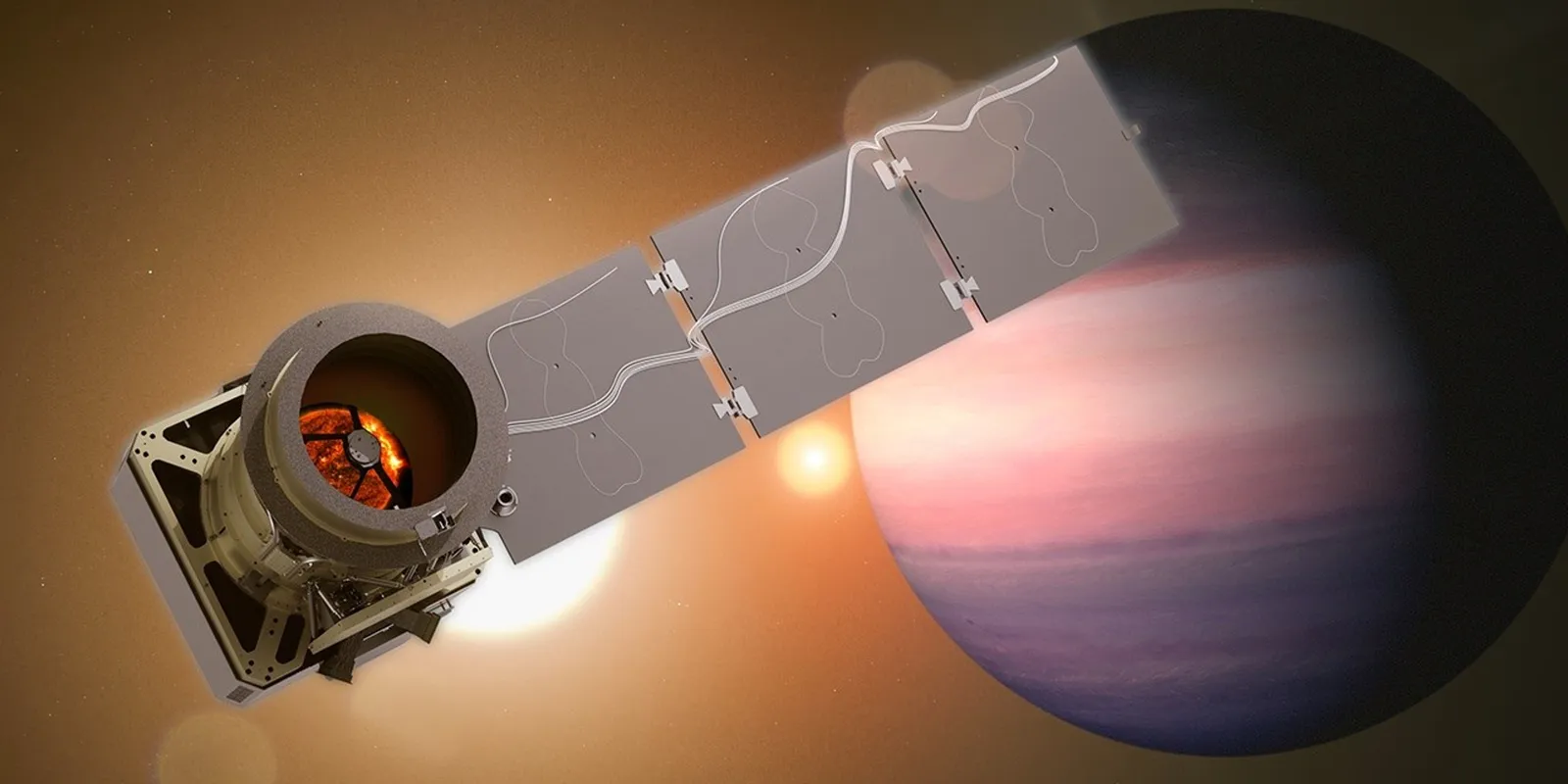
NASA has launched a new instrument for studying distant worlds — the Pandora telescope. It is the first satellite flown under the Astrophysics Pioneers program: low-cost, fast-paced missions built to answer a specific scientific question, accepting a higher tolerance for failure in exchange for speed and savings. Pandora reached low Earth orbit on January 11, completed its commissioning checks, and began full science observations.
The mission's core goal is to determine the atmospheric makeup of at least 20 exoplanets — checking for hazes, clouds, and, most importantly, water. Behind that simple description lies a technical challenge astronomers have struggled with for years.
Why It's Hard to Isolate a Planet's Signal
The standard way to glimpse a distant planet's atmosphere is to wait for a transit — the moment the planet passes in front of its star as seen from Earth. Some starlight then skims through the planet's thin atmosphere, and different molecules absorb light at characteristic wavelengths. These brightness dips reveal the chemical composition — water vapor, methane, carbon dioxide.
The problem is that telescopes capture light from the entire visible stellar surface, not just the narrow beam that passed through the planet's atmosphere. Stellar surfaces aren't uniform: they have hotter, brighter regions called faculae and cooler, darker starspots. These features grow, shrink, and shift as the star rotates, and their effects on the spectrum can easily be confused with the planet's own atmospheric signal.
Pandora's data will help close a major gap in our knowledge about planets and their host stars because, right now, we can't be entirely sure how the star's light affects measurements of what makes up exoplanet atmospheresElisa Quintana, Pandora's principal investigator, NASA Goddard Space Flight Center
How the Telescope Works
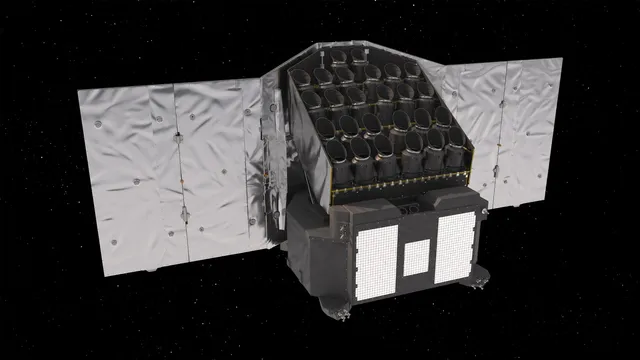
Pandora carries an unusual instrument for a space observatory — an all-aluminum telescope just 45 centimeters in diameter, jointly developed by Lawrence Livermore National Laboratory and Corning Specialty Materials. One of its detectors, which captures the near-infrared spectrum, is a spare unit originally built for the James Webb Space Telescope.
A key feature of the mission is that it observes the star and the planet simultaneously in both visible and near-infrared light. This allows scientists to track starspots and faculae separately from the planet's own spectrum during a transit.
Another advantage is observation length. Over its year-long primary mission, the satellite will study each of the 20 planets 10 times, with each session a continuous 24-hour stare that always captures a transit. Such long, repeated observations of a single target aren't feasible for oversubscribed flagship observatories like Webb, whose schedules are booked years in advance.
What This Means for Science
According to Knicole Colón, the mission's project scientist at NASA Goddard, combining Pandora and Webb data will let scientists pin down the properties of stellar surfaces and cleanly separate stellar and planetary signals. That's especially important for detecting water — one of the key indicators of a planet's potential habitability.
Water is one of the most important molecules we can measure to understand the composition and physical conditions of an exoplanet atmosphere. But features on the star can distort the water signal we're searching for. Pandora is designed to disentangle the signals from the planet and the star, helping us to understand the planets more accurately and laying the groundwork for the eventual study of planets that could harbor lifeBenjamin Rackham, Massachusetts Institute of Technology
Jordan Karburn, the mission's deputy project manager at Lawrence Livermore, said the spacecraft and all its instruments are performing well, and the team is now confidently moving into the science phase.
Who's Behind the Mission
The mission is led by NASA's Goddard Space Flight Center, with project management and engineering handled by Lawrence Livermore National Laboratory. Corning built the telescope, while Blue Canyon Technologies provided the spacecraft bus, performed assembly and testing, and supports mission operations. NASA's Ames Research Center handles data processing, and the mission's science data is available through the NASA Exoplanet Archive, operated by IPAC at Caltech. The University of Arizona leads mission operations.
Pandora is a low-cost complement to major observatories, not a replacement for them. But missions like this are exactly what's needed to close gaps that busy flagship telescopes simply don't have time to address.