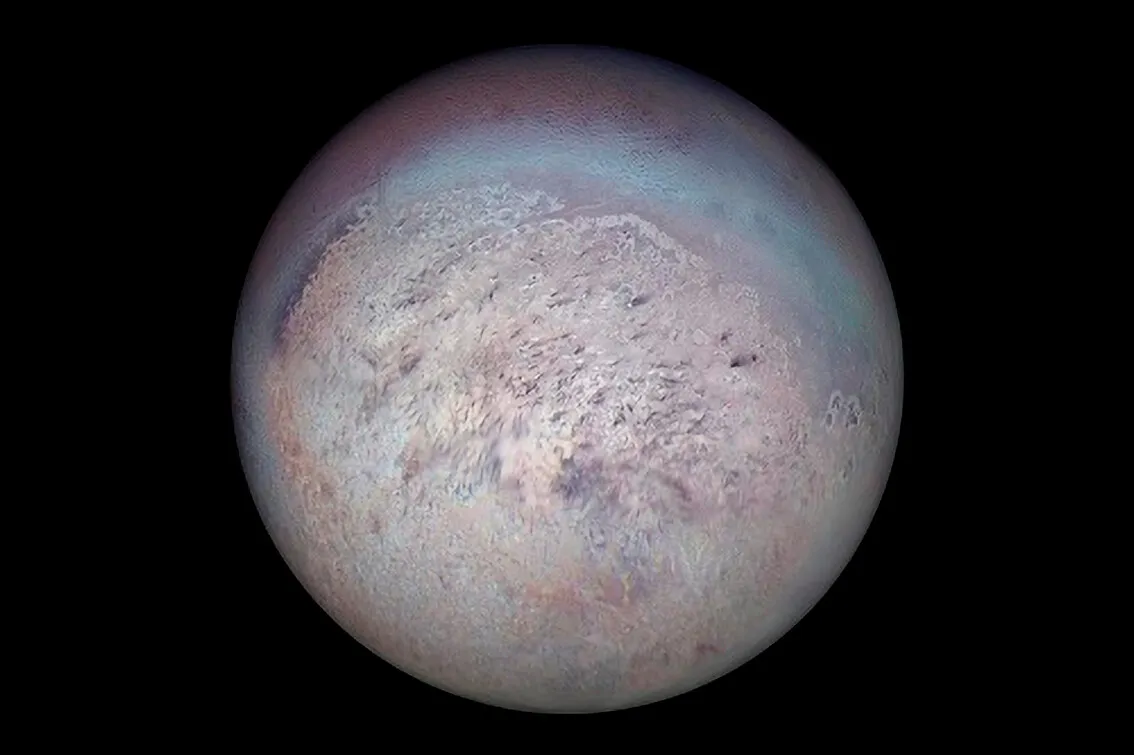
Triton is one of the strangest moons in the solar system. It orbits Neptune backwards relative to the planet's own rotation, a unique trait among large planetary moons. This retrograde motion is the main clue that Triton wasn't born alongside Neptune at all — it was likely once a dwarf planet from the distant Kuiper Belt, captured by Neptune's gravity and turned into a moon. A new study published in Nature Astronomy asks what this violent history means for Triton's interior, and whether the moon could have generated its own magnetic field.
Triton is the seventh-largest moon in the solar system, only 25% smaller than our own Moon. We still know little about it: humanity's only close visit was the Voyager 2 flyby in 1989. The spacecraft detected a highly ionized nitrogen atmosphere and photographed nitrogen geysers — dark streaks visible on the surface. Beyond the geysers, Triton's surface looks flat and nearly crater-free, suggesting it gets resurfaced fairly often. Surface temperature hovers around -235°C (38 kelvin), among the coldest in the solar system.
Capture as a Heat Source
The authors argue that the capture event itself could have heated Triton from the inside. Right after being caught by Neptune, the moon would have traveled on a highly elliptical, tilted orbit. Over time, as Triton interacted with other bodies around Neptune, its orbit gradually circularized. That process caused Triton to lose orbital energy, which converted into internal heat.
The team estimates this heat could have been enough to melt iron deep inside Triton. Molten, convecting iron is exactly the material that powers Earth's magnetic field in its core. This internal heating could also have consequences beyond magnetism: it might have melted water ice as well, potentially making Triton an ocean world with a subsurface liquid ocean.
How Triton's Dynamo Might Work
A magnetic field is born from a dynamo — the motion of an electrically conductive fluid that generates electric currents. The convection feeding a dynamo can be thermal or compositional. Thermal convection is what happens on Earth: hot liquid rises, cools, compacts, and sinks again. Compositional convection works differently: less dense material rises, undergoes a change that makes it denser, then sinks, while a fresh batch of lighter material rises to take its place.
The researchers modeled three extreme scenarios depending on how much sulfur Triton's interior initially contained. In the high-sulfur scenario, iron sulfide separates from the surrounding molten iron, pushing dense iron downward; the sinking iron in turn pushes sulfur-rich liquid back up — classic compositional convection. In another scenario, iron freezes and solidifies at the top, and this cold iron sinks toward the core, warming up again — thermal convection. A third scenario involves a growing iron-rich core pushing sulfur into the surrounding liquid; the sulfur rises while denser, iron-rich liquid sinks to take its place.
Reality is likely some blend of these three extremes. The authors also modeled less likely scenarios where no magnetic field forms at all. Overall, though, their models suggest this kind of convection could produce a magnetic field of roughly 1 microtesla. For comparison, Earth's magnetic field is about 50 microtesla.
One crucial caveat: this entire model depends on Triton actually being a captured object, which is the widely accepted view among researchers. If Triton had formed directly around Neptune from local gas and dust, it would have stayed cold and unable to sustain a dynamo.
Why Confirming This Is So Hard
The biggest obstacle is a lack of data. Humanity has visited Triton only once, more than three decades ago. A return visit would help, but even then, telling a dynamo apart from an ocean won't be easy: magnetic fields generated by an internal dynamo and those induced by a salty subsurface ocean look nearly identical to instruments aboard a passing spacecraft.
One useful clue may come from studying a different moon entirely — Ganymede, Jupiter's largest moon, which is also suspected of harboring both a subsurface ocean and its own dynamo. In 2031, the JUICE mission, already en route to the Jupiter system since 2023, will study Ganymede in detail. Understanding how an ocean and a magnetic field coexist there could help scientists untangle the same puzzle at distant Triton.