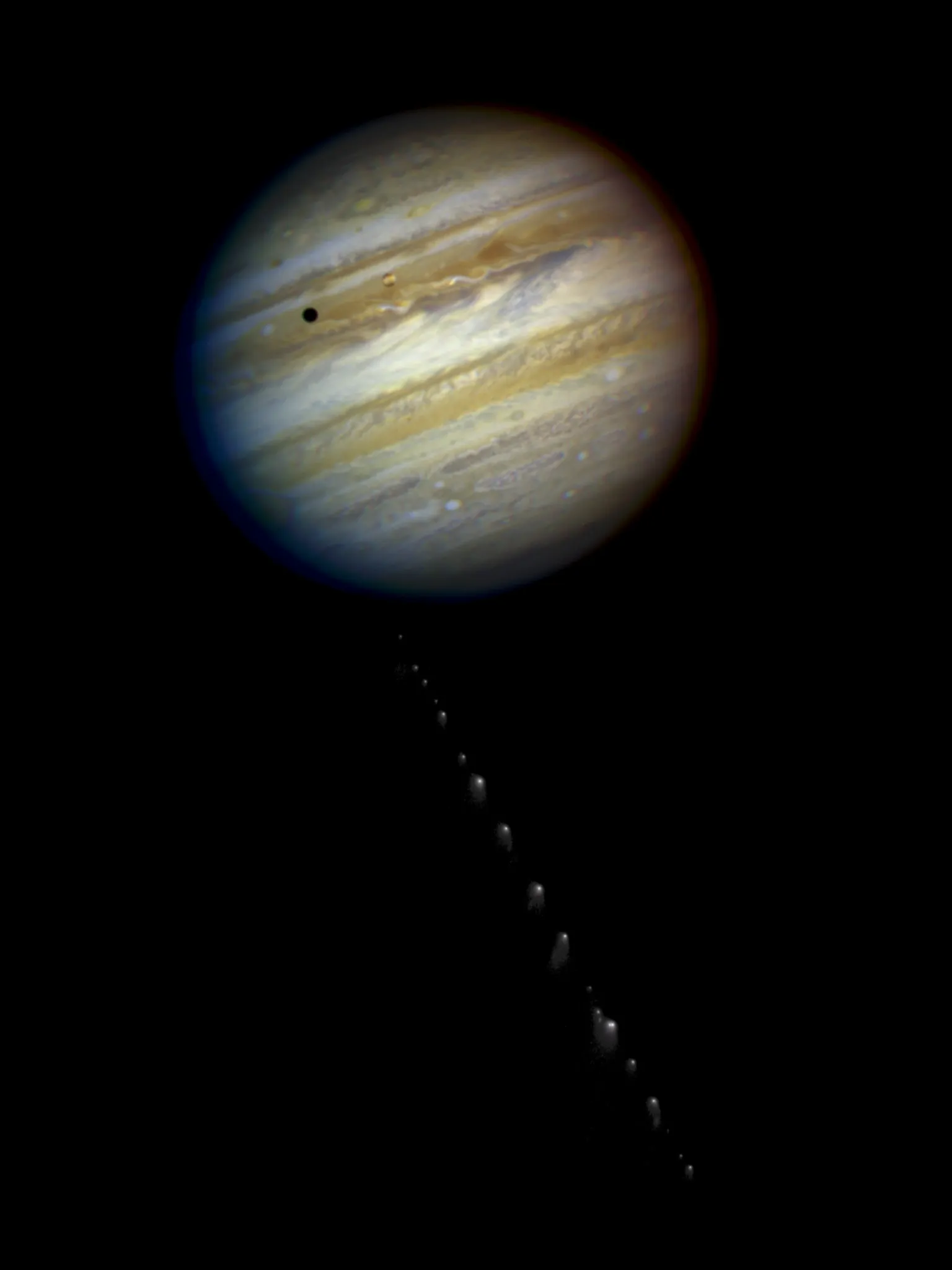
In July 1994, fragments of comet Shoemaker-Levy 9 slammed into Jupiter one after another. It was the first collision between Solar System bodies that humans observed in real time. The consequences turned out to be long-lasting: the impacts altered the chemistry of the planet's stratosphere for decades.
Within minutes of the impacts, new molecules appeared in the atmosphere — hydrogen cyanide (HCN), carbon monoxide (CO), water, carbon monosulfide (CS) and others. Some of them are still present today. These substances settled into the stratosphere at depths where the pressure is below 0.1 millibars, and most likely formed through chemical reactions in the shock-heated gas that combined Jovian and cometary material.
The question of where these molecules came from is still not fully resolved. One way to approach the answer is to measure their isotopic composition.
Why isotopic ratios matter
Isotopes are variants of the same chemical element with different numbers of neutrons. For example, carbon-12 and carbon-13, nitrogen-14 and nitrogen-15. The ratio between them differs across Solar System objects. That is why these numbers act as a marker pointing to the reservoir of material a substance formed from.
This is where the puzzle began. In 1998, four years after the collision, researchers measured the carbon and nitrogen ratios in Jupiter's HCN. The results showed an unusually low content of heavy isotopes — so low that nothing like it had been seen before in the Solar System. This suggested either an atypical cometary composition or an unknown isotope-separation mechanism in the hot shocked gas.
What ALMA revealed
To test these results, the team used observations from the ALMA radio telescope (Atacama Large Millimeter/submillimeter Array) in Chile, taken in 2017. Using radiative-transfer calculations, the astronomers determined the abundance of two HCN isotopologues — H¹³CN and HC¹⁵N — in an atmospheric layer with pressures from 0.03 to 1.8 millibars.
The values they obtained:
carbon-12 / carbon-13 = 73 ± 5; nitrogen-14 / nitrogen-15 = 245 ± 29
Compared with terrestrial references, these are 0.76─0.87 and 0.80─1.00 of their values respectively. And relative to the bulk composition of the Sun and Jupiter — 0.69─0.87 and 0.42─0.70.
The key point is that these numbers contradict the 1998 data. Instead of a strong deficit of heavy isotopes, the new measurements point rather to an enrichment relative to the bulk composition of Jupiter itself.
What this could mean
The authors offer two interpretations of this enrichment. First: it is a direct trace of cometary material preserved in the HCN molecules. Second: it is the result of 23 years of chemical evolution in Jupiter's atmosphere, which could have gradually shifted the isotopic balance.
Both explanations remain hypotheses for now. But the very fact of the disagreement with the earlier measurements shows how difficult it is to reconstruct the chemical history of a single event even after decades of observation. The aftermath of the 1994 collision still provides material for new research.