JWST confirms the Cosmic Gems galaxy at z = 9.625
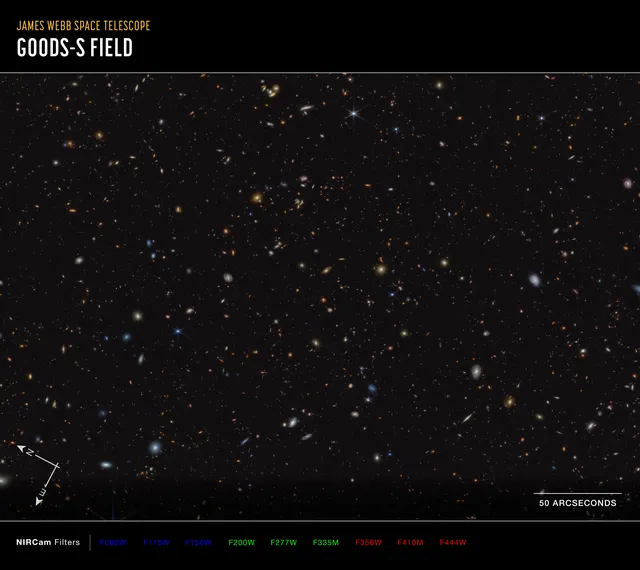
A team led by Massa et al. used JWST's NIRSpec instrument for a six-hour integration on the Cosmic Gems arc, a galaxy whose image is magnified by gravitational lensing from the cluster SPT-CL J0615-5746. The spectrum spans 0.8–5.3 μm and reveals a pronounced continuum break near 1.3 μm along with faint Hβ and [OIII] lines, pinning down a redshift of z = 9.625 ± 0.002.
Spectral fitting with Bagpipes indicates the galaxy is in a post-starburst phase — the highest-redshift mini-quenched system known so far. Five star clusters aged 7–30 Myr show extraordinarily high mass densities, 10⁵–10⁶ M☉, exceeding typical clusters in local star-forming galaxies. Spatially resolved spectroscopy at tens-of-parsec scales confirmed uniform properties across different parts of the arc.
SPYGLASS: fragments of massive star formation
Using data from the Gaia mission, a team led by Ronan Kerr traced the dynamical history of 16 low-mass stellar associations (mass under 100 M☉, age up to 50 Myr) previously thought disconnected from larger star-forming complexes. Twelve of them turned out to have plausible links to bigger complexes, and dynamical traceback revealed a shared origin for three groups — the Leo, CaNMoS, and AquENS associations.
A particularly striking case is the Leo Association, where high vertical velocities and a deceleration signature point to a collision between an intermediate-velocity gas cloud and material in Orion. If confirmed, this would be the first known case of star formation triggered by such a cloud collision in the Orion-Eridanus region. The researchers also link the shape of the Local and Orion-Eridanus Bubbles to feedback from the oldest relatives of these associations.
A new way to measure galaxy metallicity
A team led by Noah Rogers has produced the first empirical calibration of a new method for measuring gas chemical composition in galaxies — the Ne₂₃ diagnostic, based on the mid-infrared [NeII] 12.81 μm and [NeIII] 15.56 μm lines. Unlike traditional optical diagnostics, these lines are insensitive to electron gas temperature, removing a major source of systematic error in oxygen abundance measurements.
The calibration used JWST/MIRI observations of ten HII regions with known O/H values from the CHAOS project, plus eight low-metallicity galaxies. Ne₂₃ correlates strongly with O/H over a 1.5 dex range, with a scatter of just 0.06 dex — far tighter than optical methods achieve. This makes it possible to reliably estimate metallicity in dusty, metal-rich galaxies out to z ≈ 0.8.
Ultra-fast wind from a black hole: > 0.2c
A team led by Pierpaolo Condò carried out a systematic reanalysis of the complete XMM-Newton (1.5 Ms) and NuSTAR (500 ks) X-ray datasets from 2016 for the Seyfert galaxy IRAS 13224-3809. Applying three spectral models across all time intervals, the researchers unambiguously confirmed a strong, variable ultra-fast outflow moving at over 0.2 the speed of light.
They found a correlation between outflow velocity and source luminosity, along with rapid wind acceleration in response to X-ray flares. This fast reaction points to magnetic reconnection as the driving mechanism, analogous to solar coronal mass ejections, rather than radiation pressure, previously the leading candidate. The outflow carries enough momentum and kinetic power to drive efficient AGN feedback onto its host galaxy.
Black hole mergers in AGN disks
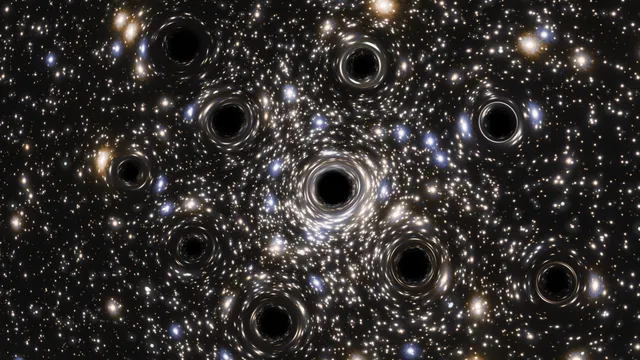
Hiromichi Tagawa, Zoltán Haiman, and Bence Kocsis built one-dimensional N-body simulations combined with a semi-analytical model to explain the properties of roughly 200 binary black hole mergers detected by gravitational-wave observatories. The model focuses on the environment of accretion disks around active galactic nuclei, where black holes can undergo frequent close encounters and successive mergers.
The calculations show that merger masses and mass ratios depend strongly on disk lifetime and density, as well as the number and accretion efficiency of black holes involved. The most massive events, such as GW231123, can be explained either by efficient gas accretion or by hierarchical mergers across three or more black hole generations. The model also reproduces observed correlations between mass ratio, effective spin, and chirp mass, aiding interpretation of future gravitational-wave population data.