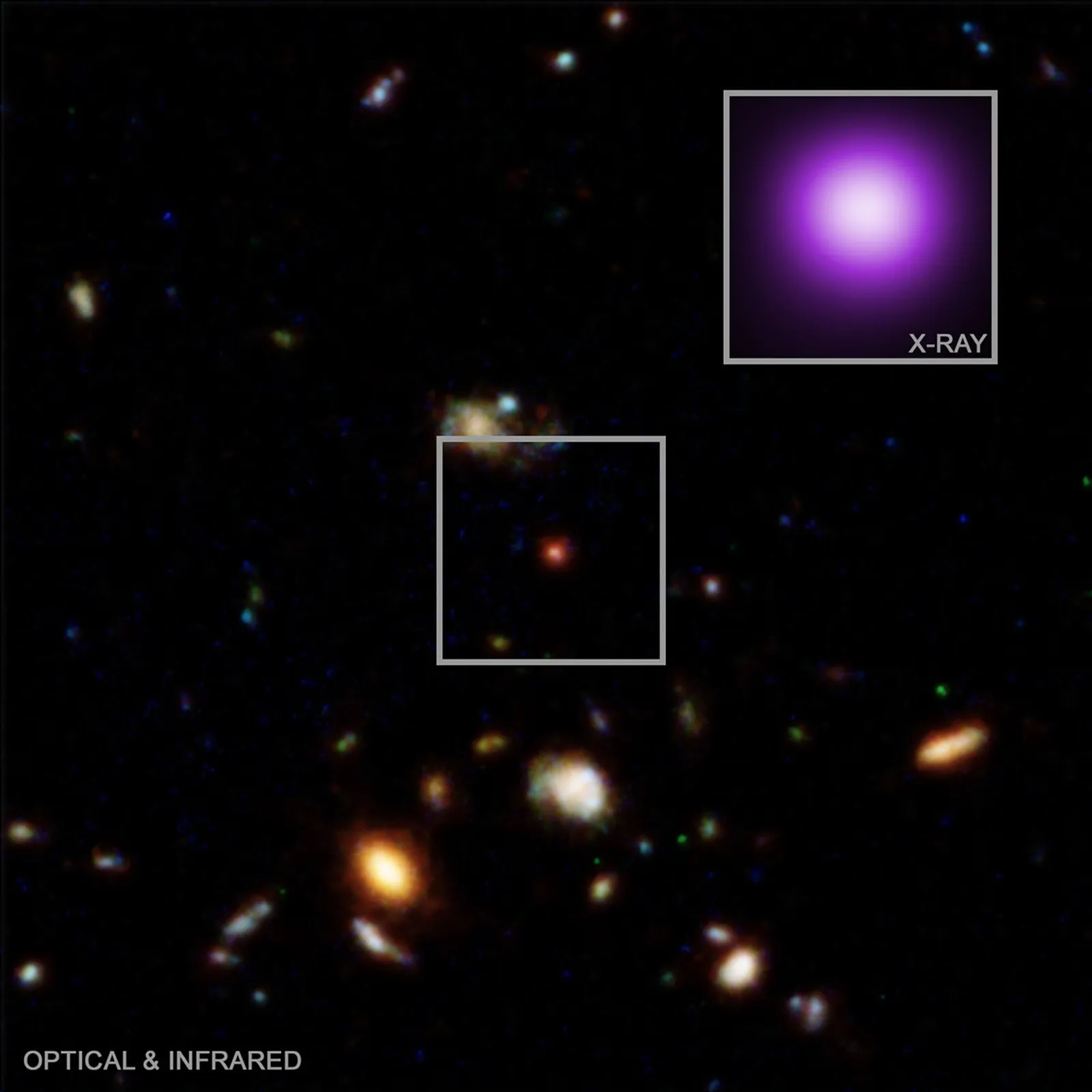
For years, astronomers have struggled to explain a strange population of objects from the early Universe known as "little red dots." Now NASA's Chandra X-ray Observatory and the James Webb Space Telescope appear to have found a concrete clue that could tie the whole picture together.
The object in question is 3DHST-AEGIS-12014, an "X-ray dot" located roughly 11.8 billion light-years from Earth. The findings were published in The Astrophysical Journal Letters.
What "little red dots" actually are
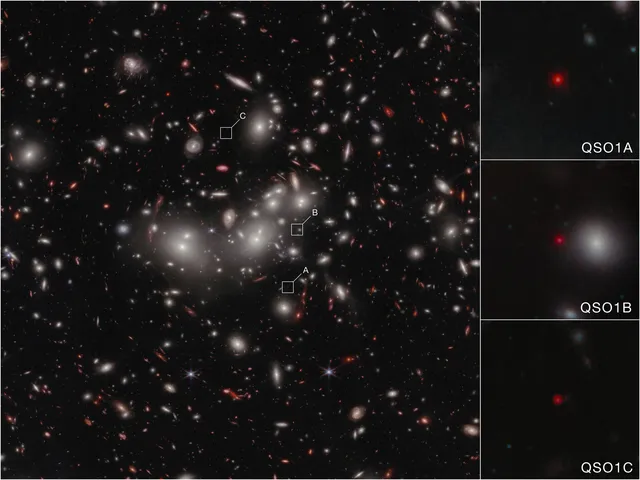
Soon after Webb began science operations, reports of a new class of objects started coming in. Astronomers were finding small, compact red sources 12 billion light-years away or farther — objects that existed when the Universe was less than two billion years old.
Hundreds, possibly thousands, of these sources have since been identified.
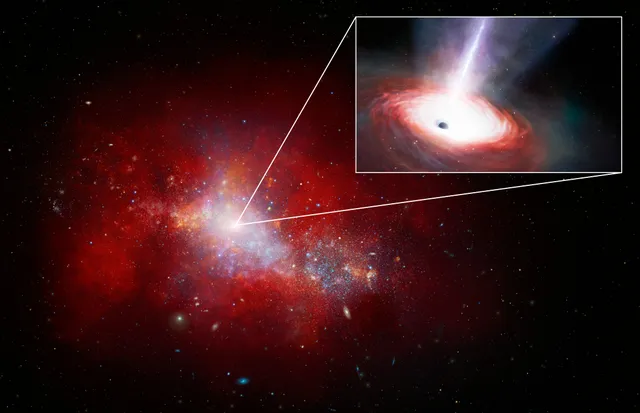
Most researchers think they are supermassive black holes wrapped in dense clouds of gas. That envelope hides the signatures normally used to identify a growing black hole — the ultraviolet and X-ray light produced by material falling onto it. Because their spectra resemble stellar atmospheres, the scenario became known as the "black hole star."
The catch is that the vast majority of little red dots show no X-ray emission at all, which has made the hypothesis hard to test directly.
A dot that glows where others stay silent
A team led by Raphael Hviding of the Max Planck Institute for Astronomy compared new Webb data with a deep survey Chandra had carried out more than a decade earlier.
Among hundreds of faint red sources, one stood out. 3DHST-AEGIS-12014 has all the hallmarks of an LRD — compact size, red color, extreme distance — yet it emits X-rays, something no other object in the class does.
This single X-ray object may be – to use a phrase – what lets us connect all of the dots.Raphael Hviding, Max Planck Institute for Astronomy
Co-author Anna de Graaff of the Center for Astrophysics | Harvard & Smithsonian points to the underlying puzzle: if little red dots really are rapidly growing black holes, why don't they give off X-rays like other such objects do. Finding one dot that behaves differently offers a way into understanding what powers the rest.
A gas cloud full of holes
The researchers propose that the X-ray dot represents a transition phase between a classic LRD and a typical growing supermassive black hole.
As the "black hole star" consumes its surrounding gas, patchy gaps gradually open up in the dense envelope. X-rays from material falling onto the black hole start leaking through those gaps — and that's exactly what Chandra detected.
The data also show variations in X-ray brightness, consistent with a rotating gas cloud: patches of denser and thinner gas pass in front of the black hole in turn, alternately blocking and letting the X-rays through.
Eventually, once all the gas has been consumed, the envelope disappears completely, and the object becomes indistinguishable from a standard active supermassive black hole.
Co-author Hanpu Liu of Princeton University notes that if the X-ray dot's status as a transition phase is confirmed, it would be the first object of its kind observed — and the strongest evidence yet that the growth of supermassive black holes drives at least some of the little red dot population.
An alternative explanation, and what comes next
The researchers also leave room for another possibility: the X-ray dot could simply be a more ordinary growing black hole, veiled by an exotic type of dust that astronomers haven't encountered before.
Future observations, already being planned, should help distinguish between the two scenarios.
3DHST-AEGIS-12014 sat unnoticed in Chandra's archival data for over ten years — it took a comparison with new Webb imagery to reveal how unusual it was. The team describes this as a clear example of how pairing two observatories working in different wavelengths can produce a result neither could achieve alone.