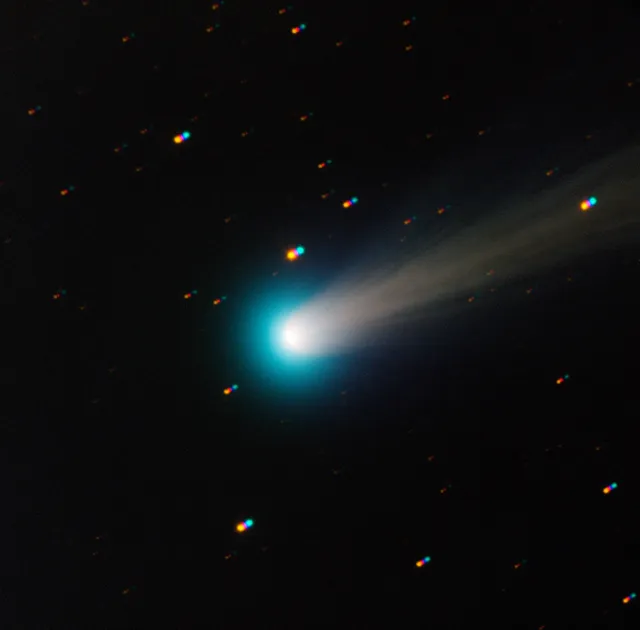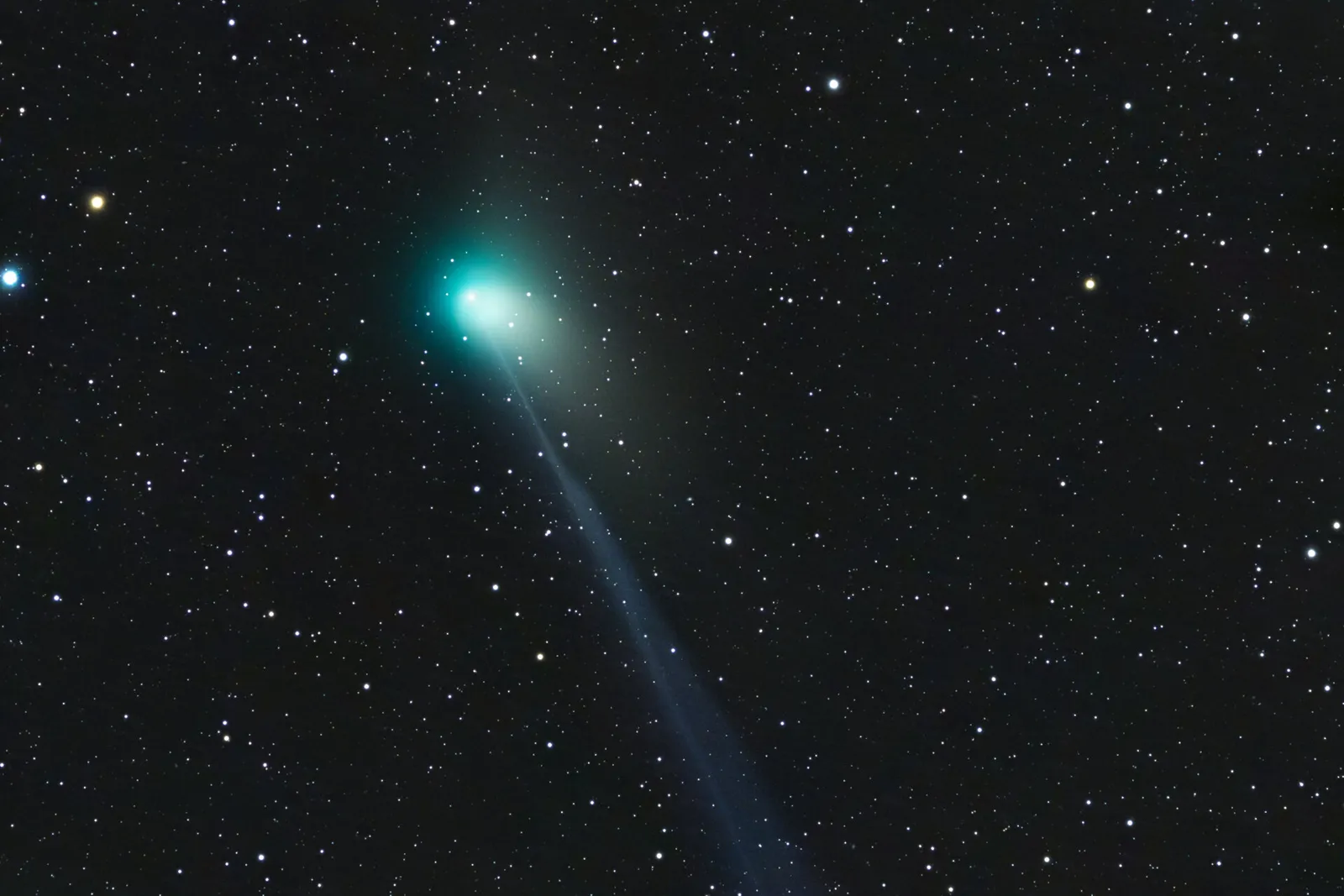
Comet C/2022 E3 (ZTF) entered astronomers' view in 2022 and within months became one of the most closely studied long-period comets in recent years. Its orbital period spans thousands of years, meaning the material it carries has remained largely unaltered since it was left over from the cloud that gave rise to the solar system.
In March 2023, a research team led by K. D. Foster of NASA's Goddard Space Flight Center secured a rare opportunity: observations from the James Webb Space Telescope and the ground-based ALMA radio observatory in Chile were conducted nearly simultaneously. The findings were published in The Astronomical Journal.
Water and methanol as tracers of origin
The study focused on two molecules — water (H₂O) and methanol (CH₃OH). Both are found not only in cometary comae but also in protoplanetary disks, the gas-and-dust structures around young stars where planetary systems form.
This makes comets a kind of chemical archive. By comparing the composition of ZTF's coma with what is observed in disks around other stars, astronomers try to determine how universal the chemical "recipe" behind planetary system formation really is.
The team used ALMA's Band 6 receiver under observing program 2022.1.00997.T, while JWST data complemented the radio observations at a different range of wavelengths. Combining the two methods allowed the researchers to build a radiative transfer model — a calculation showing how radiation passes through the coma's gas and what it reveals about molecular temperature and density.
Elevated temperature on the antisunward side
Modeling revealed that the distribution of both methanol and water in the coma is mostly concentrated near the nucleus — an expected result, since that is where ice sublimation occurs.
However, in the antisunward direction, researchers detected a statistically significant enhancement in the rotational temperature of the molecules. The authors suggest this reflects how tail material interacts with solar radiation and the solar wind, the stream of charged particles constantly flowing outward from the Sun.
Separately, JWST recorded a consistent decline in water molecule temperature with increasing distance from the nucleus. Based on non-LTE (non-local thermodynamic equilibrium) radiative transfer modeling, this is explained primarily by rotational line cooling — molecules losing energy through their own emission rather than simply dispersing into a vacuum as they move away from the heat source.
Two independent checks on one result
The study's most important methodological outcome is the consistency of the data. Values derived from JWST modeling fell within the error bars of the average values calculated from ALMA observations.
This is a rare case where a space-based infrared telescope and a ground-based millimeter-wave array independently confirm the same physical parameters of the same comet, observed nearly in sync. The results also broadly agree with earlier single-dish millimeter-wave observations, adding further confidence in the methodology.
For astrochemistry, this means one thing: pairing optical or infrared space observatories with ground-based radio interferometers makes it possible to cross-check models of cometary comae from two fundamentally different parts of the spectrum at once. That strengthens confidence in conclusions about material that has remained nearly unchanged since the solar system's formation.