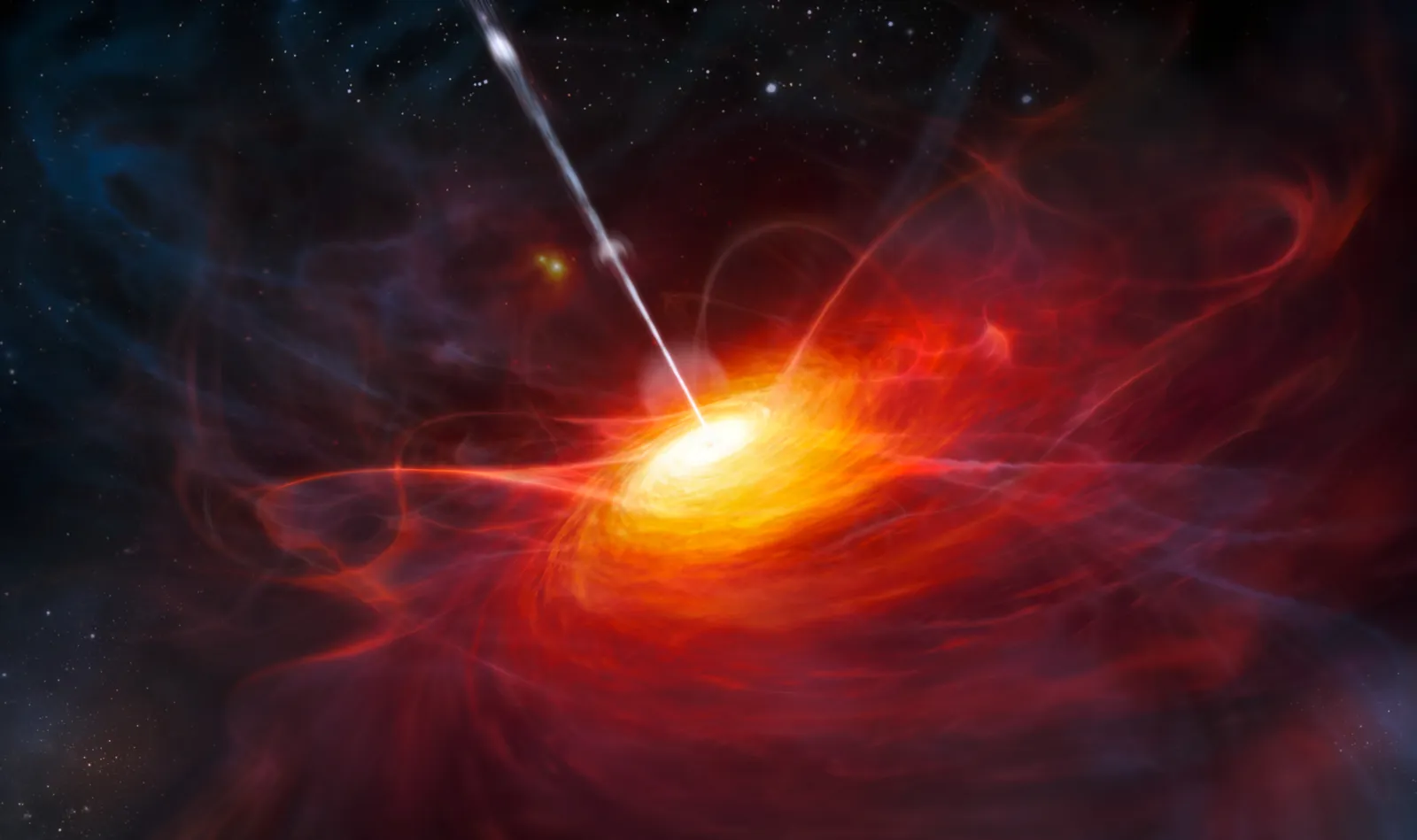
The discovery of black holes exceeding a billion solar masses in a Universe less than a billion years old has long posed an awkward question for astrophysics: how did they grow so fast, and how much energy did that growth dump into their surroundings. A new study built on detailed numerical simulations offers a coherent picture of what happens to the gas around such quasars — from the galaxy's own interstellar medium out to the much larger circumgalactic medium (CGM).
A galaxy model with a "fast" black hole
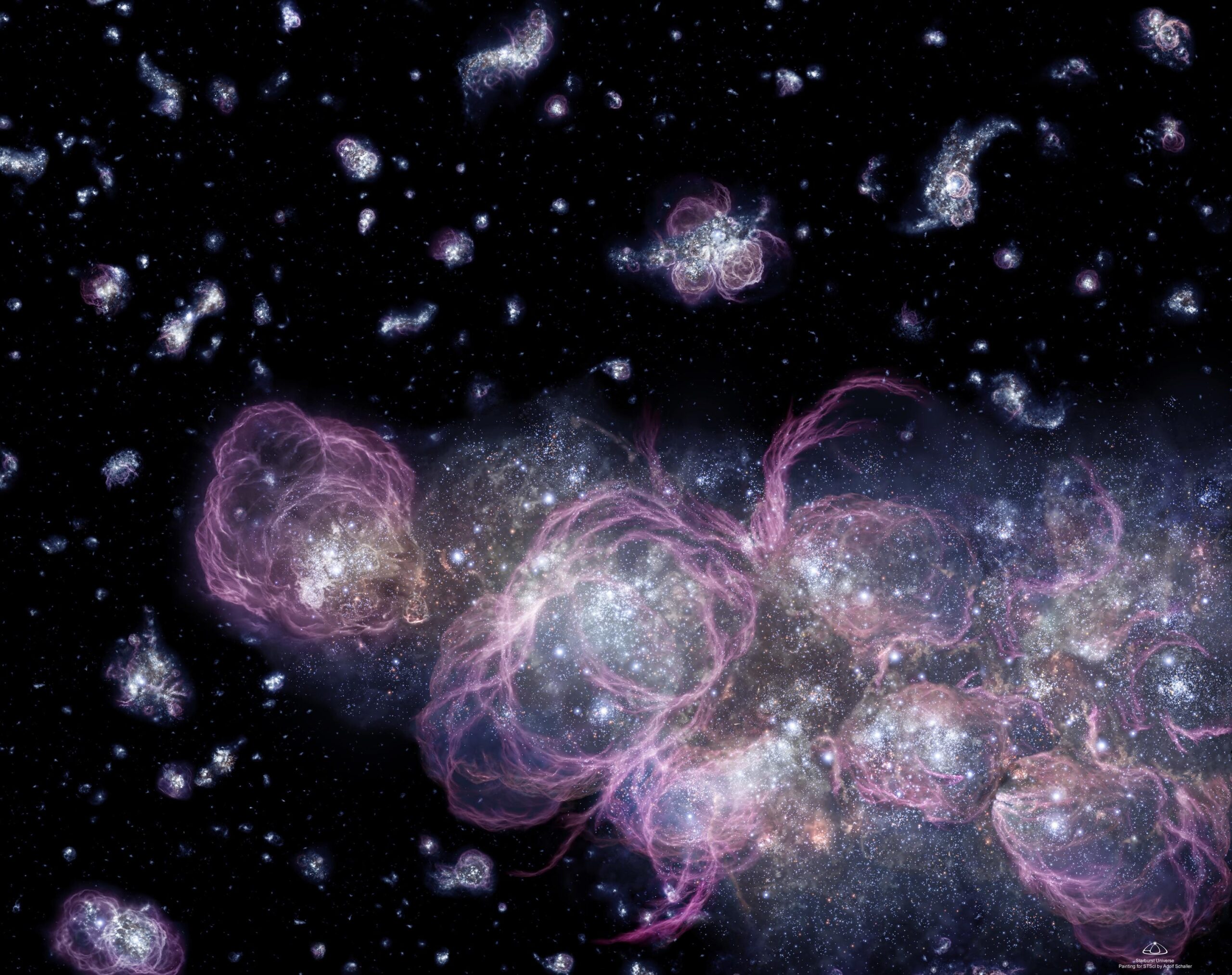
The team used zoom-in simulations — a technique where, within a larger cosmological simulation, one specific region is re-run at much higher resolution. Here, that region was a massive protocluster of galaxies at redshift z~6, an era when the Universe was roughly 900 million years old. The baseline was the FABLE galaxy formation model, modified in two important ways: black hole seeds form earlier than in the standard version, and they can accrete matter in a mildly super-Eddington regime — swallowing gas faster than the theoretical limit at which radiation pressure normally halts infall.
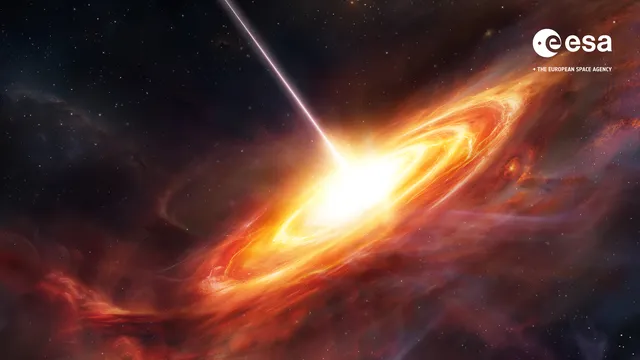
The result is a much faster-growing central black hole compared to the standard scenario. But rapid growth has a downside: for most of its lifetime, such a quasar stays Compton-thick — so densely wrapped in gas and dust from its compact host galaxy that even X-ray radiation cannot escape without significant absorption.
The "blow-out" episode and a reshaped gas environment
The key moment in the simulations is a so-called blow-out episode, which occurs once quasar feedback — the energy of radiation and winds driven from the accretion disc — builds up to sufficient strength. At that point, escape channels open through which ionizing radiation finally breaks out of the compact galaxy, and the central quasar becomes visible to an outside observer, transitioning from Compton-thick to unobscured.
This transition has consequences well beyond the galaxy itself. Powerful outflows enriched with metals (astronomical shorthand for anything heavier than hydrogen and helium) sweep through the circumgalactic medium and fragment it. Instead of a roughly uniform hot gas halo, the CGM turns into a population of cold, fast, compact neutral clumps. As a result, the fraction of the sky around the galaxy's halo covered by neutral hydrogen — the covering fraction — rises significantly. In other words, the quasar's energy release does not disperse the surrounding gas; it makes it clumpier and packed with dense cold structures instead.
Hα nebulae as an observational fingerprint of quasar activity
To see how this reshaped environment would actually look to an observer, the researchers applied a new ray-tracing radiative transfer code. The calculations showed that the CGM responds to quasar activity by forming extended Hα nebulae — hydrogen emission produced when gas is ionized by the central source's hard radiation and then recombines.
The size and luminosity of these Hα nebulae turned out to depend directly on two parameters: the strength of quasar feedback and the level of obscuration. Stronger central black hole activity produces larger, brighter nebulae. Conversely, a quasar still deeply buried in its host galaxy's gas and dust produces a more compact, fainter structure.
Enhanced early black hole growth thus fundamentally reshapes the ISM and CGM of z~6 quasars, leaving clear observable signatures in their obscuration, neutral hydrogen distribution, and extended Hα emission.
What this means for JWST observations
This work matters mainly because it provides concrete, testable observational signatures for an epoch JWST has only just begun to probe directly. Previous theoretical models of early supermassive black hole growth relied largely on indirect estimates of mass and accretion rate. Now, by comparing the neutral hydrogen distribution, the obscuration level of quasars, and the geometry of extended Hα emission in real observations with these simulation results, researchers can test whether early super-Eddington black hole growth really does leave exactly this kind of imprint on the surrounding gas. If it does, it would become one of the few ways to directly trace how giant early-Universe black holes interacted with their host galaxies during their most turbulent growth phases.