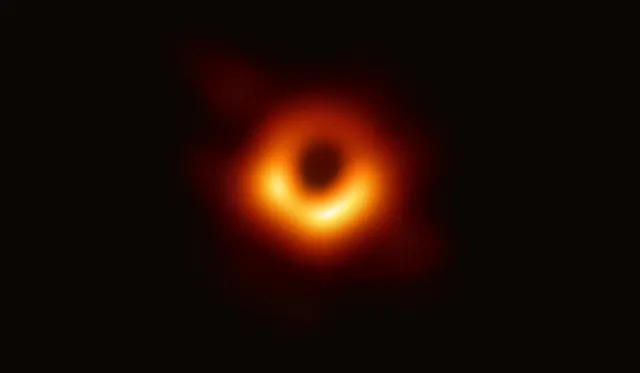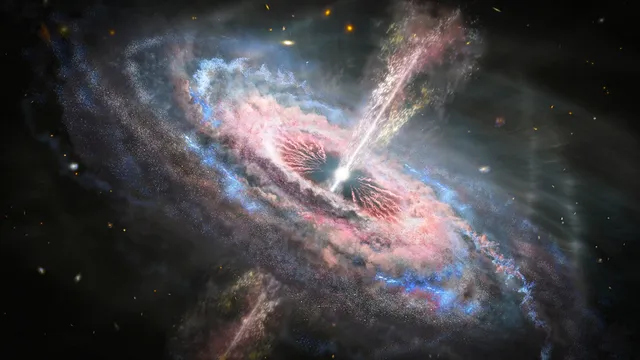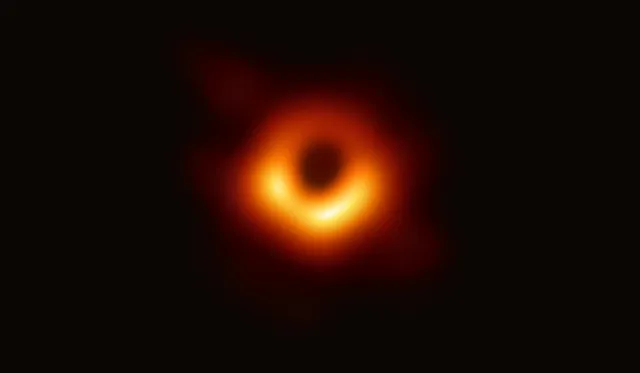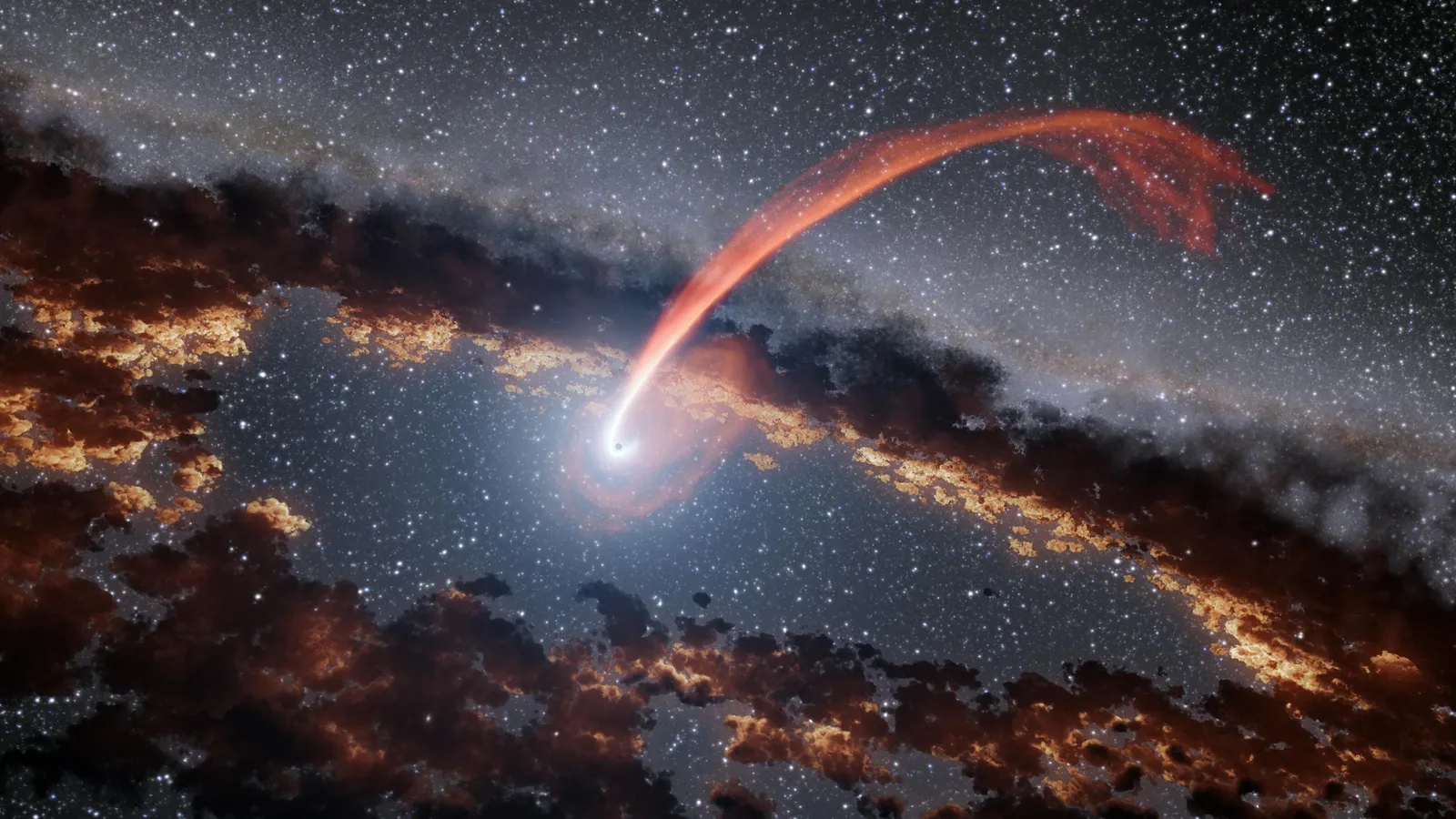
Roughly once every few tens of thousands of years, in the center of a typical galaxy, a star strays close enough to a supermassive black hole that tidal forces tear it apart. Astronomers call this a tidal disruption event, or TDE. Over the past decade, hundreds of such events have been identified, and upcoming sky surveys are expected to find many more. Most TDEs shine as a temporary bright flare in visible light and X-rays, as stellar debris forms an accretion disk and gradually falls onto the black hole. But a small subset of these events does something far more dramatic: it launches a relativistic jet.
Why TDE Jets Stand Out
A jet is a narrow, tightly collimated stream of matter ejected from the vicinity of a black hole at close to the speed of light. In TDEs, such jets reach 10^47-10^48 erg/s in isotropic-equivalent power, making them some of the brightest transient phenomena in the universe. The usual explanation invokes the Blandford-Znajek mechanism: a spinning black hole can extract part of its rotational energy through a magnetic field threading its event horizon, converting that energy into a powerful electromagnetic jet.
But the Blandford-Znajek mechanism only works under one condition — a substantial amount of magnetic flux must accumulate near the event horizon. Here's the catch: a black hole has no magnetic field of its own, so that flux has to come from somewhere. The new study systematically tests three possible sources.
Three Candidates — and Why Two Don't Work
The first, simplest option is the magnetic field of the star itself. Stars do carry magnetic fields, and one could imagine that field being "handed off" to the black hole along with the debris. However, the authors' calculations show that observed stellar magnetic fields are far too weak to power jets of this magnitude. This option is ruled out.
The second candidate is the so-called "lasso mechanism." The idea is that a large region of space around the black hole is already threaded by a weak, diffuse magnetic field — a remnant of the interstellar medium or prior nuclear activity. When a star is disrupted and forms long streams of debris, those streams, orbiting the black hole, can wind up this diffuse field like a lasso and drag it closer to the horizon. The problem is that this mechanism only works efficiently for a very specific, shallow radial profile of the magnetic field. On top of that, a separate trapping mechanism is needed to keep the captured flux near the black hole — otherwise it simply disperses before it can power a jet.
The Most Plausible Answer: A Disk's Memory
The third option turned out to be the most convincing. Many supermassive black holes already host an accretion disk before a star is ever disrupted — a leftover from previous nuclear activity or earlier accretion episodes. Magnetic flux can accumulate and be stored for a long time in the inner region of such a disk.
The most plausible source turned out to be magnetic flux already stored in the inner part of an accretion disk that existed around the black hole before it ever encountered the star.
When a star is torn apart and fresh debris falls onto the black hole, it essentially "reawakens" an already stockpiled magnetic reservoir. It's this pre-existing flux that provides the power needed for the Blandford-Znajek mechanism to operate.
What This Means for Future Observations
This result shifts the focus from "what happened to the star" to "what was happening to the black hole beforehand." If a TDE jet is mainly the result of magnetic flux preserved from a previous disk, then the likelihood of launching a jet depends not just on the parameters of the disruption itself, but on the accretion history of that particular black hole. This could explain why only a small fraction of TDEs show jets — perhaps most black holes simply lack a sufficient "reserve" of leftover magnetic flux.
For upcoming wide-field surveys, such as the Rubin Observatory, this means that predicting which TDEs are likely to produce jets will require information not just about the disrupted star, but about the prior history of that specific galactic nucleus. The authors stress that this remains a theoretical study for now, with further observations and modeling needed to confirm the picture.