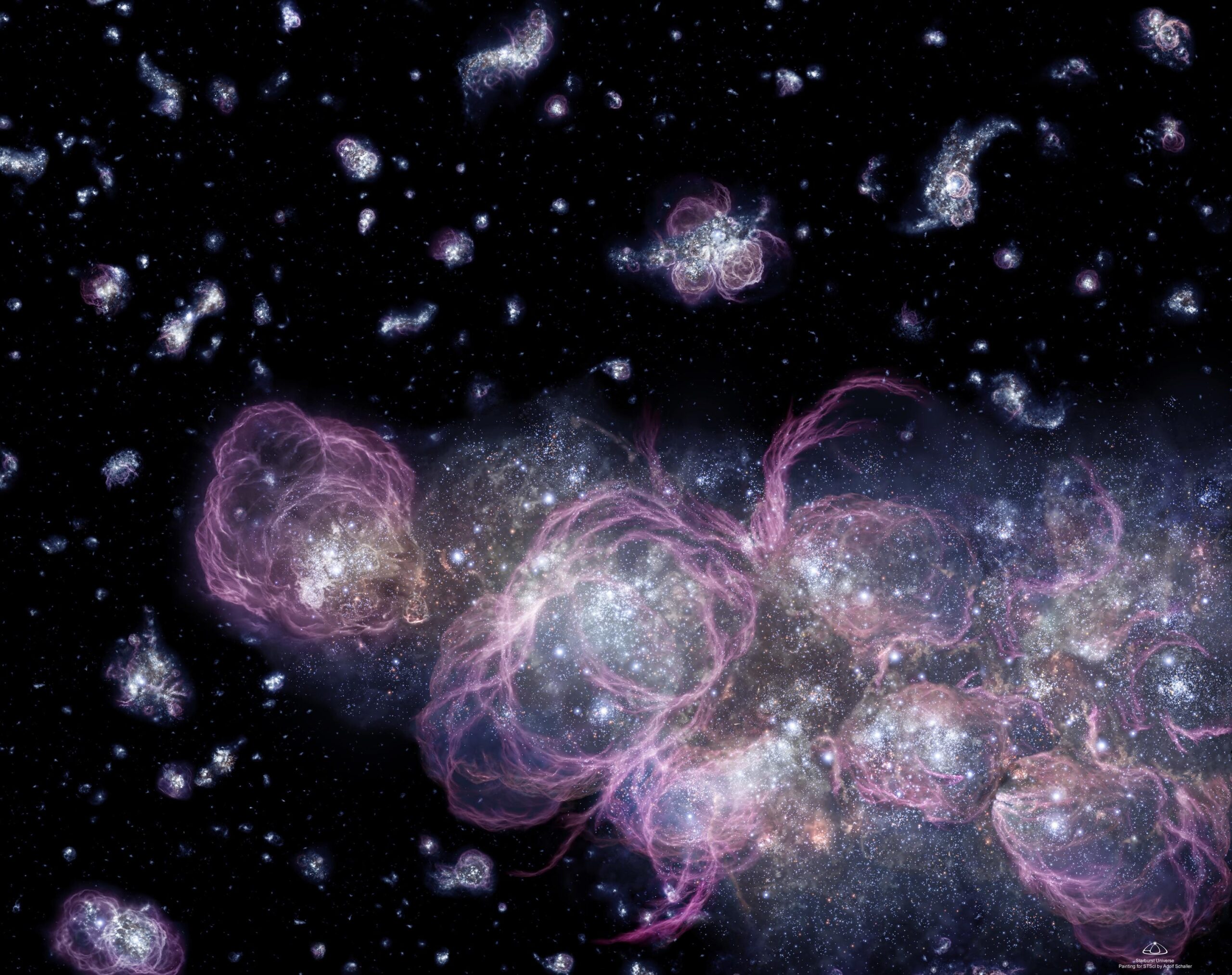
At a distance light has been traveling for more than 13 billion years, astronomers have spotted a gas clump that may hide traces of the universe's very first generation of stars. The object, informally nicknamed Hebe, was first noticed in 2024 near GN-z11, a luminous galaxy hosting an accreting supermassive black hole. New research from a team at the University of Texas at Austin tests how plausible that "first stars" explanation really is compared to alternatives.
What Hebe Is and Why It Matters
Hebe appears as a prominent blob of helium emission next to GN-z11, visible in one JWST filter but absent from infrared images of the same region. That pattern points to a very specific light source: helium recombination lines, produced when helium atoms are ionized by high-energy radiation and then recapture electrons.
The object is seen as it was just 450 million years after the Big Bang — an era when, according to theory, Population III (Pop III) stars should have existed. These hypothetical first-generation stars formed from truly pristine gas — hydrogen, helium, and a trace of lithium — with none of the heavier elements that only appear after supernova explosions. Such stars are thought to have been more massive than today's stars and to have emitted much harder ultraviolet light — exactly what's needed to ionize helium.
Two Competing Scenarios
The study's authors — Junehyoung Jeon, Tae Bong Jeong, Saiyang Zhang, and Volker Bromm — built models for two possible sources of Hebe's emission.
The first scenario: a cluster of Pop III stars. The team calculated the maximum possible mass of such a cluster, factoring in the Lyman–Werner radiation flux from the nearby galaxy GN-z11, situated just 10,000 light-years away. This radiation can either help trigger new star formation or destroy the molecular hydrogen needed for it, making it a critical factor in estimating the cluster's mass.
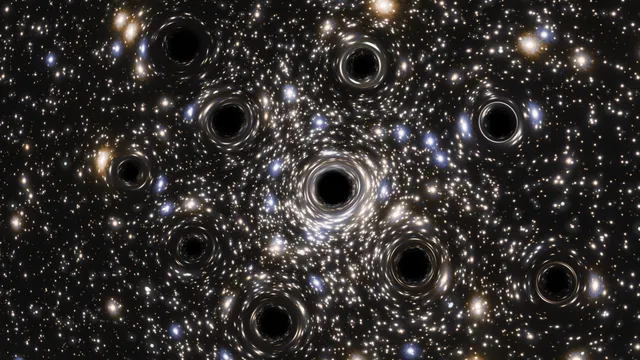
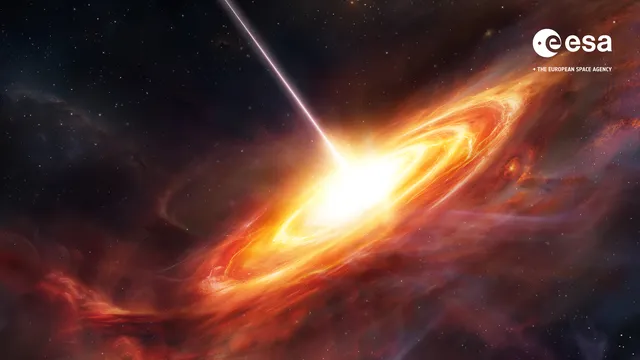
The second scenario: an accreting supermassive black hole embedded in the gas cloud — either a direct-collapse black hole (formed straight from gas, skipping the stellar stage) or a primordial black hole dating to the universe's earliest moments. The model describes the spectral energy distribution produced as such a black hole accretes pristine surrounding gas.
What the Models Showed
The black hole model proved flexible: with reasonable black hole masses, gas densities, and accretion rates, it could reproduce individual JWST flux measurements. The problem was consistency — the model struggled to match all the measurements simultaneously. Fitting one data point often came at the cost of missing another.
The Pop III star cluster model, with a mass of a few hundred thousand solar masses, instead gave the best overall match to the full set of JWST observations.
The researchers also tested a third scenario — a population of second-generation (Pop II) stars, which carry a noticeable amount of heavy elements unlike "pristine" Pop III stars. This model fit the data reasonably well too, but with an important caveat: producing the needed radiation would require roughly 10 million such stars. That many stars should generate a detectable stellar continuum, which JWST hasn't observed so far — making this scenario less convincing.
A Pop III star cluster with a mass of a few hundred thousand solar masses provided the best fit to the JWST data among all the tested scenarios.
What Comes Next
The authors stress that the hypotheses aren't necessarily mutually exclusive: Hebe could harbor both a primordial black hole and a smattering of Pop III stars at once. For now, the first-stars explanation remains the leading candidate, since it best matches current observations — though nothing is settled.
Regardless of what exactly powers Hebe's distinctive helium glow, the object remains a rare window into an era when the universe was just beginning to fill with its first sources of light. Further observations — including searches for a faint stellar continuum or more precise measurements of individual emission lines — should help narrow down the possible explanations.