Two galaxies sitting next to bright quasars turned out to be almost invisible to humanity's most powerful infrared telescope, even though radio dishes see them clearly.
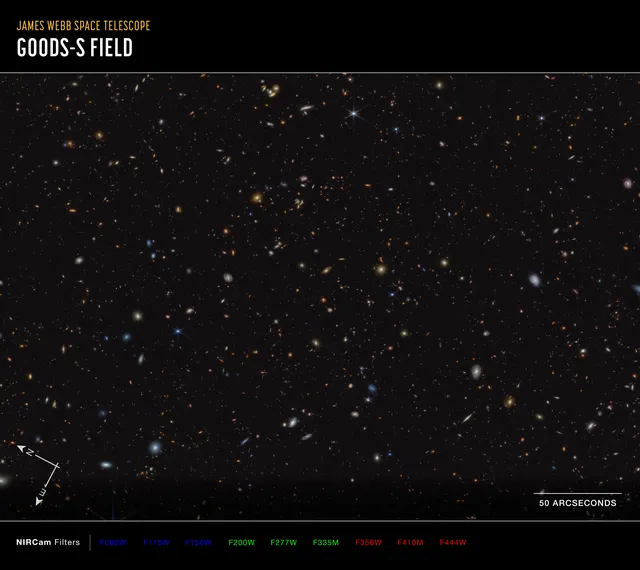
The galaxies were found within ASPIRE, a JWST program studying 25 quasars and their surroundings at redshift z ≈ 6.5–6.8, when the Universe was less than a billion years old. The same fields were observed in parallel by ALMA. In continuum and the [C II] line (ionized carbon), both objects are detected robustly. But in NIRCam imaging they practically disappear — fainter than 28.0 AB magnitude in the F356W filter.
The culprit is dust. The authors estimate extinction up to AV ≈ 7.5 magnitudes, higher than in the classic dusty galaxy Arp220. Hence the name "NIRCam-dark". Star formation rates in these galaxies reach 80–250 solar masses per year, but nearly all that light is absorbed and re-emitted in the infrared and submillimeter, bypassing ordinary sky surveys entirely.
Based on their star formation history, such galaxies look like plausible progenitors of massive quiescent (star-formation-quenched) galaxies at z ≳ 4 and descendants of UV-luminous galaxies from the z > 10 era. If the estimated number density (n ~ 10⁻⁵·⁵ Mpc⁻³) holds, they could account for about 30% of both the quiescent and the earliest luminous galaxy populations — a substantial hidden chunk of early massive-galaxy demographics.
The authors predict similar dusty galaxies should exist at z ~ 8 too, but there they will likely fall below the detection limits of even the deepest JWST and ALMA surveys — no longer just "NIRCam-dark" but fully "JWST-dark." Spotting them will require dedicated wide-field surveys of early protoclusters.