The James Webb Space Telescope keeps posing uncomfortable questions for galaxy formation theory. One of the sharpest: how did supermassive black holes exceeding a million solar masses manage to form just a few hundred million years after the Big Bang. Such rapid growth is hard to reconcile with standard accretion models — the process by which matter gradually falls onto a black hole, forming a disk around it. A new study offers an explanation that relies not on exotic physics, but on a more basic question: where does the fuel for growth actually come from.
Condition number one: delivering the fuel
Before discussing accretion rates or radiative efficiency, the authors point to a simpler and more fundamental requirement. For a seed black hole to grow to observed masses, enough baryonic matter — ordinary gas, as opposed to dark matter, which doesn't participate directly in accretion — must first reach it. This matter has to travel all the way to the bottom of the gravitational potential well of the host dark matter halo, where the seed black hole resides.
Two fundamentally different scenarios are possible here. In the first, gas falling into the halo from the cosmic environment is shock-heated to a temperature comparable to the halo's own thermal energy, and only then slowly cools and settles toward the center. In the second, gas flows in narrow cold streams, bypassing the shock-heating stage entirely, and falls almost unimpeded to the center on a free-fall timescale. This second regime is known as cold-mode accretion.
Why the cold regime does the job
The authors compared how much material each scenario could deliver to the halo center within the time available for early black hole growth. Cold-mode accretion turns out to supply enough material to reach the observed masses. Relying on shock-heated gas instead, the required amount of material could only come from extremely rare halos — so rare that this requirement looks implausible given the known distribution of halo masses in the early universe.
The researchers then compared the model's predictions with specific observed populations. Rare halos, roughly one per cubic gigaparsec, fed by cold gas inflow match the mass and number of the most massive early quasars — active galactic nuclei hosting giant black holes. Halos capable of sustaining super-Eddington accretion (where a black hole absorbs matter faster than the theoretical limit for stable growth) for black holes around 10 million solar masses match the observed number density of Little Red Dots.
Red dots as a byproduct of the same process
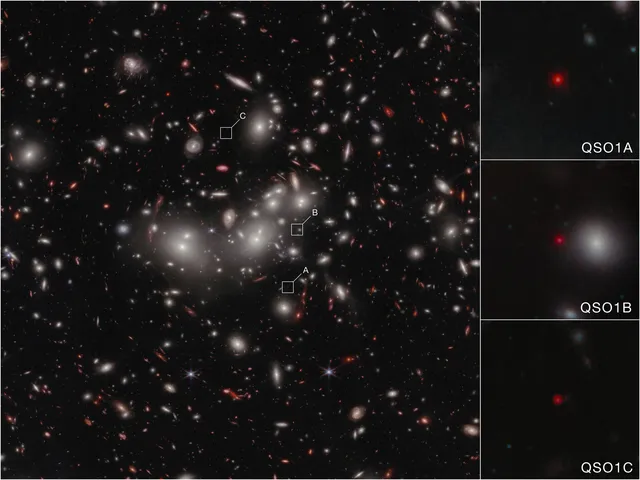
Little Red Dots are compact sources with active-nucleus-like characteristics that JWST has found in large numbers in the early universe. Their exact nature is still unresolved. This study suggests an explanation: if the abundance of such objects is set by the number of halos capable of sustaining super-Eddington accretion via cold streams, then massive quasars and Little Red Dots could be different manifestations of the same underlying process — occurring in halos of different mass and at different stages of growth.
This also offers a natural explanation for why the number of Little Red Dots noticeably declines at later cosmic epochs. According to the authors, this reflects not the disappearance of the objects themselves, but the gradual shutdown of cold-mode accretion in halos that keep growing and eventually shift to the less efficient, shock-heated feeding regime.
If these conclusions hold up under further observation, both supermassive black holes and the mysterious red dots would turn out to be not an anomaly requiring new physics, but a natural consequence of how dark matter halo masses are distributed in the early universe and how gas accumulates within them.