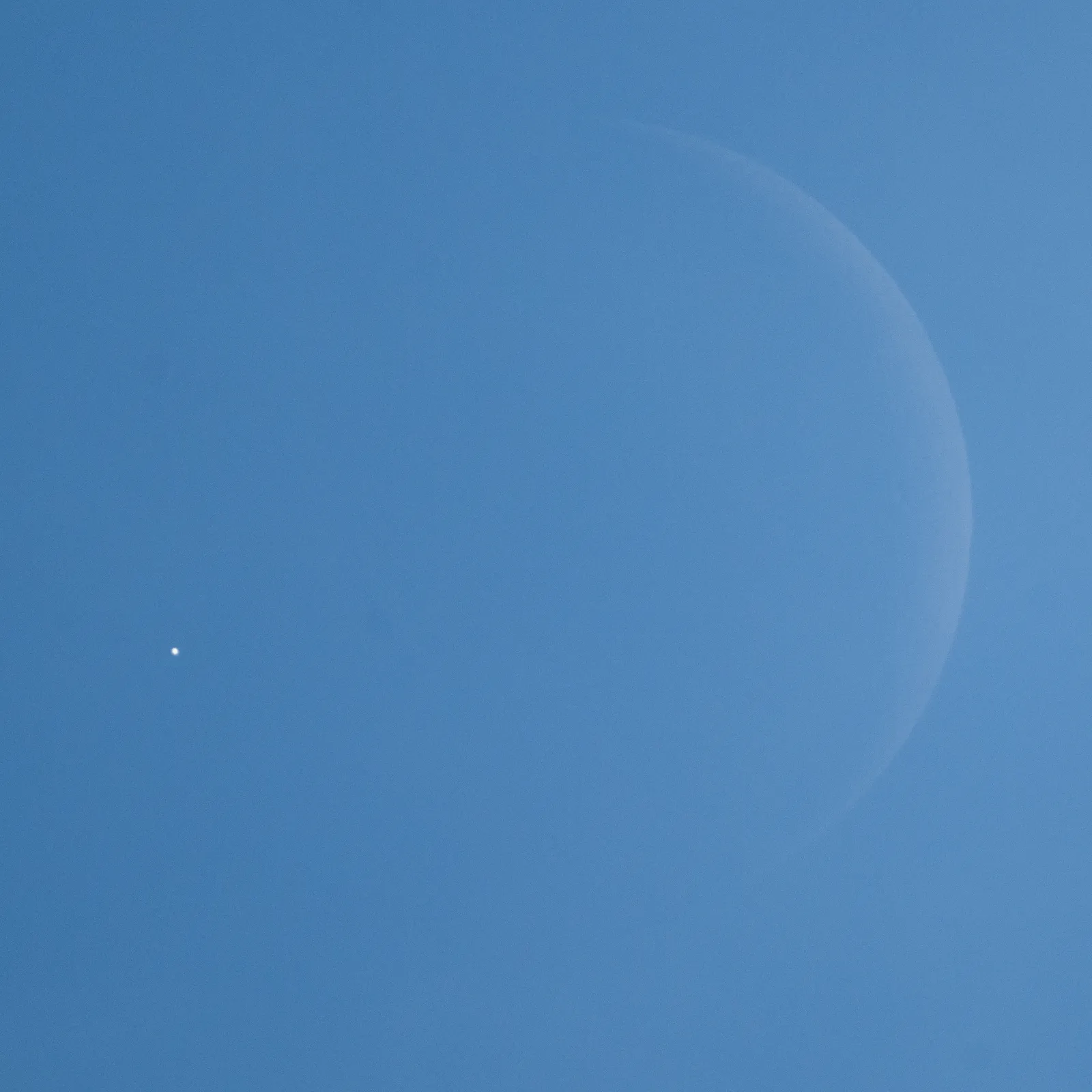
September 2026 brings together a rare set of sky events: from everyday conjunctions of the Moon with planets to the month's headline event — a daytime occultation of Venus visible directly from Ukraine. Here's what to watch, when, and how.
How to Watch the Daytime Occultation of Venus
On September 14, the Moon will pass directly in front of Venus — an event astronomers call an occultation. Unlike most such events, this one happens in broad daylight, with the Sun high above the horizon.
From Kyiv, Venus will vanish behind the lunar disk at around 12:54 and reappear around 13:50 local time. The gap between these two moments is just under an hour, during which the planet is physically hidden behind the Moon.
The naked eye won't be able to catch this: daytime sky brightness is too high, and Venus's apparent size too small. Binoculars or a telescope with sufficient magnification are required.
The critical warning here: this observation happens during the day, and the Sun may be dangerously close to the line of sight. Never point any optics toward or near the Sun — doing so can cause serious eye damage. Before observing, locate the Sun's exact position and keep it well out of your instrument's field of view.
Daytime occultations of Venus visible specifically from Ukraine occur irregularly, depending on the alignment of the Moon's and Venus's orbital parameters. That makes September 14 a genuinely exceptional event for the year.
What Else to See in September's Sky
Earlier in the month, the Moon has another planetary encounter lined up: on September 8, a thin waning crescent Moon passes close to Jupiter in the morning sky. Look for the pair low above the eastern horizon before dawn — it will be clearly visible to the naked eye. The occultation of Jupiter itself, however, is not visible from Ukrainian territory.
September 11 marks the new Moon — the darkest phase of the lunar cycle. This is the best time to observe the Milky Way and faint deep-sky objects, especially away from city lights.
On September 22, Venus reaches its greatest brightness of the entire evening season. At this point it becomes bright enough to be unmistakable in the twilight — look for it low above the western horizon right after sunset.
On September 23 at 00:06 UTC, the astronomical autumn equinox arrives — the moment when day and night length become nearly equal across the planet. It marks the conventional boundary between summer and autumn in the astronomical calendar.
September 26 brings the full Moon. It rises around sunset and shines all night, making faint-object observation harder but offering ideal conditions for a simple moonlit walk.
Neptune at Opposition: Brightest of the Year
On the night of September 25–26, Neptune — the most distant planet in the Solar System — reaches what's called opposition: a position where Earth sits directly between the Sun and the planet. This means Neptune is at its closest to Earth and brightest for the entire year.
Even so, Neptune remains invisible to the naked eye: the planet sits at a distance measured in billions of kilometers, and even at peak brightness it's too faint for unaided vision. A telescope is required.
Neptune's opposition happens every year and usually goes unnoticed by the general public, precisely because of the equipment it requires. But for telescope owners, it's the best opportunity of the year to observe the Solar System's most distant planet as clearly as possible.
Together, these events make September 2026 a month with a packed astronomical calendar — from a daytime observation with binoculars to an evening hunt for the sky's brightest planet and a telescopic encounter with the most distant one.