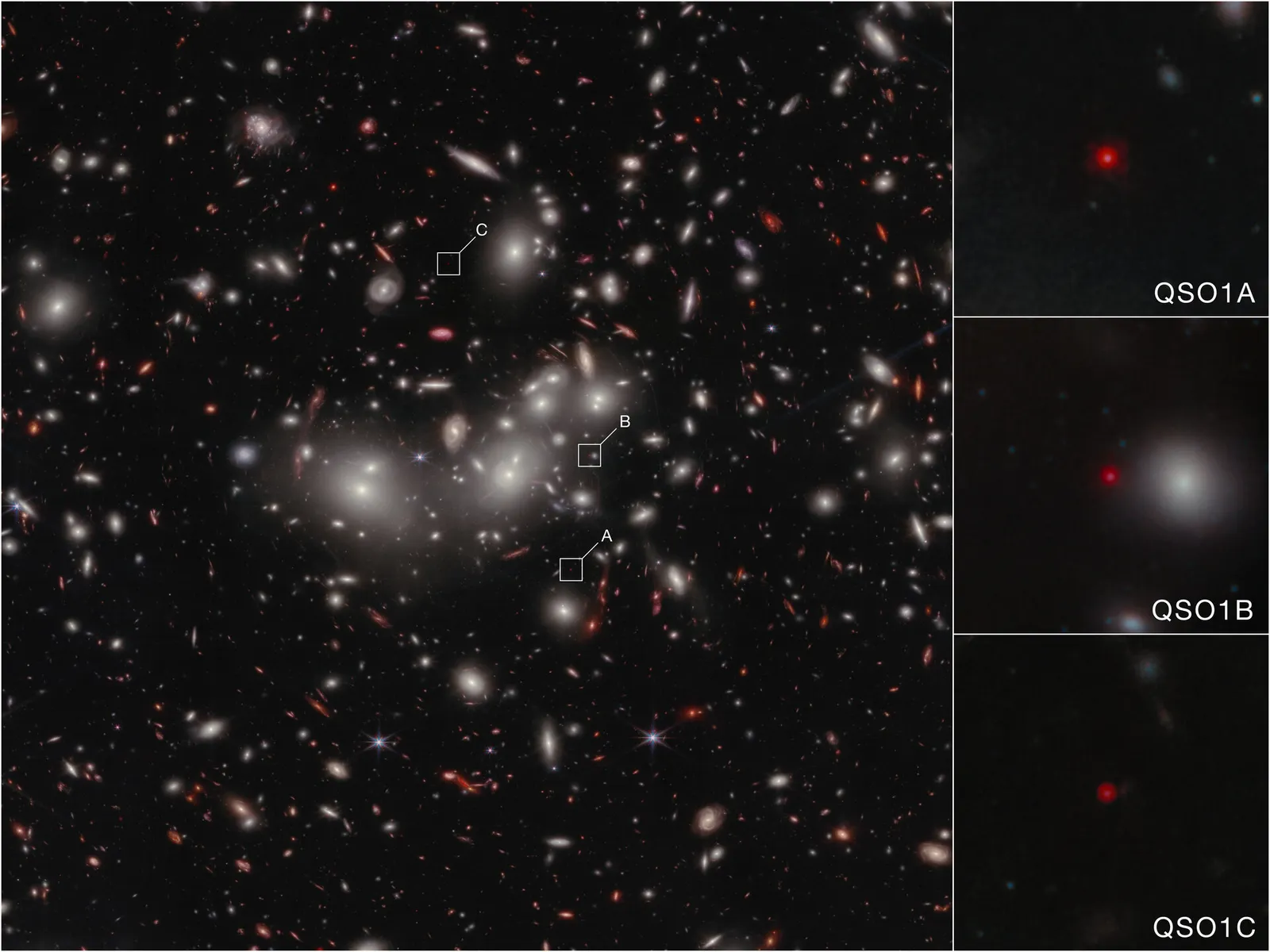
What comes first — a galaxy or the black hole at its center? Until recently, the answer seemed obvious: a galaxy forms with billions of stars, the largest of which explode and collapse into black holes. These seed black holes then grow gradually, merging with each other and swallowing surrounding matter, eventually becoming supermassive objects at galactic centers over billions of years.
The trouble is that the James Webb Space Telescope keeps finding supermassive black holes so early in cosmic history that they simply couldn't have grown this way in time. A new study of the object Abell2744-QSO1 provides the first direct evidence that at least some black holes were born massive from the start, before a proper galaxy ever formed around them.
A tiny dot magnified by gravity
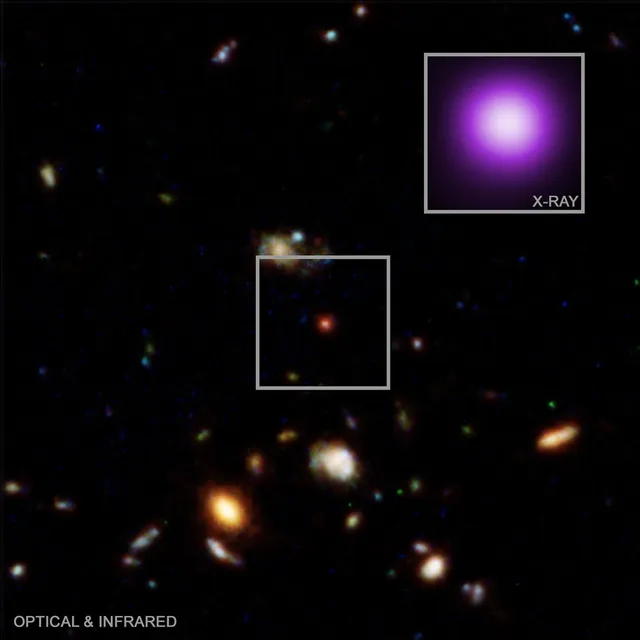
Abell2744-QSO1 (QSO1) belongs to a class of objects astronomers call Little Red Dots — compact, extremely bright infrared sources that Webb has been detecting in large numbers in the early Universe.
The object existed just 700 million years after the Big Bang, and its light has been traveling to us for over 13 billion years. The galaxy itself spans only 1,300 light-years, hundreds of times smaller than a typical galaxy like the Milky Way.
Studying such a distant, faint object would normally be extremely difficult, if not for a fortunate alignment: QSO1 sits directly behind the galaxy cluster Abell 2744, known as Pandora's Cluster. The cluster's gravity acts as a lens, bending and magnifying QSO1's light and splitting it into three separate images across the sky.
Keplerian motion reveals the black hole's mass
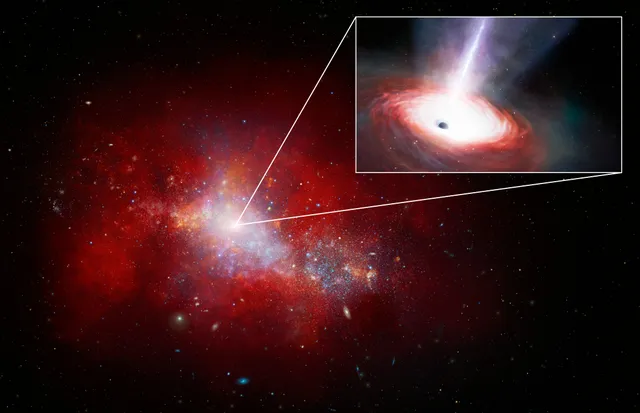
Earlier studies had already hinted that QSO1 might be little more than a cloud of glowing hydrogen and helium gas circling a black hole of roughly 40 million solar masses. But every previous mass estimate for early-Universe black holes was indirect, based on assumptions carried over from the physics of nearby galaxies.
A team led by Ignas Juodžbalis and Cosimo Marconcini used Webb's NIRSpec spectrograph with its integral field unit (IFU) to map the motion of gas surrounding QSO1's black hole. The rotation velocity turned out to depend on distance from the center exactly the way planetary speeds depend on distance from the Sun — a pattern known as Keplerian motion.
Such rotation is only possible when nearly all the system's mass is concentrated at a single point — the central black hole. If a significant share of the mass were spread out in stars across the galaxy, the gas would not rotate this way.
This allowed scientists, for the first time, to calculate a black hole's mass directly from the laws of gravity within the first billion years after the Big Bang, rather than relying on indirect estimates. The result — about 50 million solar masses — matches earlier indirect measurements of similar objects.
Two-thirds of the mass is the black hole, not stars
The most striking figure in the study: the black hole accounts for two-thirds of QSO1's total mass. For comparison, in nearby galaxies, including the Milky Way, the central black hole makes up a negligible fraction of the galaxy's total mass — thousands of times smaller a share.
Composition maps built from the same NIRSpec data revealed another anomaly. The surrounding gas is almost entirely hydrogen and helium, with very little of heavier elements like oxygen. Its metallicity (the fraction of elements heavier than helium) is below 0.5% of the Sun's — one of the most pristine gas environments ever measured.
This composition implies an absence of substantial past star formation: if generations of stars had already lived and exploded as supernovae, they would have enriched the gas with heavier elements. Instead, QSO1 looks as though the black hole appeared first, with the galaxy around it only beginning to take shape.
This is a remarkable finding. It's a paradigm shift, a total revisiting of the classical scenarios of how black holes form and growRoberto Maiolino, University of Cambridge
Primordial black holes or direct collapse
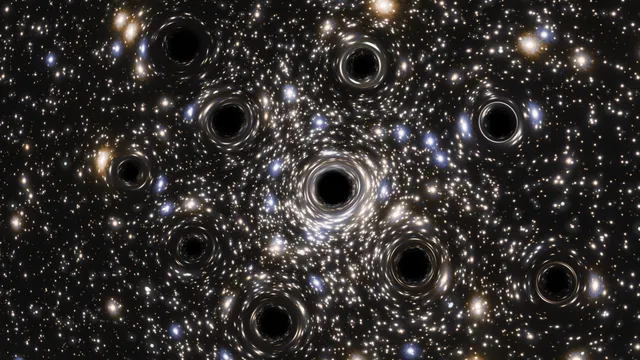
The black hole's disproportionate mass relative to its host galaxy suggests it could not have grown gradually through the merging and feeding of smaller seed black holes. Researchers see this as evidence supporting two theoretical scenarios: primordial black holes or direct collapse black holes.
In both scenarios, the object is born massive from the outset — possibly within the first second after the Big Bang, or somewhat later through the direct collapse of a giant gas cloud, skipping the intermediate stage of a star. Both ideas had long remained purely theoretical, and QSO1 offers the first observational evidence in their favor.
The team believes Little Red Dots like QSO1 could not have been rare in the early Universe and is now analyzing similar objects. The goal is to determine whether supermassive black holes routinely predate the galaxies they now inhabit. The results are published in Nature and the Monthly Notices of the Royal Astronomical Society.