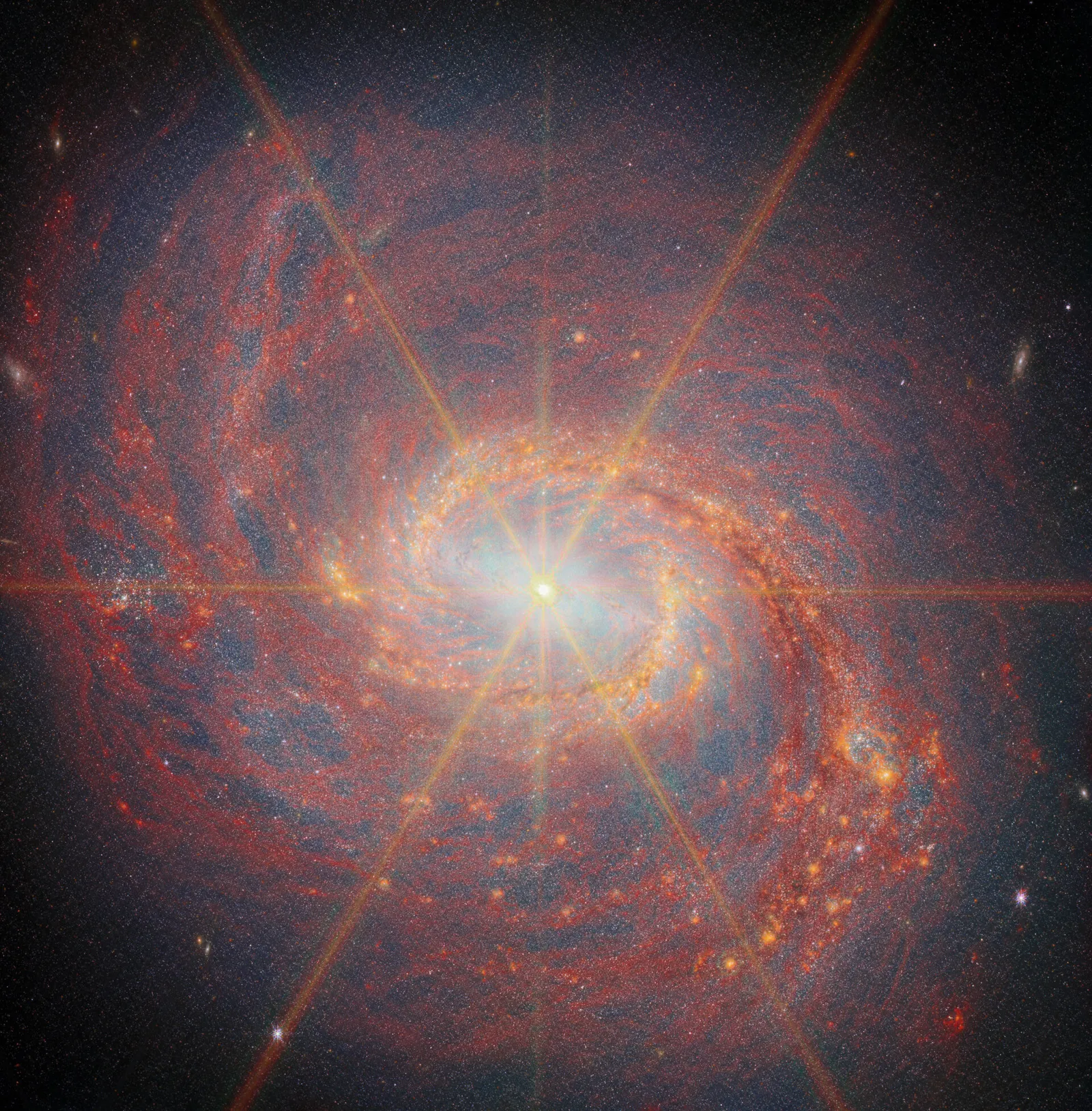
Messier 77 is one of the most studied spiral galaxies among astronomers, and for good reason. It sits just 45 million light-years away in the constellation Cetus, relatively close by cosmic standards. That proximity lets researchers pick out details that would be lost in more distant galaxies. A new image from the James Webb Space Telescope, captured by its Mid-Infrared Instrument (MIRI), shows M77 with a level of detail never seen before.
The data behind this image come from observing programme #3707, which surveyed massive, nearby star-forming galaxies to build a rich dataset for studying the life cycle of stars — birth, life and death. M77 turned out to be one of the most striking examples of that cycle.
A black hole outshining the entire galaxy
At the heart of M77 lies an active galactic nucleus (AGN), a compact region packed with superheated gas. It is so bright that it outshines the rest of the galaxy combined, and even overwhelms the light-gathering capacity of Webb's cameras.
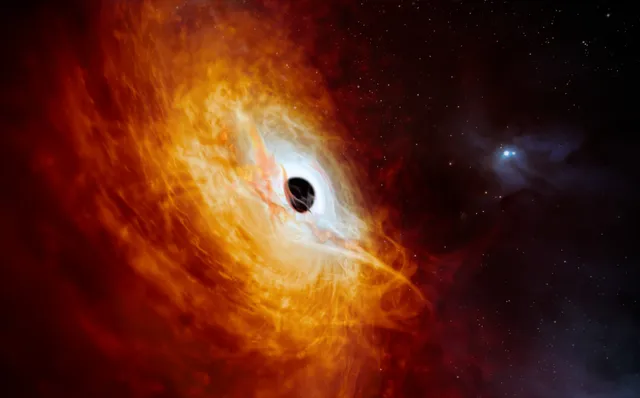
The source of this energy is a supermassive black hole eight million times the mass of the Sun. Gas from the galaxy's central regions is pulled in by its gravity and forced into a tight, rapid orbit around the black hole. There it collides, heats up, and releases enormous amounts of radiation.
Bright orange lines appear to radiate from the centre of M77 in the image. These are not a real feature of the galaxy but an optical effect known as diffraction spikes. They form when intense light is bent slightly at the edges of Webb's hexagonal mirror segments and around one of the struts supporting the secondary mirror. This six-plus-two-pointed pattern appears in every Webb image, but only when the light source is extremely bright and concentrated. Usually that means stars — but M77's nucleus is bright enough to produce the same effect.
A bar and starburst ring hidden from ordinary light
M77 is known not only for its visible AGN but also for its prolific star formation. In near-infrared light, Webb revealed a bar spanning the galaxy's central region — a feature invisible in ordinary visible-light images.
The bar is enclosed by a bright ring known as a starburst ring, formed by the inner ends of M77's two spiral arms. Such regions are marked by extremely high rates of star formation. The ring spans more than 6,000 light-years and shows intense, widespread starburst activity, visible as densely packed orange bubbles throughout the ring. Because M77 is relatively close to Earth, this ring has become one of the best-studied examples of a starburst region.
Dust vortex and hydrogen tentacles beyond the disc
The disc of an active spiral galaxy like M77 is filled with gas and dust, both a byproduct of and fuel for future star formation. MIRI captured the glow of interstellar dust grains at longer wavelengths, shown in blue. The dust forms a vast vortex of smoky, swirling filaments with cavities in between. Along the spiral arms, glowing orange bubbles mark regions carved out by newly formed star clusters.
Beyond Webb's focused view, M77's arms merge into a faint, extended ring of hydrogen gas thousands of light-years wide, where star formation continues. Vast, tenuous filaments of hydrogen stretch across this ring and out into intergalactic space, forming an outer layer around the galaxy.
Their tentacle-like appearance is why M77 is also known as the Squid Galaxy. The resolution of Webb's instruments reveals star clusters and rich reservoirs of gas within this outer structure, data that can be used to trace the cycle of star formation in M77 and similar galaxies.