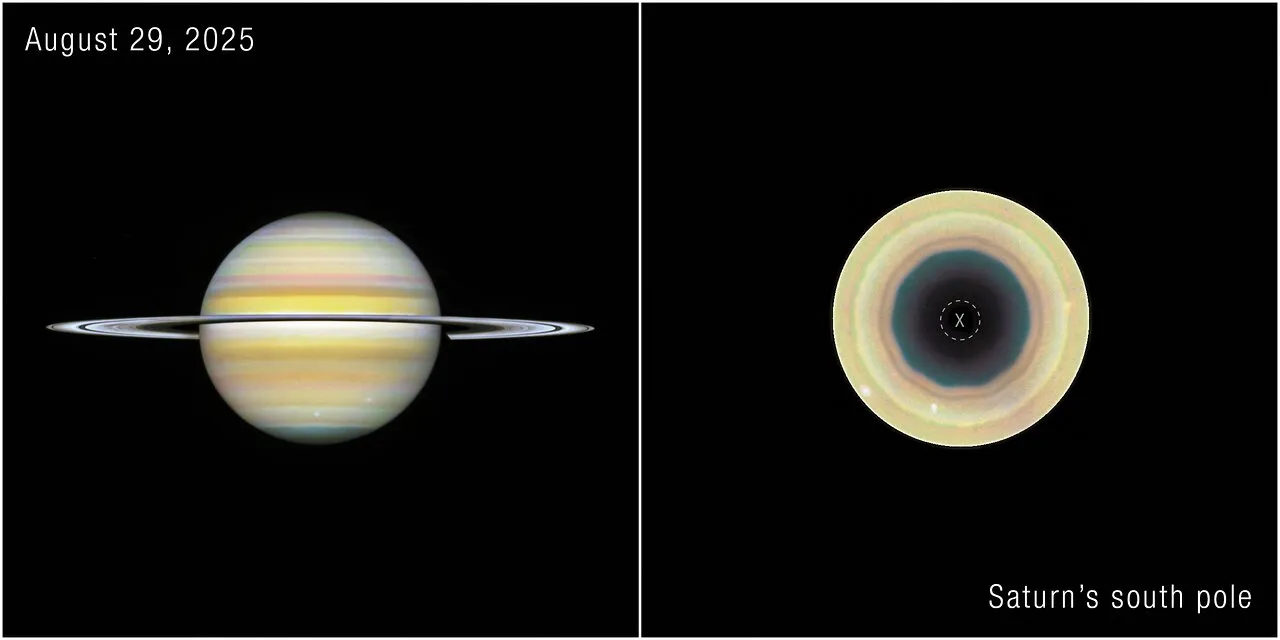
For the first time, astronomers have detected a large, regular atmospheric feature at Saturn's south pole — a giant, ten-sided wave. The structure, named the decagon, was found using the NASA/ESA Hubble Space Telescope, and the findings were published in the journal Science Advances.
The discovery matters because a similar pattern at Saturn's opposite, northern pole has been known for more than 40 years — the famous hexagon, observed at every look since the 1980s. The southern hemisphere had stayed quiet the whole time. The Cassini spacecraft, which orbited Saturn from 2004 to 2017 and had a good view of the south pole, found no stable formation there. That makes the southern decagon look like something genuinely new to researchers — possibly even a different type of atmospheric phenomenon rather than a simple southern "twin" of the northern hexagon.
How amateur images led the way
The decagon was first spotted not by professional astronomers with large telescopes, but by contributors to the Planetary Virtual Observatory Laboratory — a website run by the University of the Basque Country that accepts ground-based images of Solar System planets from observers worldwide. In 2024, Agustín Sánchez-Lavega, together with amateur astronomers Trevor Barry and Jean-Paul Oger, noticed a faint undulating band along Saturn's south pole. Images from 2025 strengthened the case further: this was no fluke, but a persistent structure.
Seeing Saturn's south pole from Earth became possible thanks to the planet's changing seasons: Saturn's axial tilt gradually turned its southern hemisphere back toward Earth, bringing the pole into view for ground-based observers again.
What Hubble revealed
Ground-based observations offered only the first hints, so Hubble stepped in. From orbit, it captures images undistorted by Earth's atmosphere and can record a full rotation of Saturn with high sharpness. The Hubble data came from the Outer Planet Atmospheres Legacy (OPAL) program, which has photographed the giant planets every year for more than a decade.
Reviewing the archive, researchers found faint traces of the future decagon as far back as 2023 — before the structure became clearly defined in ground-based images. That means the feature developed gradually rather than appearing suddenly.
The decagon sits within one of Saturn's powerful jet streams and extends through multiple atmospheric layers. That indicates the phenomenon isn't confined to the top cloud layer but has a vertically extended structure. Because Hubble photographs the planet at different wavelengths of light, and each wavelength probes a different atmospheric layer, the decagon's apparent position shifts slightly depending on which "depth" is being observed.
The northern hexagon has been there every time we've looked for more than 40 years. This feature is different — it appears to be strengthening, giving us the rare opportunity to watch a giant atmospheric pattern develop.Amy Simon, NASA Goddard Space Flight Center
Why now remains an open question
Sánchez-Lavega noted that the search for a southern counterpart to the northern hexagon had been going on since 1990 — precisely because Saturn's north-south jet stream symmetry suggested a similar feature should exist. Yet neither earlier Hubble observations nor Cassini data showed anything like it. Why the decagon began forming now, after decades of silence, remains unknown.
The most intriguing part to me is that this seems to have just formed recently. The question is, why did it suddenly form now when we haven't seen one before?Amy Simon, NASA Goddard Space Flight Center
Researchers plan to keep observing to determine whether the decagon settles into a long-lived structure like the northern hexagon or continues to evolve. Further study will involve not only Hubble but also the James Webb Space Telescope, plus computer models of atmospheric dynamics.
Why it matters
Co-author Mike Wong of the University of California, Berkeley, emphasized that discoveries like this come from long-running observation programs rather than single snapshots.
When we started the OPAL program, we expected compelling surprises but we didn't know what to expect specifically. A lot of the discoveries we see coming from OPAL are not just based on one observation, but on years and years of data. Regular observations over time are enabling a lot of new findings.Mike Wong, University of California, Berkeley
Understanding how and why such giant regular structures form in the atmospheres of gas giants could also help explain jet streams and vortex patterns in Earth's own atmosphere. For now, Saturn's decagon is a new observation without a final explanation. But that open question is exactly what makes further observations so worth watching.