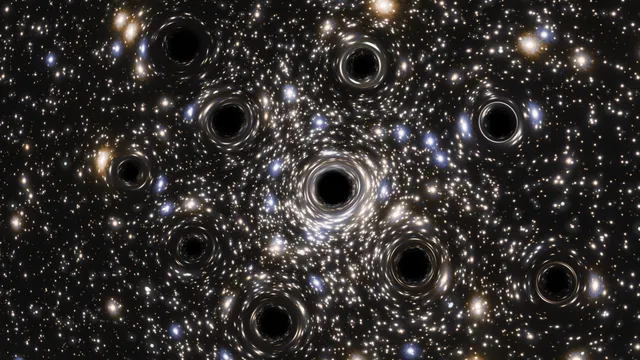
OJ 287 is a blazar — an active galactic nucleus with a jet pointed almost directly at Earth — located in the constellation Cancer, its light having traveled for over 3.5 billion years. The object is known for its regular brightness flares, which astronomers attribute to a supermassive binary black hole system: a smaller companion, believed to be billions of times the mass of the Sun, is thought to orbit an even larger primary and periodically punch through its accretion disk. Now a new piece of evidence has been added — the first image of the inner jet structure of OJ 287 obtained with the resolution of the Event Horizon Telescope (EHT).
An 18-microarcsecond snapshot
The EHT observed OJ 287 at a wavelength of 1.3 mm, achieving an angular resolution of 18 microarcseconds — a record level of detail for this source. Over just five days of observations, the inner jet showed measurable changes in structure and polarization, the shortest timescale on which such evolution has ever been directly imaged in this object.
The inner jet displays a twisted ridgeline structure. Individual features within it appear to move at superluminal speeds of up to 22c. This is not a violation of physics but a relativistic effect: because the jet points nearly along our line of sight, motion within it appears magnified to an observer on Earth.
Two jet components rotate polarization in opposite directions
Linear polarization maps revealed three polarized features whose electric-vector position angles (EVPAs) changed noticeably during the observing run. One of them shows radial polarization, a signature typically associated with a recollimation shock — a feature that forms when the jet is compressed by external pressure.
The most striking result concerns the two innermost components, which rotate their EVPAs simultaneously but in opposite directions. The faster one, moving at an apparent speed of 17.4 ± 6.5c, rotates counterclockwise at roughly 3.7° per day. The slower one, at 10.2 ± 2.2c, rotates clockwise at about 2.5° per day. This directly rules out models in which the observed polarization variability results from a blend of unresolved, overlapping components.
A helical magnetic field, not an optical blend
Previously, the presence of a helical magnetic field in AGN jets had only been inferred indirectly, from integrated or time-variable polarization signals, without spatially resolving the underlying structure. The new observations provide the first spatially resolved evidence: a helical magnetic field threads the jet's collimation and acceleration zone in OJ 287, and the moving components illuminate different phases of that helix as they travel.
The opposite rotation directions and differing angular speeds are explained by propagating shocks interacting with a Kelvin-Helmholtz instability — the same mechanism that produces eddies at the boundary between two streams moving at different speeds, similar to how wind generates waves on water.
What future observations will test
The model built by the research team predicts that closer to the core, in the jet's acceleration zone, polarization swings should be even faster than those already measured. Testing this will require denser time sampling — more frequent EHT observing sessions over short intervals.
If the prediction holds, it would strengthen the case for a helical magnetic field as the mechanism shaping and accelerating jets around supermassive black holes — not only in OJ 287, but in active galactic nuclei more broadly.