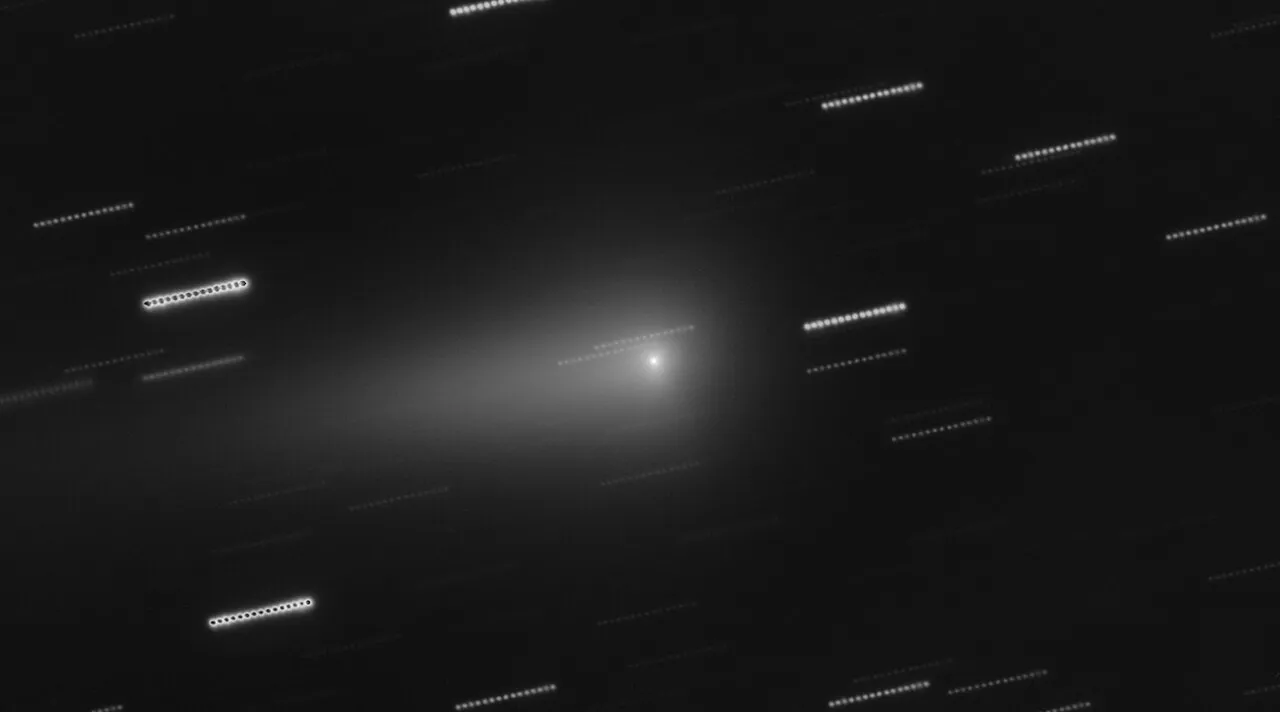
Comet 3I/ATLAS has already made history as the brightest interstellar object ever spotted by astronomers. Now it may earn another distinction — the oldest object whose composition humanity has ever studied directly.
3I/ATLAS is only the third known object to enter the Solar System from interstellar space, following 'Oumuamua in 2017 and comet Borisov in 2019. Unlike its predecessors, 3I/ATLAS turned out to be bright enough to allow detailed spectroscopic observations — an analysis of light broken down into its components, which reveals the chemical makeup of a substance.
What Astronomers Measured
The team used ESO's Very Large Telescope (VLT) in Chile. Researchers recorded specific chemical fingerprints of the comet — characteristic signals of individual elements and compounds in its light. This is the first observation of this kind for an interstellar comet: such detailed compositional data had never before been obtained for an object from beyond the Solar System.
This kind of analysis reveals not just what the comet is made of today, but the conditions in which it formed billions of years ago. The chemical makeup of the ice, dust, and gas released from a comet's nucleus as it heats up preserves a "memory" of its original environment — temperature, the presence of certain molecules, and its distance from its parent star at the time of formation.
Where the Interstellar Visitor Came From
The resulting chemical profile suggests that 3I/ATLAS most likely formed in the outskirts of an old star system — its distant periphery, where material could remain relatively unchanged over a very long time. This sets it apart fundamentally from comets native to our own Solar System, whose age is tied to that of the Sun itself — about 4.6 billion years.
If the hypothesis of an ancient origin is confirmed by further study, 3I/ATLAS could turn out to be older than the Sun. That would mean the material making up the comet condensed long before our own star and its planets ever formed.
Why It Matters
Every interstellar object that passes through telescopes' field of view is a unique opportunity to study material from another planetary system without sending a probe there. Thanks to its brightness, 3I/ATLAS has given astronomers the most detailed data of any such body observed so far.
The study doesn't prove the existence of life or any technology beyond the Solar System — it concerns only the chemical composition of an icy, dusty body. But the data offers a rare glimpse into the chemistry of an era that predates the Sun's birth, and helps astronomers better understand whether the process of planetary system formation elsewhere in the Galaxy is typical — or unusual.
Further observations of 3I/ATLAS, while the comet remains within reach of telescopes, could confirm or challenge the hypothesis of its ancient origin and reveal more about the star system it came from.