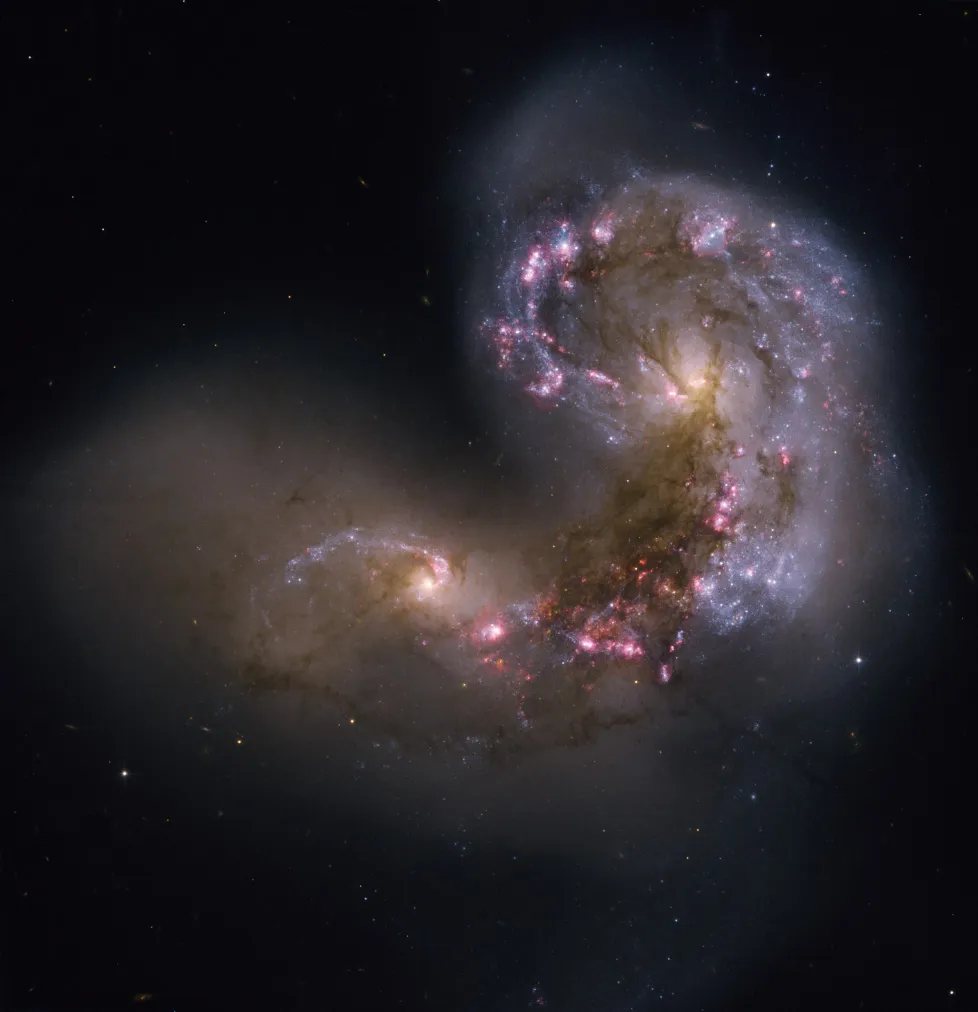
The Antennae galaxies, located roughly 60 million light-years from Earth, are one of the most iconic examples of a galaxy collision visible in the sky. Two spiral systems have already passed through each other once and are now moving back together, their disks overlapping in a shared central zone. It is precisely there, in the so-called overlap region, that astronomers observe unusually intense star formation.
This region gives birth to super star clusters (SSCs) — compact stellar assemblies with masses of millions of suns, far denser than anything found in the Milky Way. What triggers their formation has remained a largely theoretical question for decades: cloud-cloud collisions were proposed as a plausible mechanism, but direct observational proof was missing. A new study led by Tomonari Michiyama, published in the Astrophysical Journal, changes that picture.
ALMA resolves the cloud into two components
The researchers used the ALMA radio telescope to observe a super giant molecular cloud (SGMC) in the Antennae's overlap region. Observations targeted the CO (J = 1–0) line, a standard tracer of molecular hydrogen gas, achieving an angular resolution of 0.12 arcseconds — corresponding to a physical scale of about 14 parsecs, roughly 45 light-years, at this distance.
That level of detail revealed something previously hidden in a single blurred blob: the cloud actually consists of two distinct gas components moving toward each other with a velocity difference of about 50 km/s. One component has a distinctive "U" shape within a large filament, likely sculpted by the ram pressure of an incoming gas flow. The other displays hub-filament morphology — multiple gas threads converging toward a shared central node.
This combination — a flow-deformed structure paired with a converging, hub-like one — is exactly the geometry theorists expect from the collision of two massive gas clouds. The authors note that this morphology is naturally interpreted within a cloud-cloud collision scenario.
Ionized gas at the collision interface
A second line of evidence came from continuum radio emission at 108 GHz, detected precisely at the apparent interface between the two gas components. Analysis showed this emission is dominated by free-free radiation — the signature produced when free electrons scatter off ions in hot, ionized gas surrounding young, massive stars.
The inferred rate of ionizing photons matches the stellar mass and age of the super star clusters already identified optically in this same region. In other words, the amount of energy released by the young stars corresponds precisely to what would be needed to build the SSCs actually observed there.
Further support came from infrared imaging by the James Webb Space Telescope. Bright infrared emission is spatially coincident with the zone where ALMA data place the predicted collision interface between the two clouds. Three independent lines of evidence — gas kinematics, radio emission from ionized material, and infrared glow from young stars — all converge on the same location.
What this means for cluster formation theory
Taken together, these observations provide what the authors describe as compelling, multiwavelength evidence that cloud-cloud collisions play a key role in triggering super star cluster formation in merging galaxies. This is not merely a theoretical possibility but a process caught in the act.
The Antennae remain a unique laboratory precisely because they allow astronomers to observe extreme star-forming conditions at a relatively close distance and with sufficient resolution to resolve individual structures. The results give theoretical models of cluster formation a concrete observational benchmark for how giant gas clouds collapse into the densest stellar systems in the universe — objects that, in their compactness, resemble the ancestors of today's globular clusters.