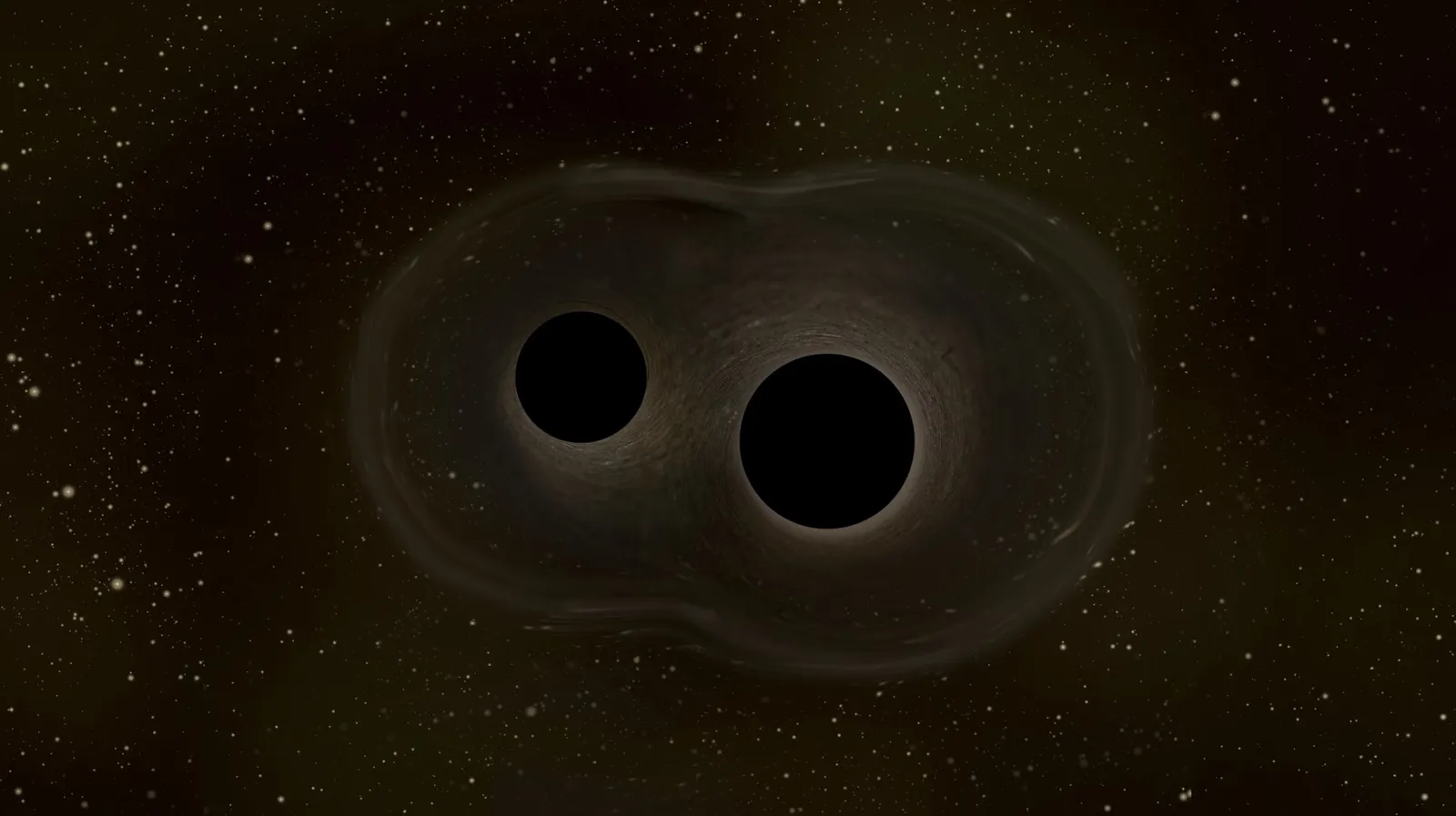
Gravitational-wave astronomy has grown accustomed to massive objects: black holes weighing dozens of solar masses, neutron star pairs slightly heavier than the Sun. The event S251112cm, detected by the LIGO-Virgo-KAGRA network in November 2025, breaks that familiar pattern. At least one of the merging objects has a mass lower than the Sun's — and that single fact challenges every standard explanation.
A new study by Md Riajul Haque, Fabio Iocco, and Luca Visinelli considers the event as a merger of two primordial black holes — hypothetical relics from the earliest moments of the Universe. The authors don't claim this is certainly the case, but they show the interpretation is consistent with current data and doesn't conflict with existing constraints on how many such objects could exist.
Why a sub-solar mass breaks standard physics
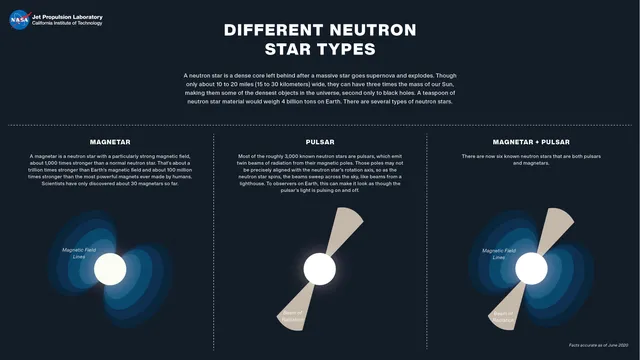
Neutron stars form from the collapse of massive stellar cores and have a minimum mass below which they simply cannot remain stable — roughly one solar mass. Stellar black holes emerge from even heavier collapsing cores and likewise never come in below that threshold.
An object with a mass under this limit falls outside both categories. It doesn't fit any known channel of stellar evolution. That is precisely why the LVK detection of S251112cm, with its unusual mass parameters, immediately drew attention from theorists searching for alternative formation mechanisms for compact objects.
Primordial black holes as relics of the early Universe
One candidate for such an alternative mechanism is primordial black holes (PBHs). Unlike stellar black holes, they aren't the product of a star's collapse. They form from the collapse of density fluctuations — irregularities in the distribution of matter — in the first moments after the Big Bang, long before the first stars existed.
Because their formation has nothing to do with stellar physics, PBH masses could in principle span an enormous range, from asteroid-scale to far above solar. Sub-solar values — 0.1 to 1 solar mass — fit comfortably within that range. Primordial black holes are also considered a possible candidate for dark matter, which gives any observational hint of their existence significance well beyond a single event.
Calculating the probability of a PBH scenario
The authors combined analytic estimates of the PBH merger rate with current observational constraints on their abundance and the sensitivity of LVK searches. The goal was to estimate how likely LVK would be to detect an event like S251112cm if PBHs indeed make up part of dark matter.
The result depends on how strict the existing constraints on PBH abundance are taken to be. Under a moderately relaxed constraint scenario, the probability of observing such a merger in the 0.5 to 1 solar mass range reaches unity — meaning the event becomes essentially expected. In more conservative scenarios, and at the lower end of the mass range, the probability drops but remains notable, around 0.5.
What stands in the way of a firm conclusion
The main source of uncertainty lies in the constraints themselves on the PBH fraction of dark matter. These come from various astrophysical observations and depend on assumptions that different research groups have yet to fully reconcile. Because of this, the authors state plainly that their results cannot be regarded as proof that S251112cm is indeed a merger of two primordial black holes.
Still, the paper's main contribution isn't about this single event — it's about the method itself. Sub-solar gravitational-wave signals show genuine potential as a tool for probing primordial black holes and testing their role in dark matter. Every new event of this kind will narrow the range of possible explanations — and may eventually deliver a definitive answer.