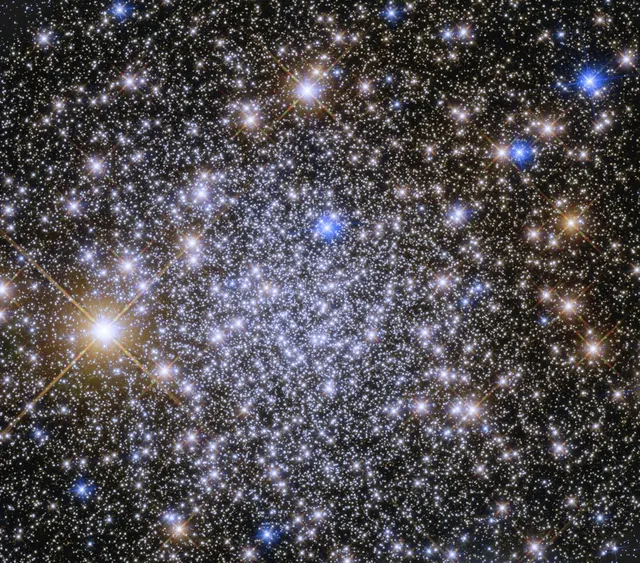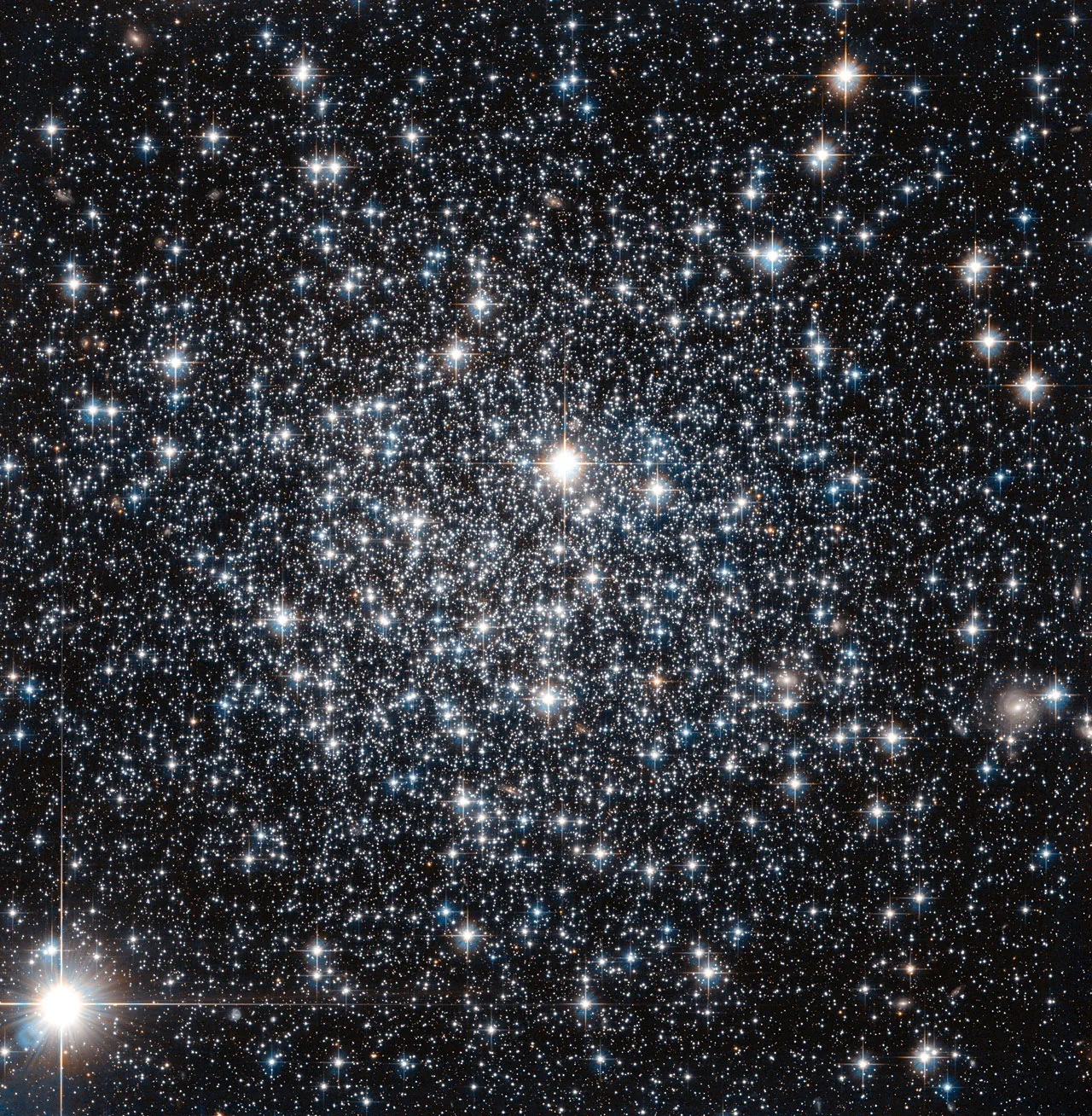
Globular clusters are the Milky Way's oldest megacities: hundreds of thousands to millions of stars packed into a ball a few dozen light years across. At the core, stars sit thousands of times closer together than near the Sun. Nobody keeps to themselves in a place like that — stars constantly tug on their neighbors, trade energy in close flybys, and slowly reshuffle the whole population over billions of years.
Binary stars — pairs locked in orbit around each other — feel this crowding more than anyone. A passing star can steal energy from a pair and shrink its orbit, pump energy in and widen it, or break the couple apart entirely. The outcome depends on the neighborhood the binary lives in, so a cluster's surviving couples and their locations record the cluster's dynamical history. A new study takes a census of these couples in six clusters, from downtown to the city limits, and finds that some neighborhoods are strangely deserted.
Spotting a stellar couple that blends into one point of light
Even Hubble's sharp optics can't resolve a binary star in a cluster into two separate points — the pair is too tight. But there's a trick: the combined light of two stars makes the point too bright for a single star of that color. On a color-magnitude diagram (a plot of stellar brightness against color), such a pair sits above the narrow sequence of single main-sequence stars. Two identical stars — twins — appear exactly 0.75 magnitudes brighter, and pairs form a separate "secondary main sequence" above the single-star track.
The lighter the companion, the smaller the brightness offset, so only pairs where the secondary star is at least 40-50% as massive as the primary can be reliably picked out. Counting these visible pairs gives only a lower limit — the "minimum binary fraction." To estimate the full fraction, including hidden lopsided pairs, the authors built synthetic color-magnitude diagrams with different input binary fractions and found the one that best matched the observed data.
Two impostors had to be weeded out. The first: chance alignments, where two unrelated stars along the same line of sight blend into a single overly bright point that mimics a binary. The second: foreground and background stars that don't belong to the cluster but land in the same patch of sky. The first effect was measured by injecting artificial stars of known brightness into the images and counting how often crowding merged them into false binaries. The second was estimated by counting interlopers in fields beyond the cluster's edge.
A census across six star cities
Earlier binary surveys had a blind spot: Hubble's sharp but narrow cameras cover only the crowded centers, leaving cluster outskirts largely uncounted. The new study combined deep Hubble ACS images of the cores with ultra-deep wide-field images from the Very Large Telescope and the Large Binocular Telescope that reach beyond each cluster's tidal radius — the point where the Milky Way's gravity overtakes the cluster's own. The result is the first homogeneous, center-to-edge binary census of six clusters: 47 Tucanae, NGC 5053, M12, M72, M15, and M30, spanning a wide range of dynamical ages — the ratio of a cluster's actual age to its relaxation time, the timescale over which stellar encounters reshuffle its population.
Five of the six clusters showed the same odd pattern: couples common downtown, common again in the countryside, and scarce in between. The total binary fraction peaks at 0.12-0.30 in the centers, plunges to 0.00-0.08 at intermediate radii, and climbs again beyond roughly 1-2 half-light radii. In 47 Tucanae the minimum is compatible with zero binaries at all before the outskirts recover to 0.1-0.3. In NGC 5053 and M30 the outermost measurements are about 50-150% higher than the central ones. This is the first firm detection of such a bimodal profile — the standard picture had held that binary fraction simply decreases outward.
There are two exceptions. M15 is the lone cluster with the old-fashioned profile — a central peak declining smoothly outward. M30 is a surprise in the opposite direction: it has already undergone core collapse, a late dynamical stage after which binary fraction is expected to fall off smoothly, yet it still shows a clear dip and outer rise.
Why the middle empties out
Two processes, both driven by stellar encounters, can hollow out the middle. The first is disruption. Binaries are sorted into "hard" and "soft": a hard binary is bound tightly enough to survive encounters (which actually tighten it further), while a soft, wide binary gets loosened until it falls apart. The dense inner and intermediate regions are rough places for a fragile couple, while the calm outskirts, where encounters are rare and slow, let wide binaries survive the cluster's whole life.
The second process is mass segregation. Binaries are heavier than typical single stars, so encounter after encounter drags the survivors toward the center, building the central peak. Together, the two processes empty the middle from both sides. Companion simulations (Bruce et al. 2026) show that this combination naturally produces the observed bimodality, and that the layered structure of clusters hosting multiple stellar populations makes it strong and long-lived. The same simulations suggest that binaries flung out of a collapsed core could explain the unexpected dip in M30.
A clock built from binary stars
The data contain one more clue that internal dynamics is the culprit: the dip's position acts as a clock. The authors found that the location of the binary fraction minimum correlates with a cluster's dynamical age, sitting farther from the center in dynamically older clusters — as if the emptied-out ring slowly creeps outward as encounters reach ever larger radii. The minimum's position also correlates with an independent, established dynamical age indicator, the A+ parameter, which measures how far blue straggler stars have sunk toward the center. Two completely different stellar populations telling the same time is a strong hint that both are reading the cluster's internal dynamics.
For decades, the working assumption was that binaries in globular clusters simply thin out with distance from the center. This census shows that in five of six clusters they do something richer: crowding the core, deserting the middle, and holding their ground in the outskirts. That shape, and the way its minimum drifts outward with dynamical age, is a fossil of billions of years of stellar encounters — and the companion simulations suggest it also remembers how the cluster was born, with one stellar population nested inside another.
The practical payoff is a new dynamical clock. Blue stragglers already serve this role; ordinary binary stars, which every cluster has in abundance, can now serve it too. And since wide-field surveys like Rubin Observatory will image cluster outskirts across the sky, the humble double star may soon help tell the story of how each of the Milky Way's oldest star cities was built.